Advertisement

Member Login

Like this Page?


Follow Us
Follow us on twitter. Follow us on LinkedIn. Follow us on YouTube.
Our Feeds
Repository RSS. Forum RSS. User Comment RSS. News RSS.
Contact Us
post/email Forum or Email
telephone US +1 617 5008224
telephone EU +44 113 8152220
telephone Toll Free: Skype
Live Chat Live Chat

Who's Online

We have 53 guests and 36 members online

Total Downloads

177544


Enter Amount:


Signup Now! Subscribe, login and start downloading. Latest Calculations! Follow us on Twitter.

PILEGRP.xls
 

This Excel calculation can be downloaded by ExcelCalcs subscribers.Please login or Subscribe.

Description:

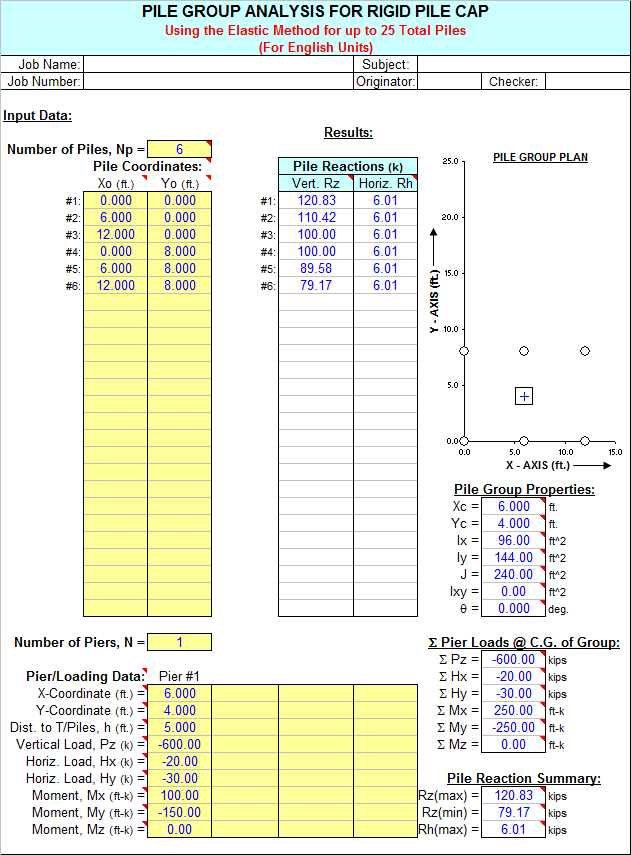
"PILEGRP" is a spreadsheet program written in MS-Excel for the purpose of analysis of pile groups with rigid caps using the "elastic method".  Specifically, the properties of the pile group are calculated, and then based upon the applied vertical and horizontal loadings, the vertical and horizontal pile reactions are calculated. There is also a worksheet to check beam and punching shear in the pile cap for a single corner pile, for the purpose of estimating the required pile cap thickness and subsequent pile cap weight.

This workbook has some concrete design in them, based on the ACI 318-99 Code in their original form.  To reflect the use of the ACI 318-05, I decided to give the user the option of selecting what ACI Code is desired to be used, 318-99, 318-02, or 318-05, in those specific worksheets.  Once the user selects the desired ACI Code, the appropriate "phi" factors are displayed and used.  One word of caution, be careful not to mix & match "phi" factors and load factors from the various concrete codes.  It's obviously up to the user to be consistent.  For the purpose of just what specific concrete analysis and design is done in this workbook, the selection of either ACI 318-02 or 318-05 gives the same results.

This program is a workbook consisting of ten (10) worksheets, described as follows:
  • Doc - Documentation sheet
  • Piles (<=25) - Pile group analysis for up to 25 total piles and 4 piers/loadings
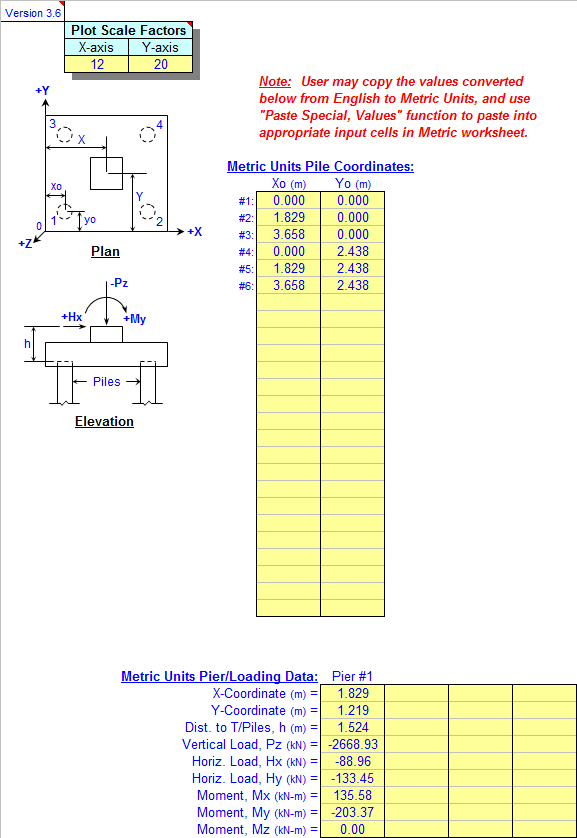
  • Piles (<=25)(metric) - Pile group analysis for up to 25 total piles and 4 piers/loadings (metric)
  • Piles (<=75) - Pile group analysis for up to 75 total piles and 8 piers/loadings
  • Piles (<=75)(metric) - Pile group analysis for up to 75 total piles and 8 piers/loadings (metric)
  • Piles (<=300) - Pile group analysis for up to 300 total piles and 17 piers/loadings
  • Piles (<=300)(metric) - Pile group analysis for up to 300 total piles and 17 piers/loadings (metric)
  • Piles (<=400) - Pile group analysis for up to 400 total piles and 23 piers/loadings
  • Piles (<=400)(metric) - Pile group analysis for up to 400 total piles and 23 piers/loadings (metric)
  • Corner Pile Shear - Beam and punching shear checks for pile cap for single corner pile

Program Assumptions and Limitations:

1.  The Pile Group worksheets assume a minimum of 2 piles and a maximum of either 25, 75, 300, or 400 piles for a pile group.

2.  This program uses the "elastic method" of analysis, assuming that the pile cap is in fact "rigid", so that the applied loads are linearly distributed among the piles.  A common "rule-of-thumb" is to assume a pile cap thickness equal to least 1/10 of the longest dimension (length or width) of the pile cap.  All piles are assumed to be vertical, and of equal size and length (stiffness).  Battered piles are NOT permitted.  The tops of all piles are assumed at the same level.

3.  This program assumes an orthogonal X-Y-Z coordinate system.  All piles and piers MUST BE located in the "positive" (1st) quadrant.  "Negative" pile or pier/loading location coordinates are NOT permitted. "Right-Hand-Rule" sign convention is used for all applied forces and moments at pier locations.

4.  The piles and piers/loadings can be numbered in any desired order.  However, the user should make sure to either clear the contents of all spreadsheet cells that are not used for input or those cell values should be input = 0.  All piles and piers/loadings MUST BE input in proper numerical sequence with no "breaks" in the numerical order of input data.

5.  This program does NOT include the weight of the pile cap or piers in the calculation of the vertical pile reactions. However, the total weight of the pile cap and piers may be included by assuming an additional "ficticious" pier located at the centroid of the pile cap plan area, and applying the total weight at that "pier" location.

6.  This program does NOT check the actual calculated pile reactions (vertical and horizontal) against known or given allowable pile reactions for downward, uplift, or lateral cases.  This is done so that the extent of any acceptable overstress is left up to the judgement of the user.  However, in all cases this must be checked by the user.

7.  This program does NOT perform all of the necessary checks for the beam-type shear or punching shear for the pile cap, as this must be done independently by the user.  However the "Corner Pile Shear" worksheet can be used to estimate the required pile cap thickness and subsequently the pile cap weight to be accounted for.

8.  This program does NOT check the flexural requirements of the pile cap, as this must be done independently by the user.

9.  This program contains numerous “comment boxes” which contain a wide variety of information including explanations of input or output items, equations used, data tables, etc.  (Note:  presence of a “comment box” is denoted by a “red triangle” in the upper right-hand corner of a cell.  Merely move the mouse pointer to the desired cell to view the contents of that particular "comment box".)

Calculation Reference
ACI Manual
| Find on Amazon.com | Find on Amazon.co.uk | Find on Amazon.fr | Find on Amazon.de | Find on Amazon.ca |
Concete Design
| Find on Amazon.com | Find on Amazon.co.uk | Find on Amazon.fr | Find on Amazon.de | Find on Amazon.ca |
Concret Pile Design
| Find on Amazon.com | Find on Amazon.co.uk | Find on Amazon.fr | Find on Amazon.de | Find on Amazon.ca |

Version History
Subscribe to this topic and get notified by mail about new posts Favorite to this topic Discuss this item in the forum. Check the version history to see how this calculation has changed over time. Use the Subscribe button to receive an automatic email should this calculation be updated to a higher version. Use the Favourite button so you can easily find this calculation in the future.

Submitted On:
21 Jul 2008
Submitted By:
ATomanovich
File Date:
21 Jul 2008
File Author:
Alex Tomanovich
File Version:
3.6
File Size:
1,940.00 Kb
File Type:
xls
Downloads:
650
Rating:
stars/5.gifTotal Votes:6
Like this?:
More submitted by this user.
HTML Link:
Copy code below to your web page to create link to this page:
HTML Window:
Copy code below to your web page to create a dynamic window to this download:

Comments  

 
#3 rakaonly 2009-02-16 07:54
Tyo sipil ui, ni software kayaknya boleh juga... Thanx Gan..
 
 
#2 MSH 2008-09-09 16:19
After I used, benefited, and enjoyed your spreadsheets, finally I found the time to say, "Thank you".
 
 
#1 yuvraj.jadhav 2008-04-03 07:40
satisfactory
 

Please sign in or register to add a comment.

ExcelCalcs Trailblazers

I have been chasing up feedback from new users signing up to XLC Pro accounts in the last month. I am delighted with their positive feedback. “I started using XLC but I am now insisting that my whole team use the add-in .“ “It is a great tool for validation and pres...

Increasing Engineering Confidence

Engineering training - “I run a team of engineers and whilst there are plenty of soft options for training expounding the latest management techniques there is precious little to develop the engineering skills of my team”. This is a familiar story we hear from clients of our trai...

Join our Corporate Partners Scheme

You are probably familiar with our tools of mass knowledge distribution on our website but ExcelCalcs also works more closely with corporate partners providing engineering training and engineering consultancy services. What’s more these services and ExcelCalcs subscriptions are availa...

Introducing ExcelCalcs eFormulas

ExcelCalcs eFormulas aims to replace traditional engineering formula books providing innovative functionality to copy from our webpages and paste directly into Excel. Once in Excel it is easily edited to suit your own problems this functionality is far more flexible than 'stuck on the web'&n...

Deciphering Spreadsheets with XLC

At some time or other you will have been given someone else’s spreadsheet only to be left scratching your head not having a clue as to what the calculation is doing.  If you are wise you will not use it because you can’t understand it. If you are wiser still you’ll use our...

Make Amazing Calculations

In our good calculation guide we emphasise the importance of sketches in calculations but you can produce interactive 3D wireframe sketches by incorporating Turan Babacan’s latest upload. Turan uses 3D charts to great effect in his Excel FEM programs. Andy Pope also has a 3D chart spr...

Coming Soon XLC Ribbon

A new version of XLC is in the final stages of development which will be compatible with the 64 bit version of Excel 2010 (currently it works with the 32 bit version of Excel 2010, 2007 2003 and 2000). We’ll keep you posted with progress. Please send us details of any features you ...

An Allowable Business Expense

Most ExcelCalcs users charge subscription fees back to their employers as a business expense. The cost is easily justified as membership of the site have been shown to yield a 23% productivity benefit. Many people do not realise that you don't even need a PayPal account to pay - you can pay...

Document Control at ExcelCalcs

Document control is a key issue for engineers but it can become an administrative nightmare. Here at ExcelCalcs we have developed many tools to control the calculations we distribute and as a member you have access to all these tools. Problem ExcelCalcs Document Control...