
BUOYANCY ANALYSIS FOR CONCRETE PIT OR TANK
Description
Program Description:
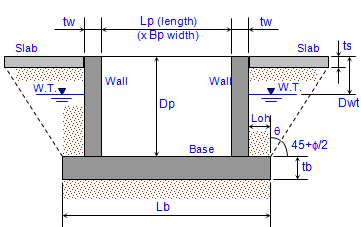
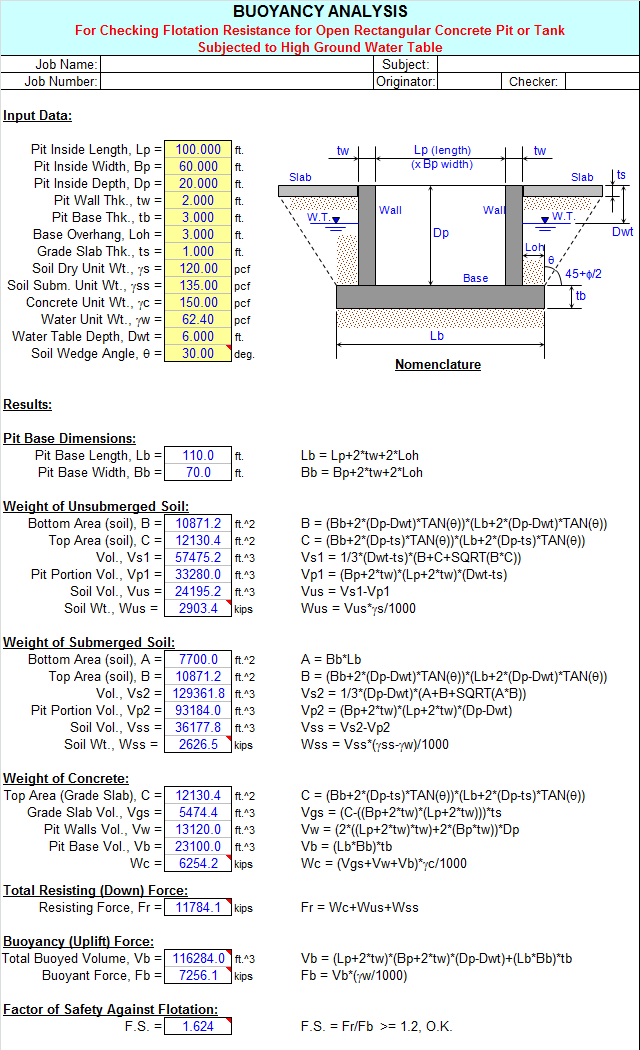
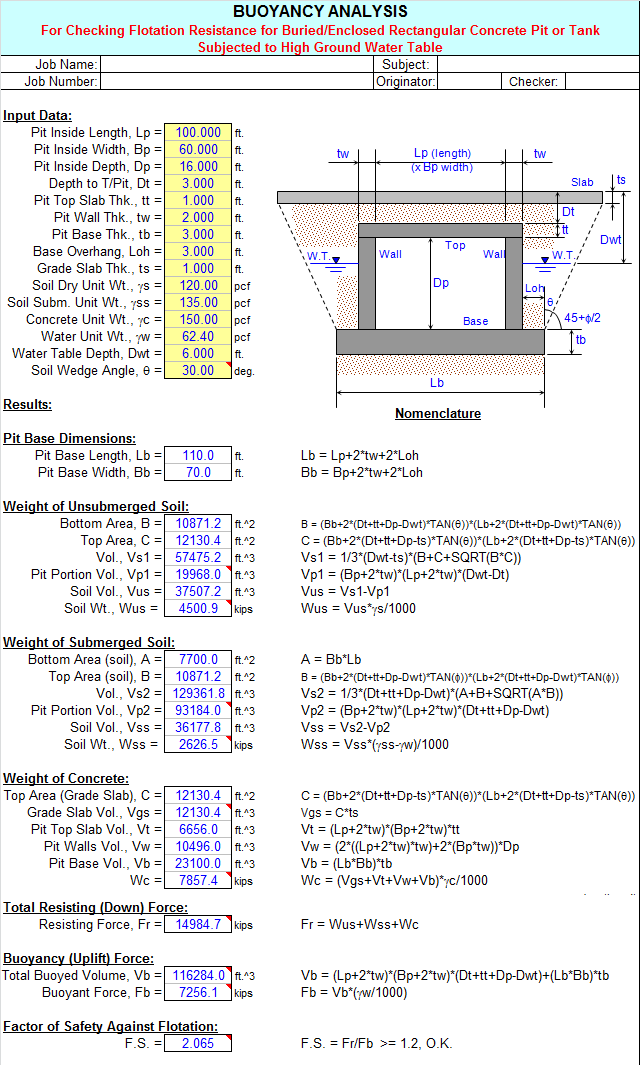
"BUOYANCY" is a spreadsheet program written in MS-Excel for the purpose of performing a buoyancy analysis, checking the resistance to flotation, for either an open or buried/enclosed rectangular concrete pit or tank.
This program is a workbook consisting of three (3) worksheets, described as follows:
Doc
Open Pit or Tank
Enclosed Pit or Tank
Program Assumptions and Limitations:
1. This program is based on the Archimedes Principal on buoyancy which is stated as follows:
"Any object, wholly or partially immersed in a fluid, is buoyed up by a force equal to the weight of the fluid displaced by the object". Thus, the volume of water displaced by the object multiplied times the unit weight of water is equal to the buoyant force.
2. Use of "overhangs" (extensions) on the pit/tank base allows the user to account for a "block or wedge" of soil around the periphery of the concrete pit/tank.
3. For soil above the water table, the dry unit weight is used for determining the weight considered to contribute in resisting flotation. For soil below the water table, the submerged weight (gs - gw) is used for determining the weight considered to contribute in resisting flotation.
4. The full concrete unit weight is used for the walls, base, top slab (if applicable), and tributary grade slab (if applicable) as weight considered to contribute in resisting flotation.
5. The total weight resisting flotation is the sum of the pit/tank concrete weight, the tributary grade slab weight (if applicable), the unsubmerged soil weight, and the submerged soil weight.
6. The total "buoyed volume" is determined as the total volume of water which is displaced by the pit/tank.
7. The total "buoyant force" is then determined by multiplying the "buoyed volume" times the unit weight of water.
8. The factor of safety against flotation is the total weight resisting flotation divided by the total "buoyant force".
9. This program assumes a Factor of Safety >= 1.2 to be satisfactory, taken against the highest anticipated water table level. This also allows for some uncertainty in the contributing factors and variables. Where the weights calculated are well established, this Factor of Safety could be reduced to 1.1. In determining the Factor of Safety, allowance should be made for future removal of weight, for example the removal of soil.
10. This program contains “comment boxes” which contain a wide variety of information including explanations of input or output items, equations used, data tables, etc. (Note: presence of a “comment box” is denoted by a “red triangle” in the upper right-hand corner of a cell. Merely move the mouse pointer to the desired cell to view the contents of that particular "comment box".)
Calculation Preview
Full download access to any calculation is available to users with a paid or awarded subscription (XLC Pro).
Subscriptions are free to contributors to the site, alternatively they can be purchased.
Click here for information on subscriptions.
Flynn,
Sorry I took over a year to respond. I've been retired now for a couple of years, so I don't check on this website as often as I used to.
Anyway, I do not have an SI units version of this spreadsheet. However, all of my spreadsheets, including this one, are protected, but not with a password. So you can unprotect it and "massage" it to your liking.
Regards,
Alex
I have added the necessary program logic to cell C60 in calculating the total buoyed volume to address the condition where the water table is above the top of the tank.
The version of this workbook is now 1.2.
These same errors did not exist in the "Open Pit or Tank Worksheet".