
Fire Pump Sizing to NFPA 20 - Power, Drive Rating and Accessory Sizes
 (0/0)

Description
Fire Pump Sizing to NFPA 20 - Power, Drive Rating and Accessory Sizes
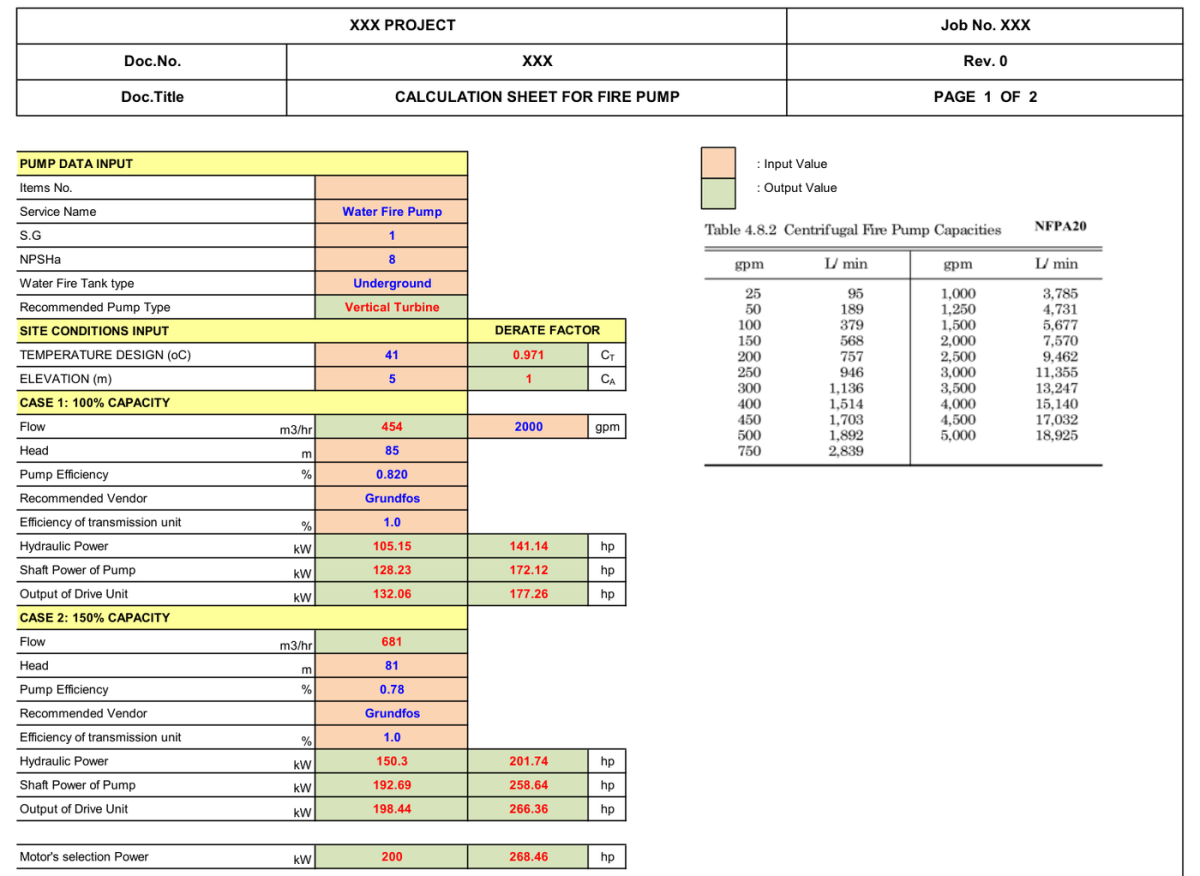
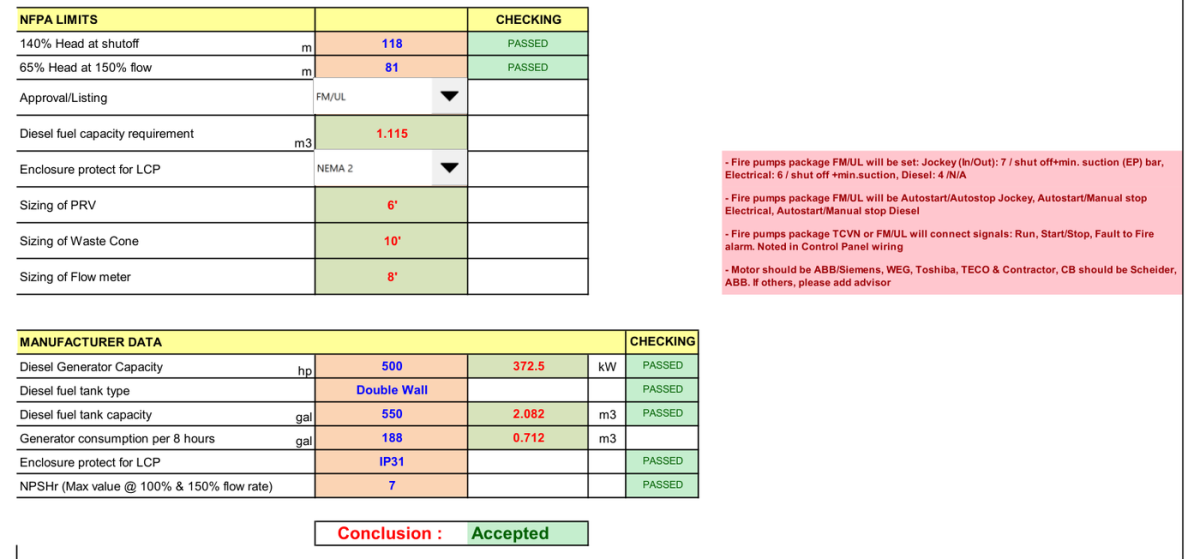
Sizes a fire pump and its driver to NFPA 20. From the rated flow, rated head, specific gravity, pump efficiencies and the site temperature and elevation, it finds the hydraulic, shaft and drive power at 100% and 150% of rated flow, derates for site conditions, selects the next standard drive size and sizes the diesel fuel tank. It checks the NFPA limits on shut-off head and on head at 150% flow, reads relief valve, waste cone and flow meter sizes from NFPA 20 Table 4.26(a), and lists the main NFPA installation requirements.
Inputs
- Rated flow (gpm) and rated head (m), specific gravity and NPSH available
- Head at 150% flow and at shut-off, from the pump curve
- Pump efficiency at 100% and 150% flow, and transmission efficiency
- Site design temperature (°C) and elevation (m)
- Water tank arrangement, approval/listing, generator and fuel tank data for the checks
Outputs
- Temperature and elevation derate factors CT and CA
- Hydraulic power, shaft power and drive output at 100% and 150% flow (kW and hp)
- Selected standard drive size and the diesel fuel tank volume
- PASSED / UNPASSED checks against the NFPA shut-off and 150%-flow head limits and the manufacturer data, with an overall conclusion
- Relief valve, waste cone and flow meter sizes
The example is a 2,000 gpm pump at 85 m head, at 41 °C and 5 m elevation: the drive output at 150% flow is 198.44 kW, a 200 kW drive is selected and the fuel tank is 1.115 m³. SI units with US customary equivalents. The workbook was uploaded as an Excel 97–2003 .xls file and is now supplied as .xlsx.
Checked and corrected
Every result was recomputed independently. ExcelCalcs made three corrections to the uploaded file (17 November 2026, version 1.1). The example's results are unchanged, because its site is below 91.4 m and above 25 °C; the corrections matter at other sites and sizes.
- Elevation derate CA now follows NFPA 20: 3% per 304.8 m (1,000 ft) above 91.4 m (300 ft). The original started derating at 300 m, reading 300 ft as 300 m, and so overstated the engine power available at any site above 91 m. At 300 m, CA is now 0.979 (was 1.000); the drive output at 150% flow rises from 198.44 to 202.70 kW and the selected drive from 200 to 220 kW. At 1,000 m, CA is 0.911 (was 0.93).
- Temperature derate CT is now capped at 1, as NFPA 20 derates only above 25 °C. Below 25 °C the original gave a factor above 1 and so reduced the drive power: at 15 °C it gave 1.018 and 189.28 kW; it now gives 1.000 and 192.69 kW.
- Drive size selection now reads the sheet's full list of standard sizes. The reversed list it used had lost the 45, 55 and 75 kW sizes, so a pump needing 49.8 kW (the example at 500 gpm) was given a 90 kW drive; it is now given 55 kW. A 74.3 kW demand (750 gpm) now selects 75 kW instead of 90 kW.
Please note
- The temperature and elevation derates are NFPA's diesel-engine derates, but the drive is picked from a list of electric motor sizes, so decide which driver you are sizing. The sheet combines the factors as CT × CA, which is slightly more conservative than NFPA's (CA + CT − 1).
- The margin factors on the hidden left-hand page are set to zero, so no margin is added to the drive power; sizing at 150% flow already covers the overload point.
- Enter the pump efficiencies from the selected pump's curve rather than relying on the vendor “experience efficiency” list.
- Generator fuel use (188 gal per 8 hours) is a fixed figure, not tied to the generator size, and some remarks and prompts are specific to the author's organisation and to Vietnamese TCVN practice.
- The size list contains placeholder entries of 501, 502 and 503 kW; a demand just over 500 kW will select one of these, so pick the next real size by hand.
Calculation Preview
 (0/0)
Full download access to any calculation is available to users with a paid or awarded subscription (XLC Pro).
Subscriptions are free to contributors to the site, alternatively they can be purchased.
Click here for information on subscriptions.

**What needs to change**
- Elevation derate (cell AK15): the formula starts derating at 300 m, but NFPA 20 Figure A.11.2.2.4 derates 3% per 304.8 m above 91.4 m (300 ft). At 1,000 m the sheet gives 0.93 where NFPA gives 0.91, so the engine is under-derated at any site above 91 m. Suggested formula: =MIN(1, 1-0.03*(AJ15-91.4)/304.8).
- Say whether the drive is a diesel engine or an electric motor: the temperature and elevation derates are NFPA's engine derates, but the result is picked from a list of electric motor sizes.
- The margin factors (V58:V60) are all zero although the table beside them gives 0.1 to 0.3; apply them or explain why not.
- Please remove the table of pump "experience efficiencies" by manufacturer, and let the user enter the efficiency from the chosen pump's curve.
- Please remove the photograph watermarked plcsaigon.com and the manufacturer's brochure image, which are not yours to publish. The extracts from NFPA 20 used to explain the method are fine.
- Remove the company-specific remarks and prompts, and the old "PIPE WALL THICKNESS CALCULATION SHEET" header.
- The file properties name a different author and company; if the sheet was built on someone else's work, please credit them.
- Add a short purpose statement at the top and say how you checked the results.
If you upload a corrected version we'll be glad to review it again: a corrected calculation earns a 3-month XLC Pro subscription, and one that follows the guide in full earns 12 months.
We offer guidance for authors on The Good Calculation Guide: [https://www.excelcalcs.com/calcs/good-calc-guide](https://www.excelcalcs.com/calcs/good-calc-guide). We hope that this does not discourage you from trying again and thanks for your interest in the site.
**What we corrected**
- AK15, the elevation derate, now follows NFPA 20: 3% per 304.8 m (1,000 ft) above 91.4 m (300 ft). Before, it started at 300 m. At a 300 m site C_A is now 0.979 instead of 1.000, and your 2,000 gpm example would need 202.70 kW and a 220 kW drive rather than 198.44 kW and 200 kW.
- AK14, the temperature derate, is now capped at 1, as NFPA derates only above 25 °C. Below 25 °C it used to give a factor above 1 and reduce the drive power.
- AJ35 now picks the drive from the full list of standard sizes in column BD. The reversed list in column BC had lost the 45, 55 and 75 kW sizes, so a 500 gpm pump needing 49.8 kW was given 90 kW; it now gets 55 kW.
An independent check of your example agreed with your sheet: hydraulic power 105.15 kW, drive output 198.44 kW at 150% flow, a 200 kW drive and a 1.115 m³ fuel tank. Your example site is at 5 m and 41 °C, so its results do not change. A few points remain for a future version: say whether the drive is a diesel engine or an electric motor, since the derates are NFPA's engine derates; explain or apply the margin factors in V58:V60, which are all zero; and remove the placeholder sizes 501–503 kW from the size list.
Thank you for a well-organised calculation that takes a fire pump all the way from duty point to accessories. I have awarded you a 3-month XLC Pro subscription by way of thanks. Our guidance for authors is in The Good Calculation Guide: [https://www.excelcalcs.com/calcs/good-calc-guide](https://www.excelcalcs.com/calcs/good-calc-guide).