
Open Channel Flow Calculations
 (5/7)
Description
Open Channel Flow by Manning’s Equation for Five Channel Shapes
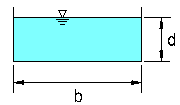
Calculates the flow area, hydraulic radius and discharge for uniform flow in five common open channel cross-sections: a V-shaped channel, a rectangular channel, a right-triangular channel, a trapezoidal channel and a partly full circular channel. Each section is drawn on the sheet with its dimensions labelled, and the working is shown with the input values substituted.
Method
Manning’s equation in US customary units, Q = (1.486/n)AR2/3S1/2, with A and R worked out from the section geometry. For the circular channel the depth of flow is found from the central angle θ: A = (θ − sinθ)D²/8 and R = (1 − sinθ/θ)D/4.
Inputs
- Depth of water and channel width or diameter (in)
- Side slope angle (V and trapezoidal channels) or central angle (circular channel)
- Manning’s roughness coefficient n and slope of the flow line S
Only the sections whose input cells are filled in are calculated.
Outputs
- Flow area A (ft²), hydraulic radius R (ft) and discharge Q (ft³/s) for each section
- Top width of the V channel; depth of flow in the circular channel
The stored example, a V channel 1 in deep with 15° side slopes, n = 0.035 and S = 0.01, gives A = 0.0259 ft², R = 0.0402 ft and Q = 0.0129 ft³/s. The other four sections are left blank.
Please note
- In the right-triangular channel the “hydraulic radius” formula returns the wetted perimeter (√(b² + d²) + d, in ft) instead of area divided by wetted perimeter, so the discharge for that shape is greatly overestimated. Use R = 0.5bd / [√(b² + d²) + d] (in inches, then ÷ 12) instead.
- Some of the substituted-value text strings for the rectangular and triangular channels pick up the wrong input cells; the numerical results of the rectangular channel are not affected.
- Uniform, steady flow only. US customary units. No macros.
Author: Doug Lee (as shown on the sheet).
Calculation Preview
 (5/7)
Full download access to any calculation is available to users with a paid or awarded subscription (XLC Pro).
Subscriptions are free to contributors to the site, alternatively they can be purchased.
Click here for information on subscriptions.


Congratulations Doug.
Thank you for your Open Channel Flow calculation. We checked the V channel example independently and got the same discharge (0.01292 ft³/s), and the rectangular, trapezoidal and circular formulas check out too.
While rewriting the description we found one error. For the right-triangular channel, cell W52 calculates (√(b² + d²) + d)/12, which is the wetted perimeter in feet, not the hydraulic radius R = A/P. The label in L52 shows the same formula. As a result the discharge in W53 is greatly overestimated: with b = d = 12 in, R should be about 0.21 ft but the sheet uses 2.41 ft, so Q comes out roughly five times too high. R should be 0.5bd / (√(b² + d²) + d), divided by 12.
A smaller point: the substituted-value text in T41 and T52 picks up input cells from other channels (W23 and W35 instead of W35 and W46). Only the displayed working is affected.
We have mentioned these points in the file's description so users are aware. If you upload a corrected version, we will review it and publish it as the next version.
ExcelCalcs Review Team