
Pump Sizing Calculator_Simplified
 (5/1)
(5/1)
Description
What this free calculator helps you do
- estimate hydraulic power
- calculate shaft power
- estimate motor input power
- work with single-stage and multi-stage setups
- apply series and parallel stage logic
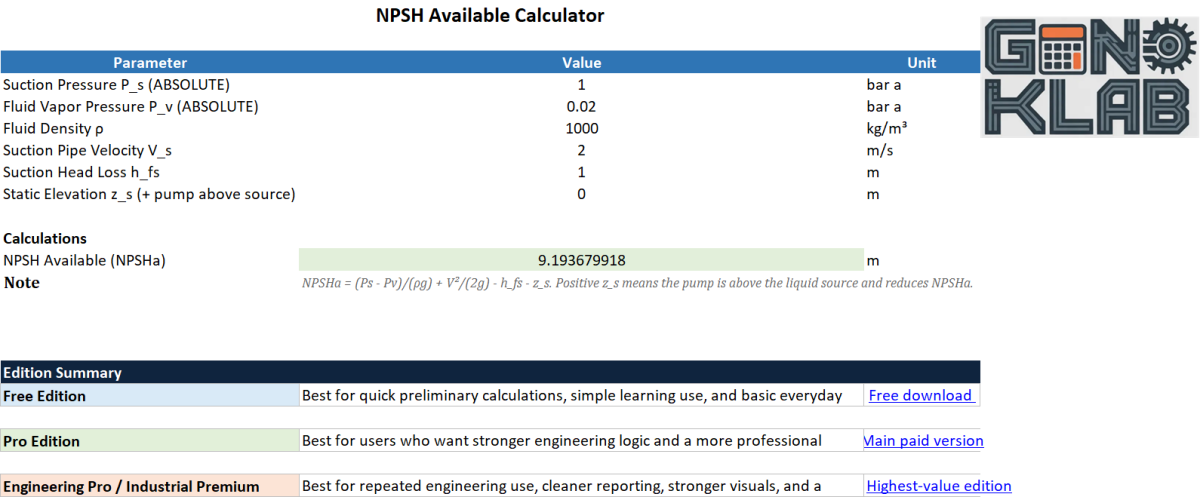
- calculate NPSH available
- run quick preliminary pump checks in Excel
A free, single-workbook pump sizing tool from GonokLab for quick preliminary hydraulic and motor sizing of centrifugal (and basic positive-displacement) pumps. Enter your duty point and fluid properties and the workbook returns the power demand at each stage of the drivetrain, plus a suction-side cavitation check.
What it calculates
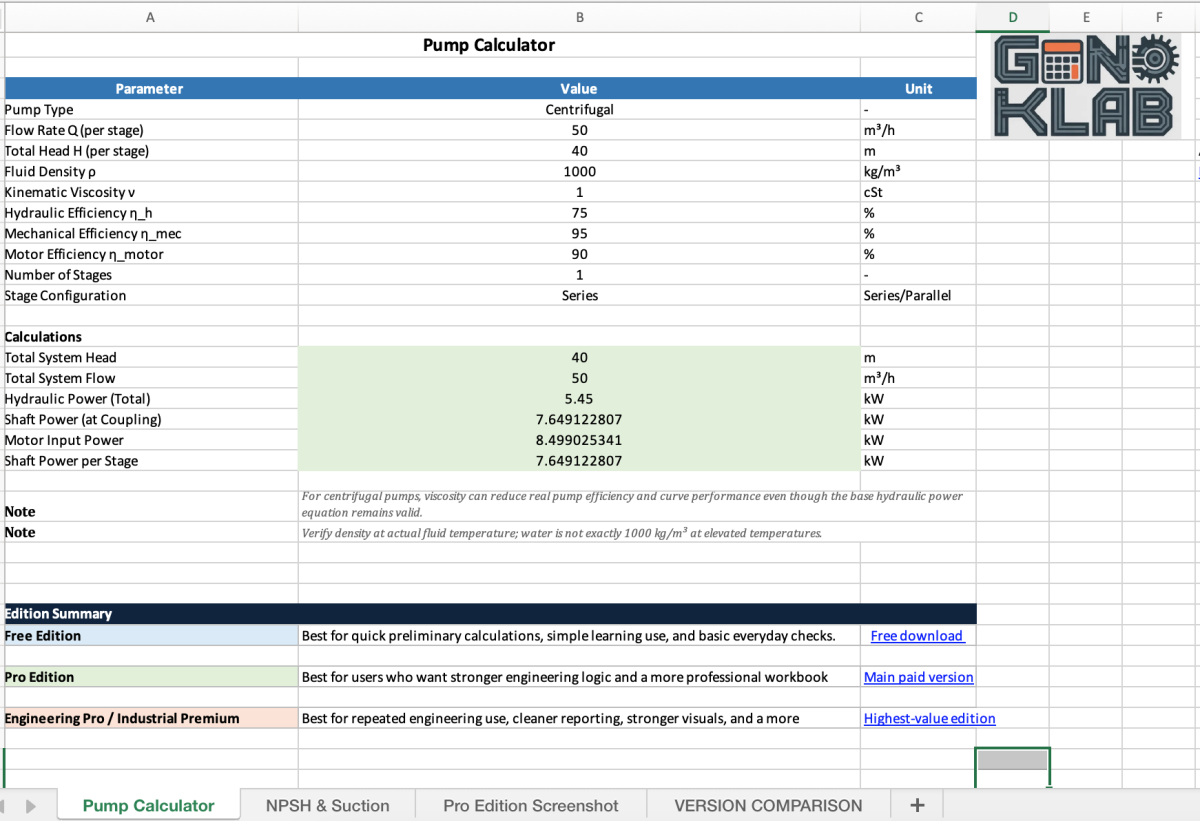
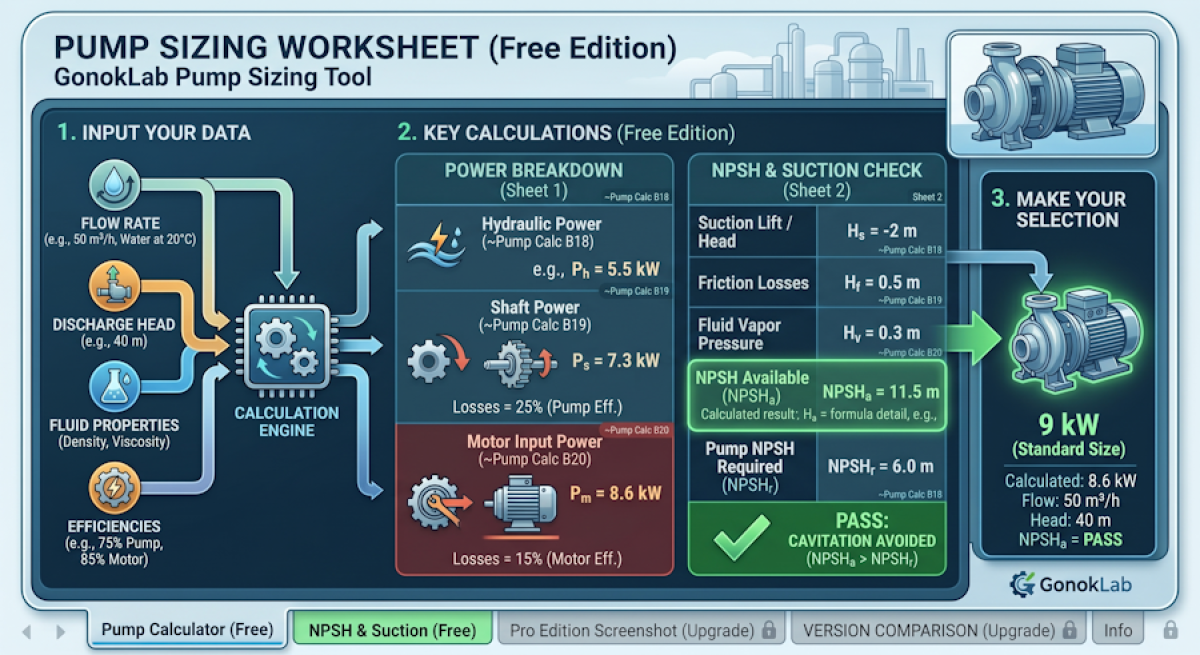
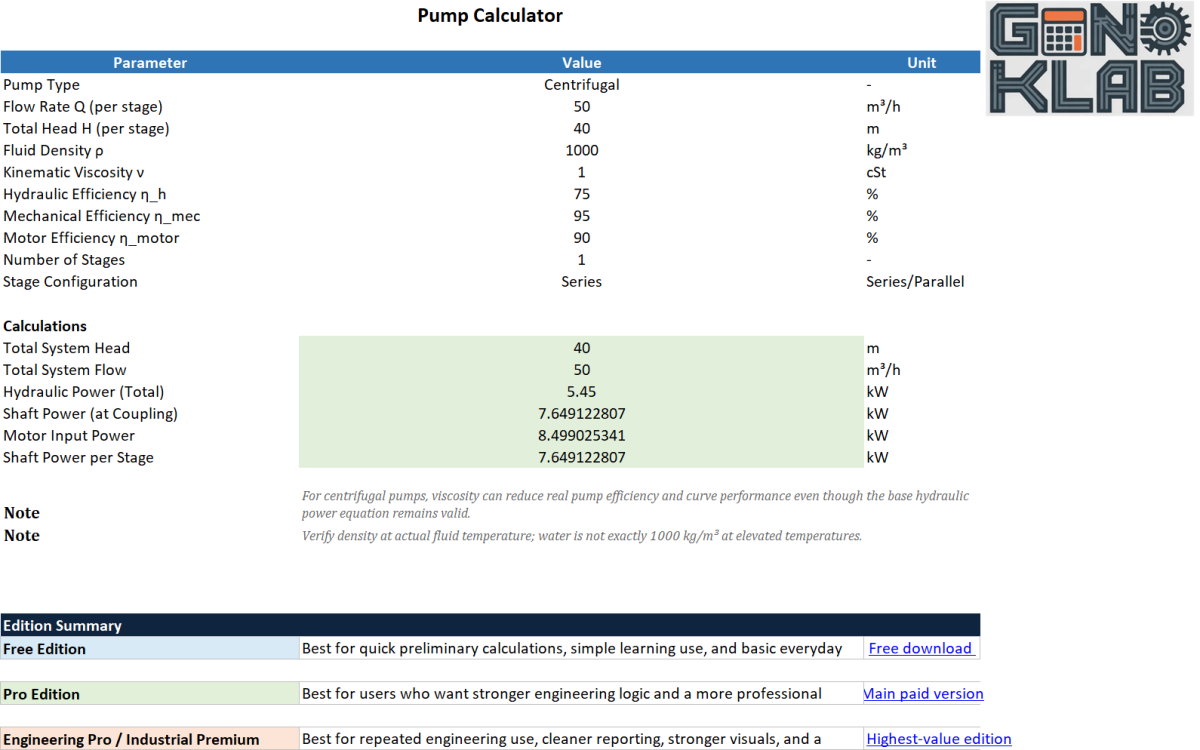
Sheet 1 — Pump Calculator
- Inputs: pump type, flow rate Q, total head H, fluid density ρ, kinematic viscosity ν, hydraulic / mechanical / motor efficiencies, number of stages, and series/parallel configuration.
- Outputs:
- Total system head and flow (accounts for series vs. parallel staging)
- Hydraulic power — useful work delivered to the fluid
- Shaft power at the coupling — after hydraulic and mechanical losses
- Motor input (electrical) power — after motor efficiency
- Shaft power per stage
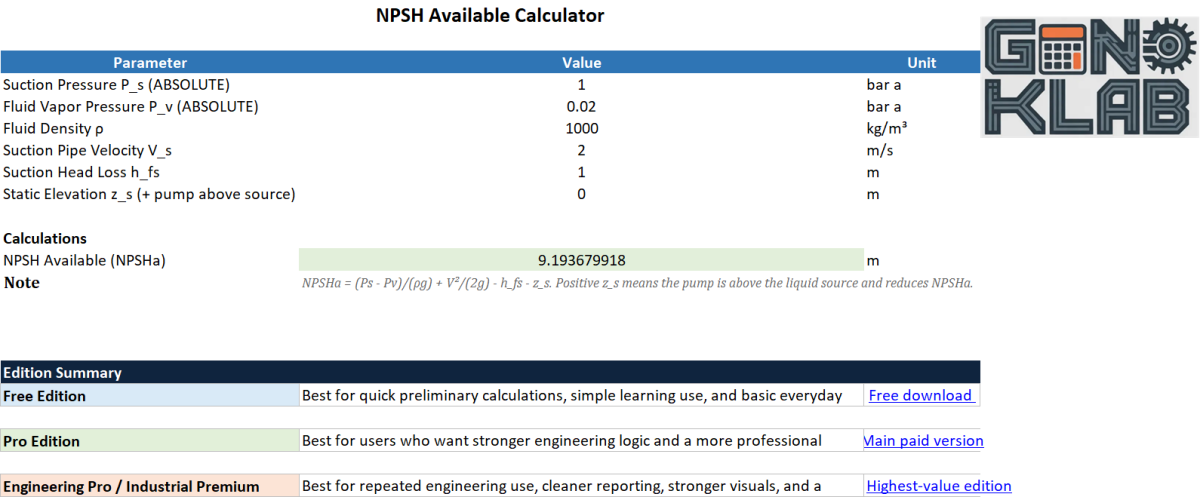
Sheet 2 — NPSH & Suction
- Inputs: absolute suction pressure, vapor pressure, density, suction pipe velocity, suction head loss, and static elevation (positive when the pump sits above the source).
- Output: NPSH Available using NPSHa = (Ps − Pv) / (ρg) + V²/(2g) − hfs − zs, to be compared against the pump's NPSH Required to guard against cavitation.
Worked example shipped with the file
Water at 50 m³/h against 40 m of head, ηh = 75 %, ηmec = 95 %, ηmotor = 90 %, single stage: hydraulic power ≈ 5.45 kW, shaft power ≈ 7.65 kW, motor input ≈ 8.50 kW. With 1 bar(a) suction, 0.02 bar(a) vapor pressure, 2 m/s pipe velocity and 1 m friction loss, NPSHa ≈ 9.2 m.
Best for
- Quick preliminary sizing and motor selection
- Students and engineers learning pump hydraulics
- Sanity-checking a vendor selection before requesting formal curves
Limitations
- Simplified model — assumes the user supplies realistic efficiency values rather than deriving them from a pump curve.
- Viscosity is captured as an input but is not used to correct centrifugal pump performance (a note in the file flags this).
- Density is taken as entered — the file reminds users that water is not exactly 1000 kg/m³ at elevated temperature.
- No standard motor-size rounding, no charts, no printable report sheet (those are features of the author's paid editions).
Workbook contents
- Pump Calculator — main duty-point and power calculation
- NPSH & Suction — NPSH available calculation
- Pro Edition Screenshot, Version Comparison, Info — author/marketing material for the paid editions
Author: GonokLab. Free edition; paid Pro and Industrial Premium editions are also offered by the author.
Calculation Preview
 (5/1)
(5/1)
Full download access to any calculation is available to users with a paid or awarded subscription (XLC Pro).
Subscriptions are free to contributors to the site, alternatively they can be purchased.
Click here for information on subscriptions.