
Bored Piles Wall and Ground Anchors
 (4/39)
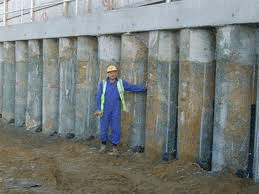
Description
Contiguous Bored Pile Wall with Ground Anchors
Analyses and designs a contiguous bored pile retaining wall supported by one or more rows of inclined ground anchors. Fourteen steps run from earth pressures and a finite-element wall analysis to the design of the anchors, piles, waling beam and head beam, with a printable report.
Method
- Rankine active and passive pressures with cohesion, up to five layers and a water table, plus uniform, strip and line surcharges
- The pile as a beam on elastic soil springs with the anchors as supports, solved by the stiffness method
- Anchor fixed length Lb = P·sf/(πdT) with a table of bond stresses, and number of strands; pile embedment against the vertical anchor load; a failed-anchor case
- Reinforced concrete design of the piles, waling beam and head beam
Inputs
- Soil layers (elevation, unit weight, φ′, c′) and groundwater level
- Excavation depth, embedment, pile size, spacing, length and modulus; surcharges
- Anchor rows and inclination; grout diameter, bond stress, safety factor, project load
- Materials and reinforcement for each member
Outputs
- Pressure diagrams, wall displacement, bending moment and shear; anchor forces
- Anchor fixed and total lengths and strands; embedment check
- Reinforcement checks with OK/NO for piles, waling and head beam
The stored example, an 8.5 m excavation with 35 cm piles at 55 cm centres and three anchor rows at 15°, gives a top displacement of 1.9 mm and anchor forces of 361, 56 and 169 kN; the top anchor needs a 5.95 m fixed length with two 0.6 in. strands. The pile flexure check reads NO (125.5 against 110.3 kNm).
Please note
- The vertical anchor component in the embedment (D) check takes the sine of the inclination in radians instead of degrees: 15 gives 0.65 rather than 0.26, so the vertical load is overstated.
- The strand area is that of a solid circle of the nominal diameter (182 mm² for 0.6 in.) rather than the strand’s actual area, which overstates strand capacity.
- The example uses E = 200 GPa for the piles; enter a concrete value for bored piles.
- SI units. No macros; sheets protected.
Calculation Preview


 (4/39)
Full download access to any calculation is available to users with a paid or awarded subscription (XLC Pro).
Subscriptions are free to contributors to the site, alternatively they can be purchased.
Click here for information on subscriptions.
Comments: 9
×

8 years ago
The spreadsheet uses a font Called 'Technic' that you do not have on your Windows 10 system. It is a free download from [https://www.wfonts.com/font/technic](https://www.wfonts.com/font/technic). I hope this helps. My earlier comment gives another link to the font.
11 years ago
I had no trouble reading the 'Technic' font. It appears to be present on my system. I have found a [link to the font](http://www.azfonts.net/load_font/1196841855_technic.html) if you do not have it installed. [Here is how to install it](http://windows.microsoft.com/en-gb/windows-vista/install-or-uninstall-fonts).

11 years ago
Thank you for your feedback.
This mistake will be considered on "Bored Piles Wall and Ground Anchors v1.7".
To see professional version of this software and development process you can follow. [http://www.iksapro.com/iksapro](http://www.iksapro.com/iksapro)
This mistake will be considered on "Bored Piles Wall and Ground Anchors v1.7".
To see professional version of this software and development process you can follow. [http://www.iksapro.com/iksapro](http://www.iksapro.com/iksapro)
12 years ago
version 1.6
account the amount of material in the system, added
account the amount of material in the system, added
13 years ago
Some bugs were fixed!
ver 1.5
ver 1.5
13 years ago
**BABACAN wrote:**
13 years ago
Truly an amazing piece of work here. I marvel at your ingenuity Turan. As a mechanical engineer with little knowledge of civil engineering what I admire most is how you make a complex topic so easy to understand - this is the hallmark of a true master of his discipline. Thank you so much.

13 years ago
My downloaded version of the file shows all of the text labels in Wingdings font which is unreadable.
Can you please advise how to correct or issue a new corrected version?
Thank you.
Randy Divito
Can you please advise how to correct or issue a new corrected version?
Thank you.
Randy Divito
Thank you for your bored pile wall and ground anchor calculation. Our check of the Rankine coefficients and the anchor 1 bond length (5.950 m) agrees with the sheet.
While rewriting the description we found two errors on the MENU sheet:
- EL18:EM26 take SIN(BK17) with the inclination entered in degrees (15), so Excel treats it as 15 radians: sin = 0.650 instead of 0.259. The vertical anchor component in the embedment (D) check is overstated about 2.5 times (on the safe side there). SIN(RADIANS(BK17)) would fix it.
- BZ19 calculates the strand area as a solid circle of the nominal diameter, (BY19·25.4)²·π/4 = 182.4 mm² for a 0.6 in strand, whereas a 0.6 in seven-wire strand has an area of about 140 mm². The strand capacity in CB19 is overstated by about 30%, so the number of strands in CD23 may be too few.
You may also want to reconsider the example's pile modulus of 200 GPa, a steel value, for concrete piles.
We have mentioned these points in the file's description so users are aware. If you upload a corrected version, we will review it and publish it as the next version.
ExcelCalcs Review Team