
Basic Pressure Vessel Stress
 (4/29)
Description
Thin-Walled Pressure Vessel Stresses
Calculates the membrane stresses caused by internal pressure in a thin-walled spherical vessel and in a thin-walled cylindrical vessel, and checks that the thin-wall approximation is valid for the chosen radius and wall thickness.
Method
Thin-shell membrane theory:
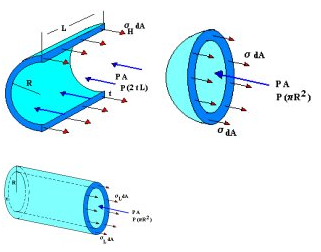
- Sphere: hoop stress σθ = pr/2t (equal in all directions)
- Cylinder: hoop stress σθ = pr/t and longitudinal stress σl = pr/2t
- Validity check: the approximation is accepted when r ≥ 20t
Diagrams on the sheet show the hoop and longitudinal stresses and the thin-shell idealisation.
Inputs
- Internal gauge pressure p (MPa)
- Vessel radius r (mm)
- Wall thickness t (mm)
Outputs
- Thin-wall validity check (“OK” or “Check r/t ratio”)
- Hoop stress in a sphere
- Hoop and longitudinal stresses in a cylinder
The stored example, p = 0.3 MPa, r = 300 mm and t = 3 mm (r/t = 100), gives 15 MPa in the sphere, and 30 MPa hoop and 15 MPa longitudinal stress in the cylinder.
Please note
- Membrane stresses only, away from heads, nozzles, supports and other discontinuities; radial stress, bending and joint efficiency are not included. This is not a design-code thickness calculation.
- The sheet does not say whether r is the inner or mean radius; for thin walls the difference is small.
- The formulas use functions from the free XLC add-in; without it the stress cells show #NAME?. Two further sheets are empty templates. No macros.
Calculation reference: Wikipedia, “Pressure vessel”.
Calculation Preview
(4/29)
Full download access to any calculation is available to users with a paid or awarded subscription (XLC Pro).
Subscriptions are free to contributors to the site, alternatively they can be purchased.
Click here for information on subscriptions.
Comments: 2
×

johndoyle-admin
19 years ago
I take your point mjlear I had copied the text from the wikipedia page which stated "the hoop stress, or stress in the radial direction". Hoop stresses follow the circumferential direction not the radial direction so I am inclined to agree with you. I have deleted the reference to radial direction and up issued the calculation to rev 03. I have reported the issue to the wikipedia page.
19 years ago
hoop stress is in the circumferential direction not the radial direction as stated