
Bolted Joint Part 1 - Preload and Joint Stiffness
 (0/0)
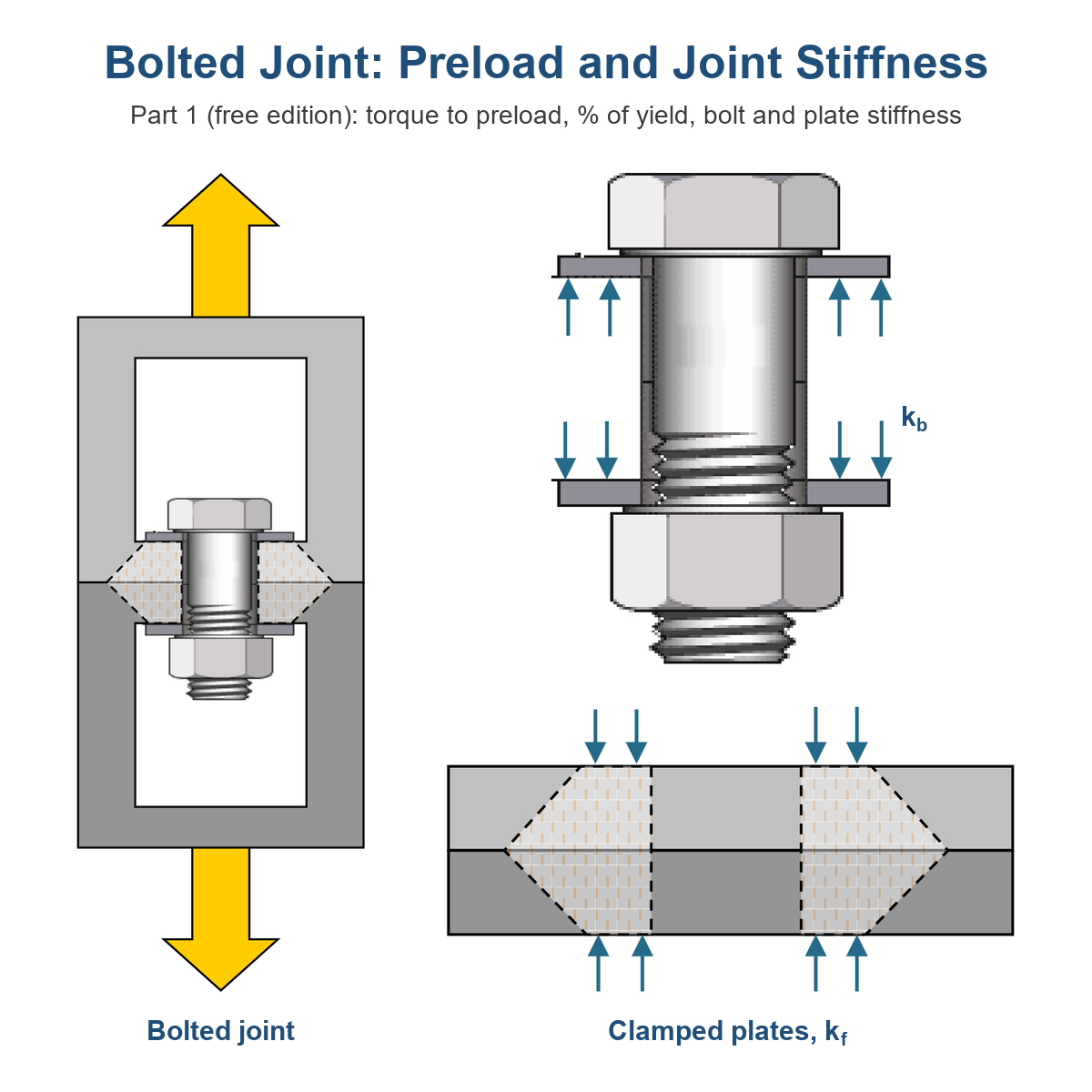
Description
Bolted Joint Part 1: Preload and Joint Stiffness (free edition)
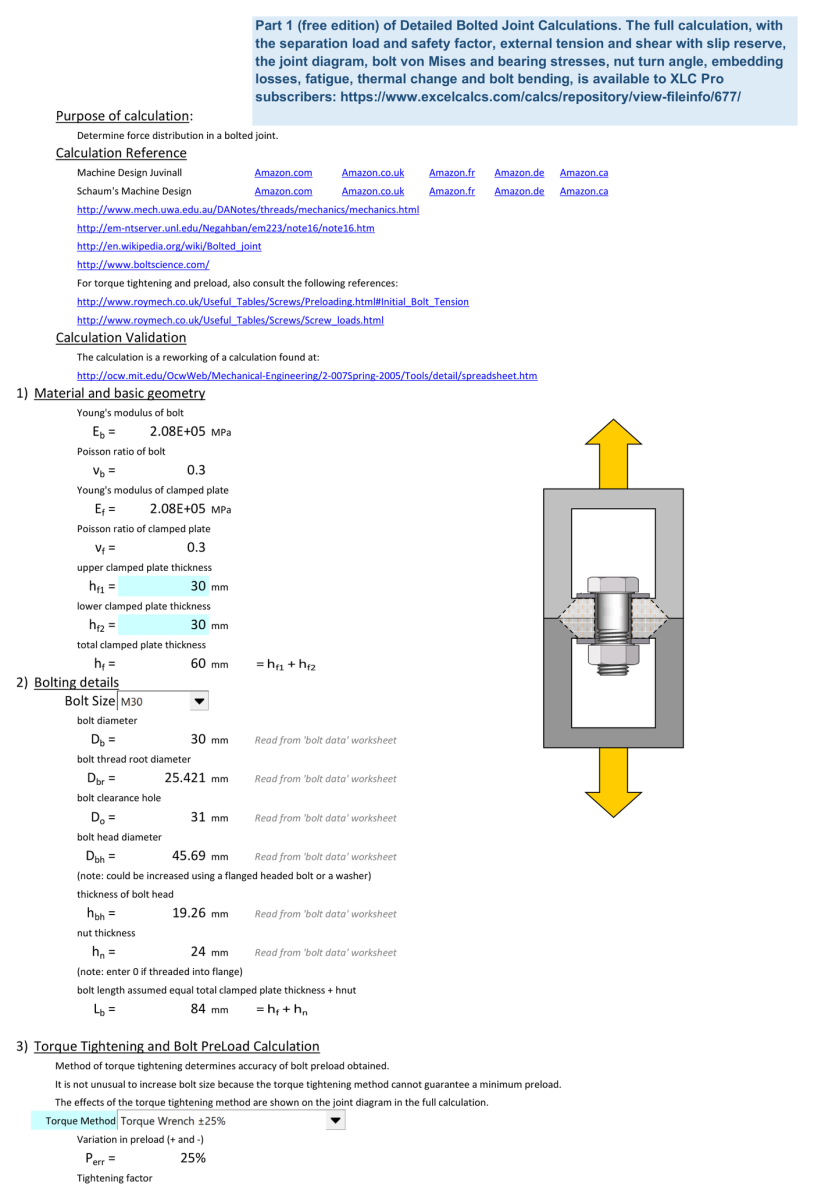
The first stage of the Detailed Bolted Joint Calculations. Enter a metric bolt size, a tightening torque and the thread and collar friction, and it tells you what preload that torque gives, how much of the torque goes into stretching the bolt and how much is lost to friction, how close the preload is to the bolt's yield, and how stiff the bolt and the clamped plates are. Every equation is shown beside its result.
Method
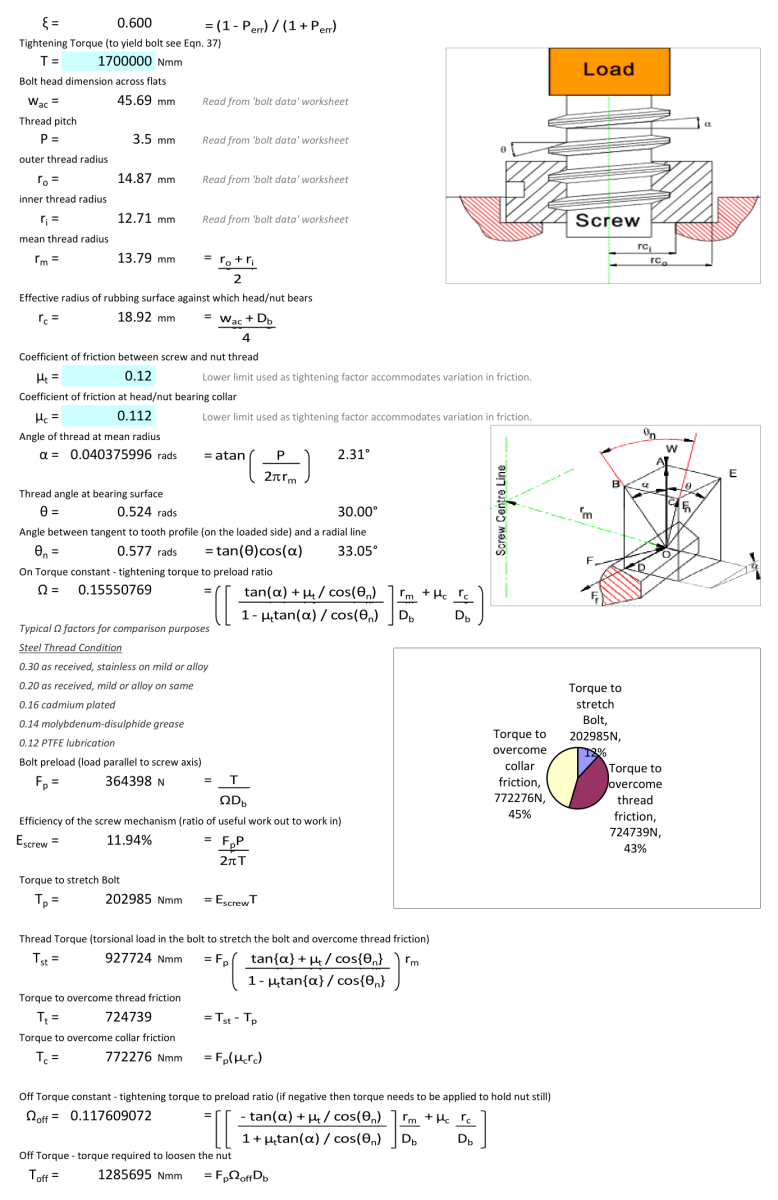
The torque constant Ω is found from the thread geometry (mean thread radius, lead angle, thread flank angle) and the thread and collar friction coefficients, and the preload follows from Fp = T ÷ (ΩDb). The tightening torque is split into the torque that stretches the bolt, thread friction and collar friction, shown as a chart. The bolt stiffness combines the shank and threaded portions in series (AE/L); the clamped-plate stiffness uses the compression cone method with a 30° cone angle. The stiffness factor K = kb ÷ (kb + kf) is the share of any external load that the bolt will carry. Bolt dimensions for M3 to M36 coarse threads are read from the Bolt data sheet.
Inputs
- Young's modulus and Poisson's ratio of the bolt and the clamped plates
- Thickness of the upper and lower clamped plates (mm)
- Bolt size (drop-down, M3 to M36) and tightening method (drop-down, operator feel to ultrasonics)
- Tightening torque T (Nmm)
- Friction coefficients in the thread and under the head or nut
- Bolt ultimate tensile strength (MPa)
Outputs
- Preload scatter and tightening factor for the chosen tightening method
- Torque constant Ω, bolt preload Fp and screw efficiency
- Torque split: to stretch the bolt, thread friction and collar friction
- Off torque (torque to loosen the nut)
- Load at which the bolt yields, preload as a % of yield, and the yield torque
- Bolt stiffness kb, clamped-plate stiffness kf and the stiffness factor K
The example is an M30 bolt of 1000 MPa UTS clamping two 30 mm steel plates, tightened with a torque wrench to 1,700 Nm: the preload is 364 kN, 80% of the bolt's yield load, and K is 0.24. SI units.
This is Part 1 of Detailed Bolted Joint Calculations
The full version adds the separation load and safety factor, the bolt load under external tension and shear with the reserve against slip, the joint diagram, bolt von Mises and bearing stresses, the nut turn angle, embedding losses, and extra sheets for fatigue, thermal change in bolt load and bolt bending. It is available to XLC Pro subscribers: https://www.excelcalcs.com/calcs/repository/view-fileinfo/677/
Please note
- The equations are displayed by the free XLC add-in for Excel: https://www.excelcalcs.com/calcs/repository/Free-Calcs/Excel-Addins/XLC-Add-In-for-Excel/. The workbook opens and shows its results without it, but the add-in is needed to recalculate when you change an input.
- The bolt yield stress is taken as 0.9 × UTS; change the formula for other property classes (for example 0.8 for grade 8.8).
- The preload uses the lower friction values entered; the tightening factor covers the scatter from friction and the tightening method.
Calculation Preview
 (0/0)
Full download access to any calculation is available to users with a paid or awarded subscription (XLC Pro).
Subscriptions are free to contributors to the site, alternatively they can be purchased.
Click here for information on subscriptions.