
Clevis and Lug Part 1 - Basic Stresses
 (0/0)
Description
Clevis and Lug Part 1: Basic Stresses (free edition)
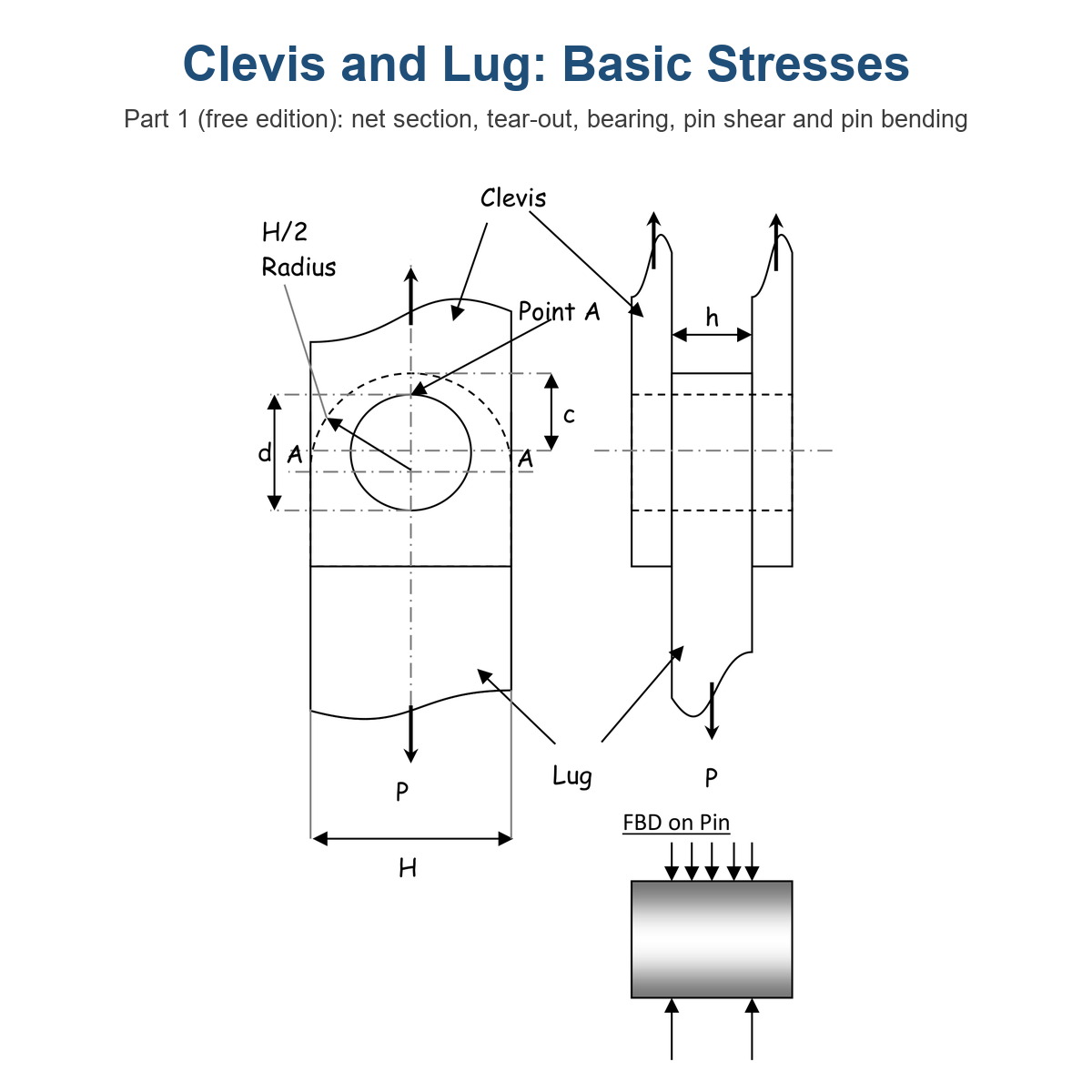
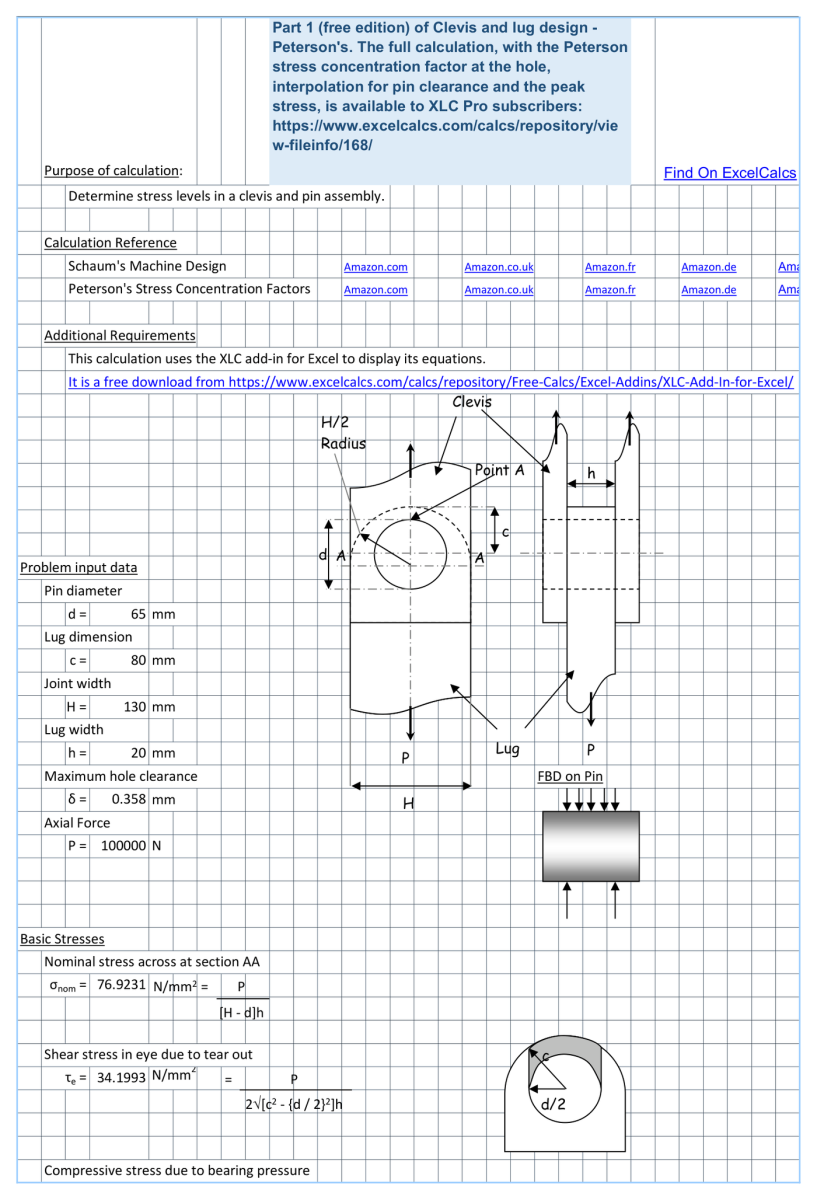
The first stage of Clevis and lug design - Peterson's. For a pin-loaded lug in a clevis it calculates the five basic stresses that make the first check of the lug and the pin: the net-section stress across the hole, tear-out shear in the eye, bearing pressure, shear in the pin and bending in the pin. Each equation is shown beside its result, and a sketch of the clevis, lug and pin defines the dimensions.
Method
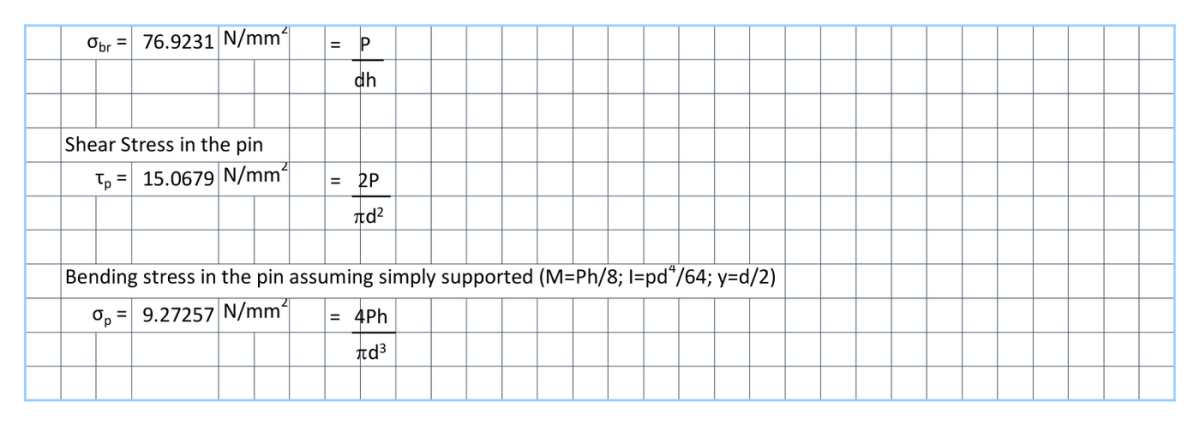
Classical nominal-stress formulas (Schaum's Machine Design): net-section stress σnom = P ÷ ((H − d)h); tear-out shear τe = P ÷ (2h√(c² − (d/2)²)); bearing σbr = P ÷ (dh); pin shear in double shear τp = 2P ÷ (πd²); and pin bending with the pin taken as simply supported, M = Ph/8, giving σp = 4Ph ÷ (πd³).
Inputs
- Pin diameter d (mm)
- Lug dimension c, from the hole centre to the end of the lug (mm)
- Joint width H, and lug width h (the lug thickness in the side view) (mm)
- Maximum hole clearance δ (mm; used by the full version)
- Axial force P (N)
Outputs
- Nominal stress across the net section at the hole
- Shear stress in the eye due to tear-out
- Compressive bearing stress between pin and lug
- Shear stress in the pin
- Bending stress in the pin
The example is a 65 mm pin in a 130 mm wide, 20 mm thick lug under 100 kN: the net-section stress is 76.9 N/mm², tear-out shear 34.2 N/mm², bearing 76.9 N/mm², pin shear 15.1 N/mm² and pin bending 9.3 N/mm². SI units.
This is Part 1 of Clevis and lug design - Peterson's
The nominal stress is not the whole story: at the edge of the hole the peak stress is the net-section stress times a stress concentration factor Kt, typically about 2 to 6. The full version adds Kt at the hole from lookup tables based on Peterson's Stress Concentration Factors, for 0.2% and 100% pin clearance, the interpolation for your actual clearance, the peak stress, and charts with your design point. It is available to XLC Pro subscribers: https://www.excelcalcs.com/calcs/repository/view-fileinfo/168/
Please note
- The equations are displayed by the free XLC add-in for Excel: https://www.excelcalcs.com/calcs/repository/Free-Calcs/Excel-Addins/XLC-Add-In-for-Excel/. The workbook opens and shows its results without it, but the add-in is needed to recalculate when you change an input.
- Part 1 does not need the XlXtrFun add-in; the full version uses it for spline interpolation.
- These are nominal stresses only. Compare them with allowable stresses for your material and design code; the stress concentration at the hole is not included.
Calculation Preview
 (0/0)
Full download access to any calculation is available to users with a paid or awarded subscription (XLC Pro).
Subscriptions are free to contributors to the site, alternatively they can be purchased.
Click here for information on subscriptions.