
Doppler Effect
 (3/1)
Description
Doppler Effect for a Moving Sound Source
Calculates the frequency and wavelength heard by a stationary listener when a sound source moves towards or away from them, showing how the pitch rises as the source approaches and falls as it recedes.
Method
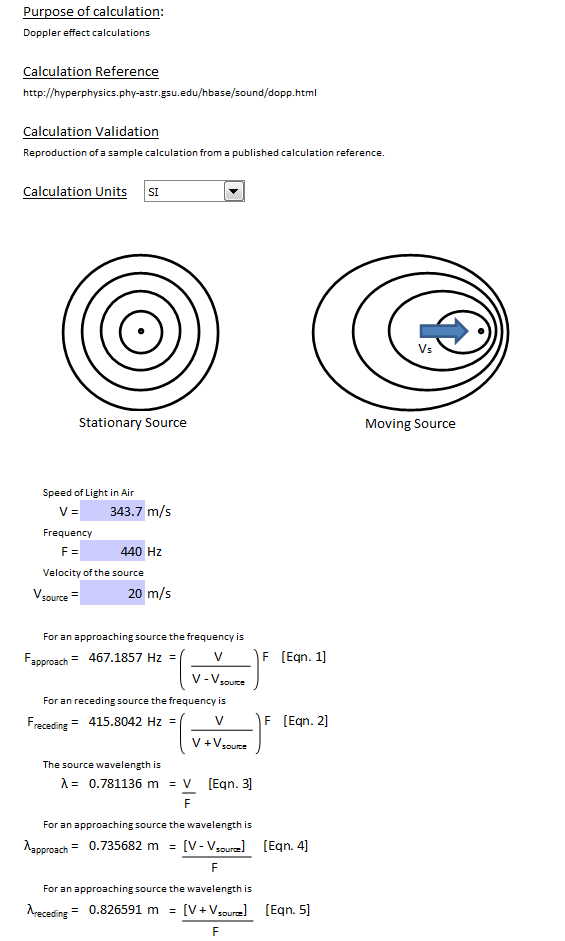
The classical Doppler equations for a moving source and a stationary observer, as given by HyperPhysics (Georgia State University), which the sheet cites: f′ = f · v / (v ∓ vs) and λ′ = (v ∓ vs) / f, with the upper sign for an approaching source. A sketch compares the wavefronts of a stationary and a moving source.
Inputs
- Speed of sound in air v
- Source frequency f
- Speed of the source vs
Outputs
- Frequency heard from an approaching source and from a receding source
- Wavelength from a stationary source, and from an approaching and a receding source
The example is a 440 Hz source moving at 20 m/s with sound at 343.7 m/s: 467.2 Hz as it approaches and 415.8 Hz as it recedes, with wavelengths of 0.736 m and 0.827 m against 0.781 m when still. A drop-down selects the unit labels (SI in m or mm, or US units in ft or in); enter the inputs in the system chosen.
Please note
- The listener is stationary and the source moves directly towards or away from them; a moving observer, wind and off-line motion are not covered. The source must be slower than sound.
- Two labels are wrong on both sheets: the input in row 25 reads “Speed of Light in Air” but is the speed of sound, and row 44 reads “approaching” but gives the receding wavelength. The calculations themselves are correct.
- No macros. The workbook has two sheets: a plain Excel version with the equations shown as pictures, and an XLC version whose equations update live and need the free XLC add-in.
Calculation Preview
 (3/1)
Full download access to any calculation is available to users with a paid or awarded subscription (XLC Pro).
Subscriptions are free to contributors to the site, alternatively they can be purchased.
Click here for information on subscriptions.