
Free Fall Calculation
 (4/10)

Description
Free Fall with and without Air Resistance
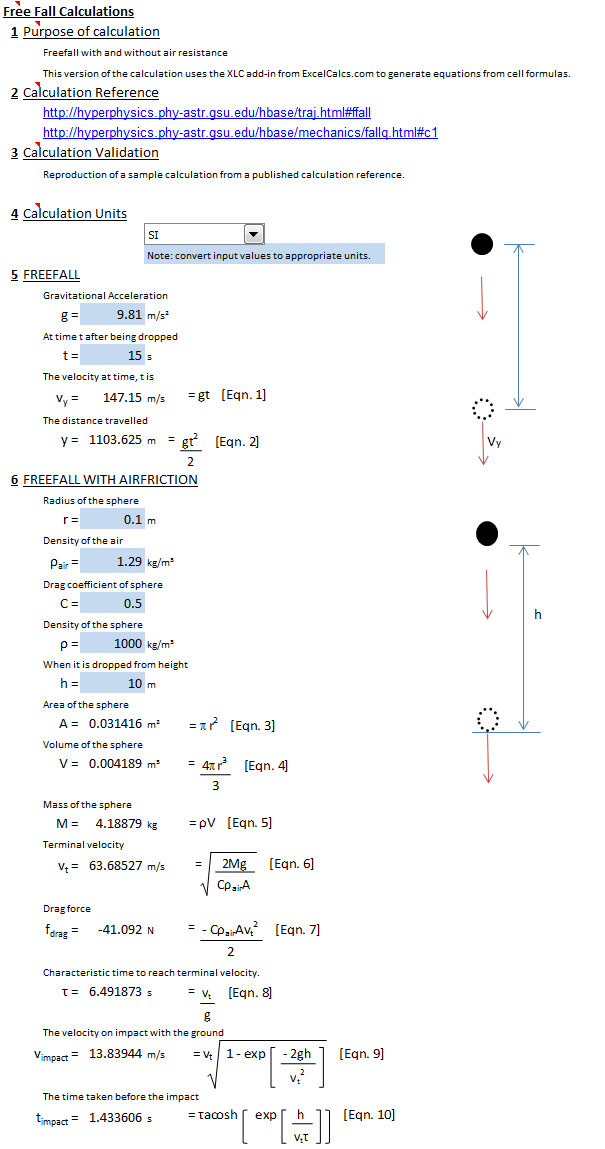
Calculates the motion of a falling body two ways: in a vacuum, the velocity and distance fallen after a given time; and with air resistance, the terminal velocity, drag force, characteristic time, and the impact velocity and fall time of a solid sphere dropped from a given height.
Method
- Without air resistance: v = gt and y = gt²/2.
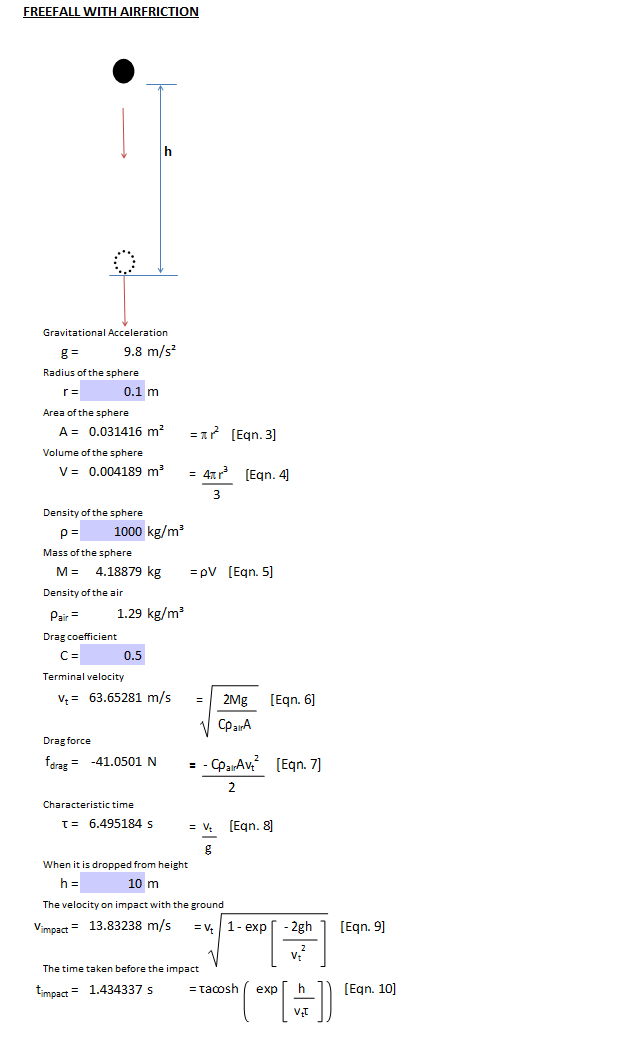
- With air resistance: quadratic drag, F = ½CρairAv², on a sphere of mass M = ρV. Terminal velocity vt = √(2Mg / CρairA), characteristic time τ = vt/g, impact velocity v = vt√(1 − e−2gh/vt²) and fall time t = τ cosh−1(eh/vtτ), the closed-form solutions given by HyperPhysics (Georgia State University), which the sheet cites.
Inputs
- Gravitational acceleration g and time t (free fall in a vacuum)
- Sphere radius r and density ρ, air density ρair, drag coefficient C and drop height h
Outputs
- Velocity and distance fallen at time t, without air resistance
- Frontal area, volume and mass of the sphere
- Terminal velocity, drag force at terminal velocity (equal to the weight) and characteristic time
- Velocity on impact and time to impact, with air resistance
The example drops a 0.1 m radius sphere of density 1,000 kg/m³ from 10 m (C = 0.5, ρair = 1.29 kg/m³): terminal velocity 63.7 m/s, impact at 13.84 m/s after 1.434 s. A drop-down selects the unit labels (SI in m or mm, or US units in ft or in); enter the inputs in the system chosen.
Please note
- The two parts are independent examples: the vacuum part uses the time t, the air-resistance part the height h.
- The drag coefficient is taken as constant and buoyancy is ignored, which is reasonable for a dense body in air.
- No macros. The workbook has two sheets: a plain Excel version with the equations shown as pictures, and an XLC version whose equations update live and need the free XLC add-in.
Calculation Preview
 (4/10)
Full download access to any calculation is available to users with a paid or awarded subscription (XLC Pro).
Subscriptions are free to contributors to the site, alternatively they can be purchased.
Click here for information on subscriptions.
Comments: 2
×

stuart1
14 years ago
The calculation is updated to use the current version of the ExcelCalcs calculation template.
14 years ago
This download has been rename from trajectories to the more accurate description Free Fall. An additional worksheet has been add with the calculation in native Excel for as well as an XLC version.