
UDL on simply supported beam.xls
 (4/30)

Description
UDL on simply supported beam
Calculates the reactions, end slopes, shear force, bending moment, slope and deflection of a simply supported beam carrying a distributed load, at any point along its length, and plots all four along the span. The load can be a full-length UDL, a partial UDL starting part way along the beam, or a load that varies linearly (triangular or trapezoidal) from its start to the right-hand support.
Method
Euler-Bernoulli beam theory using the closed-form expressions of Roark's Formulas for Stress and Strain, 7th edition, Table 8.1 case 2e (partial distributed load, both ends simply supported). Step (Macaulay) functions handle the start of the load, and every formula is shown on the sheet as a written equation.
Inputs
- Span l, elastic modulus E and second moment of area I
- Load intensity wa where the load starts and wl at the right-hand support (equal for a UDL)
- Distance a from the left support to the start of the load (0 for a full-length load)
- Position x at which results are wanted
Outputs
- Reactions RA and RB, and end slopes θA and θB
- Shear V, bending moment M, slope θ and deflection y at position x
- Charts of shear, bending moment, slope and deflection at tenths of the span, which update with the inputs
The example is a 5 m beam (E = 210,000 MPa, I = 1.9 × 108 mm4) with a full-length UDL of 1 N/mm: reactions 2,500 N, maximum moment 3.125 kNm and midspan deflection 0.204 mm. A drop-down selects the unit labels (SI in m or mm, or US units in ft or in); enter the inputs in the system chosen. A small unit-conversion utility is included.
Checked and corrected
ExcelCalcs recomputed the reactions, end slopes, shear, moment, slope and deflection independently, by numerical integration of the bending moment, for the example, for the same beam entered in metres, and for a partial trapezoidal load. Everything agreed except the deflection. ExcelCalcs made two corrections to the uploaded file (18 November 2026, version 1.2):
- Deflection (cell E66 and the chart row AF66:AP66, on both sheets, and the
written equation beside E66). The formula added the end slope θA once too
often (y = yA + θA + θAx + …), so every
deflection was out by θA in the length unit chosen and the deflection at the
supports was not zero. It now follows Roark: y = yA + θAx + …
- Example in mm: midspan deflection 0.2041 mm before, 0.2040 mm after (0.06%); deflection at the supports 0.00013 mm before, 0 after.
- The same beam in metres: midspan deflection 0.000334 m before, 0.000204 m after. The old figure was 64% too large, and over 200% too large near the supports.
- Spelling: “souce” corrected to “source” in the validation note.
Unused workbook names left over from an earlier template were also removed; they did not affect any result. With x = l, as in the example, the deflection cell shows a rounding residue of about 10−16 mm, which is zero.
Please note
- No macros. The workbook has two sheets: a plain Excel version with the equations shown as pictures, and an XLC version whose equations update live and need the free XLC add-in.
- The load always runs to the right-hand support; a load stopping short of it is not covered.
- Downward loads are positive; downward deflection is reported as negative.
- The charts plot eleven points (each tenth of the span), although their heading says ten.
Calculation Preview
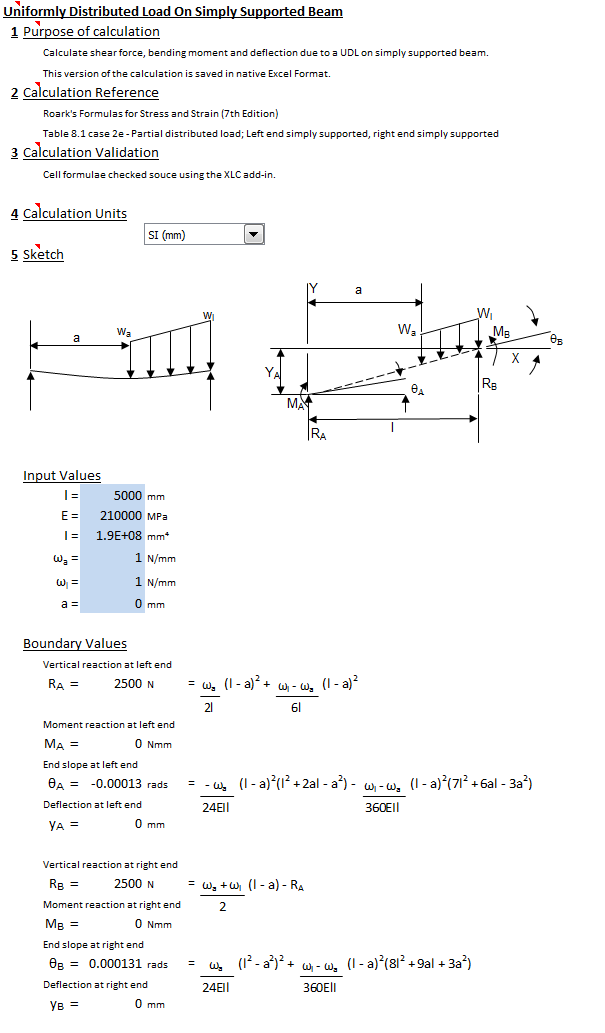
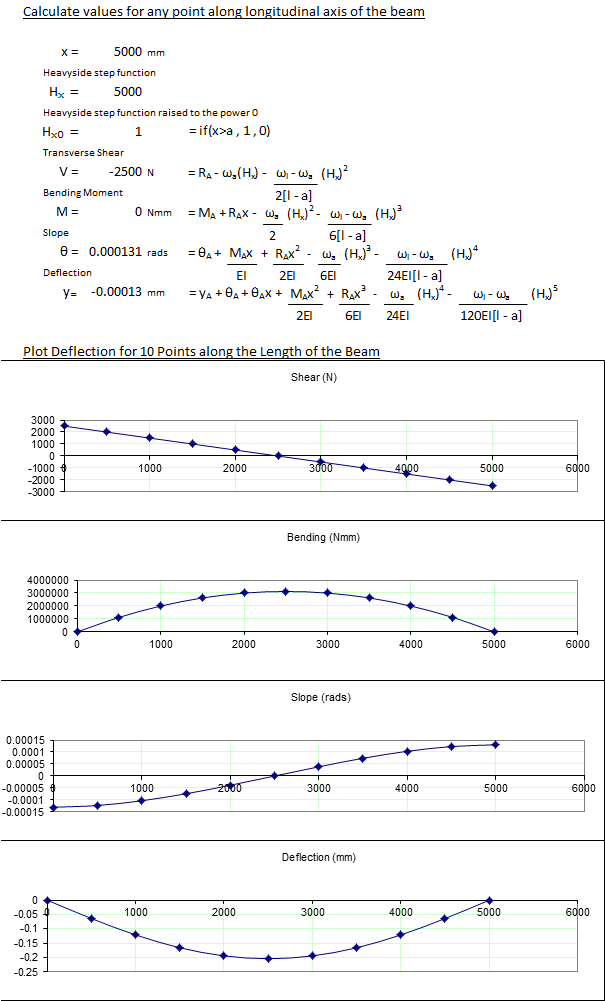 (4/30)
Full download access to any calculation is available to users with a paid or awarded subscription (XLC Pro).
Subscriptions are free to contributors to the site, alternatively they can be purchased.
Click here for information on subscriptions.


**What we corrected**
- E66 and the chart row AF66:AP66, on both sheets, and the written equation beside E66: the deflection added the end slope θA as an extra term (y = yA + θA + θA·x + ...). Roark gives y = yA + θA·x + ..., so we deleted the first θA. For your example in mm the midspan deflection goes from 0.2041 mm to 0.2040 mm, and the deflection at the supports is now 0 instead of 0.00013 mm. The error is in the length unit chosen, so it matters more in metres: the same beam entered in metres gave a midspan deflection 64% too large (0.000334 m instead of 0.000204 m).
- C9: "souce" now reads "source".
We checked every other result independently, by numerical integration of the bending moment, for your example and for a partial trapezoidal load, and the reactions, end slopes, shear, moment and slope all agreed with your sheet to five figures.
Thank you for a clear, well-referenced calculation; showing every Roark equation beside its cell made it quick to check. Our guidance for authors is in The Good Calculation Guide: [https://www.excelcalcs.com/calcs/good-calc-guide](https://www.excelcalcs.com/calcs/good-calc-guide).