
Bolt Tension and Shear in a Bracket Connection (Neutral Axis at h/7)
 (0/0)
Description
Bolt Tension and Shear in a Bracket Connection (Neutral Axis at h/7)
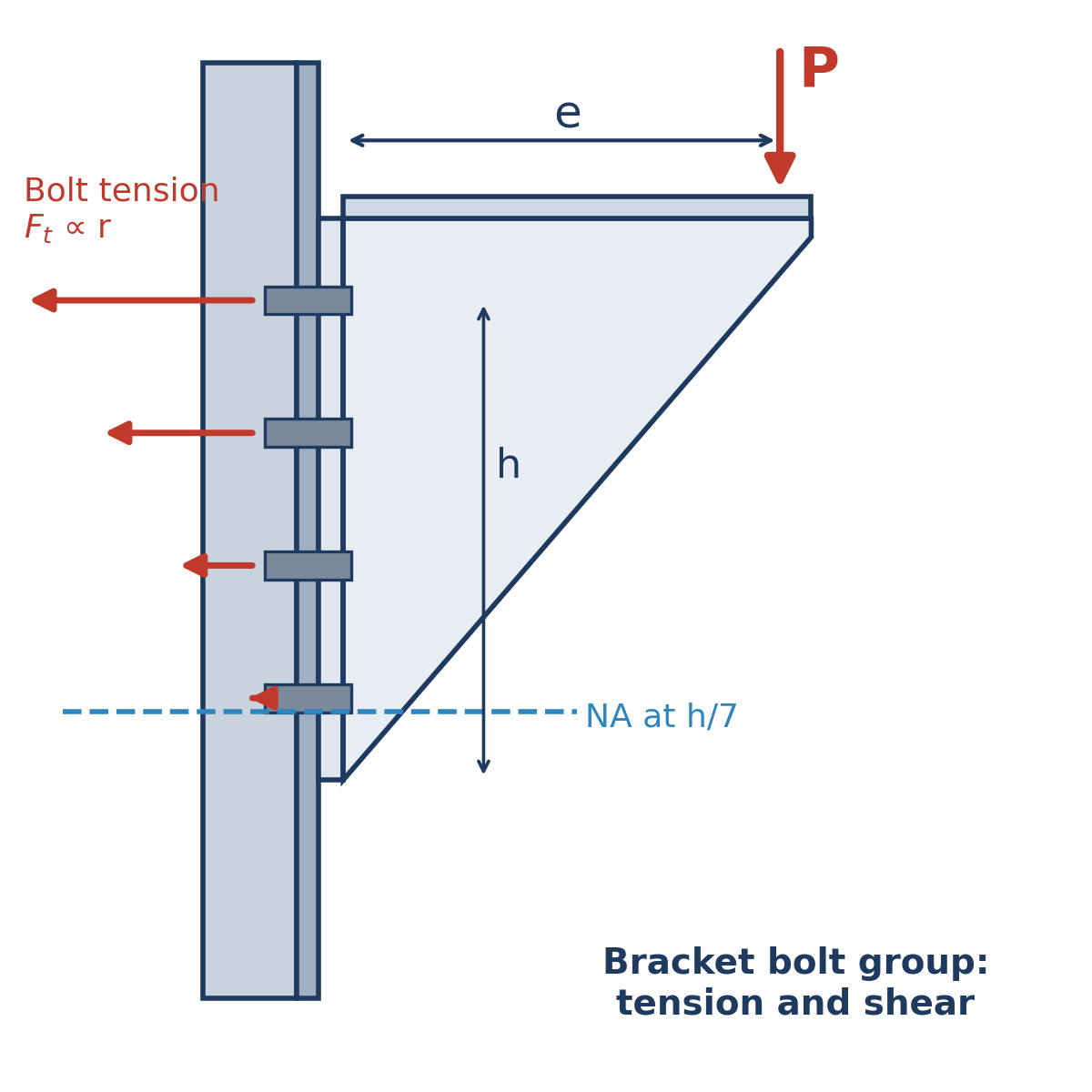
Calculates the forces in the bolts of a bracket plate bolted to the face of a column, where a vertical load P acts at an eccentricity e from the bolt line. The moment P·e tends to rotate the bracket about its lower edge, so the upper bolts go into tension while the bottom of the plate bears on the column.
The method is the standard elastic one for a bracket with bolts in tension and shear. The neutral axis is assumed to lie at h/7 above the bottom of the bracket, where h is the height of the top bolt row above the bottom edge. Each bolt row above the neutral axis is taken to carry a tension proportional to its lever arm r measured from the neutral axis, so the tension in the most highly stressed (top) row is
Ft = P · e · rn / (m · Σ rj2)
where m is the number of bolt columns and the sum covers the rows above the neutral axis. The bolt rows are equally spaced at y, with the same edge distance z at the top and bottom of the plate, so z = (D − (n − 1) · y) / 2 for a plate of overall depth D. The vertical load is shared equally by all n × m bolts as direct shear, Fs = P / (n · m).
Inputs
- Applied force P (kN) and its eccentricity e from the bolt line (mm)
- Number of bolt rows n (up to eight) and their centre-to-centre spacing y (mm)
- Overall depth of the bracket plate D (mm)
- Number of bolt columns m
Outputs
- Edge distance z, height of the top bolt row h and neutral axis position y1 = h/7
- Tension in each bolt of the top row, Ft (kN)
- Direct shear in each bolt, Fs (kN)
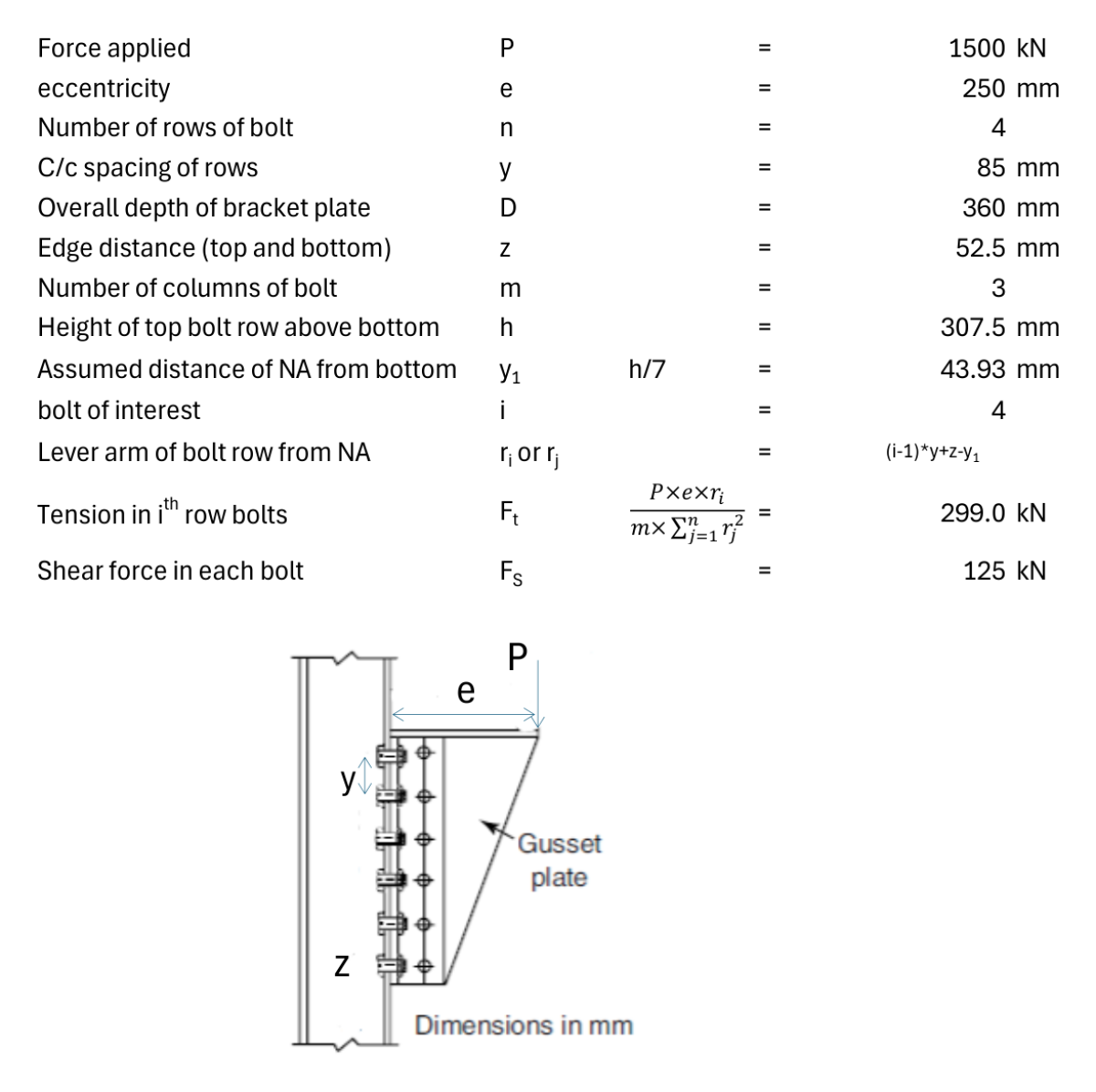
The example is a 1500 kN load at 250 mm on four rows of three bolts at 85 mm centres in a 360 mm deep plate: Ft = 299.0 kN and Fs = 125 kN per bolt. kN and mm units.
Checked and corrected
Both results were recomputed independently and agree with the sheet. ExcelCalcs made three corrections to the uploaded file (17 November 2026, version 1.1):
- Bracket depth is now an input. The 360 mm plate depth was typed inside the edge-distance formula and appeared nowhere on the sheet, so changing the number or spacing of rows silently produced an impossible geometry (five rows at 85 mm gave an edge distance of 10 mm, six rows a negative one). The depth D is now a labelled input in row 5 and the edge distance is calculated from it. The example results are unchanged (z = 52.5 mm, Ft = 299.0 kN); for five rows at 85 mm in a 445 mm plate the sheet now gives z = 52.5 mm and Ft = 199.6 kN.
- Labels now say what the cells hold. “Depth of bracket plate” is the height of the top bolt row above the bottom (307.5 mm, not the 360 mm plate) and is now labelled so; the neutral-axis expression reads h/7 rather than y/7, matching the formula.
- Spelling and wording of three labels corrected: “Edge distance”, “Lever arm of bolt row from NA” (not a radius of gyration) and “Tension in ith row bolts”.
Please note
- The neutral axis is taken at one-seventh of the height of the top bolt row. Some texts take h as the full depth of the bracket plate; with D/7 the example tension rises to about 313 kN (5% higher). Check which your reference intends.
- The whole moment P·e is given to the bolts in tension, without deducting the share carried by bearing below the neutral axis. This is conservative.
- This is a force calculator only: bolt capacity, the combined shear-and-tension check and prying are left to the user. It handles up to eight rows (a message appears beyond that) and assumes equal edge distances top and bottom; check that the edge distance shown is positive and practical.
Calculation Preview
 (0/0)
Full download access to any calculation is available to users with a paid or awarded subscription (XLC Pro).
Subscriptions are free to contributors to the site, alternatively they can be purchased.
Click here for information on subscriptions.

**What needs to change**
- Make the bracket depth (360 mm) an input cell, so the geometry stays right when the rows or spacing change.
- Rename "Depth of bracket plate" to what the cell actually holds, or use the full plate depth for the h/7 neutral axis, and say which the method intends.
- Add a title and a sentence of purpose, and cite the textbook or code the method and the h/7 assumption come from.
**Suggestions that would make it even better**
- If the figure is from a book or standard, replace it with your own sketch (it also shows six rows by two columns, not the four by three in your example).
- Add a short validation note: a worked example from the reference with the same answer.
- Consider adding the bolt capacity and the combined shear-and-tension check.
We offer guidance for authors on The Good Calculation Guide: [https://www.excelcalcs.com/calcs/good-calc-guide](https://www.excelcalcs.com/calcs/good-calc-guide). If you upload a corrected version we'll be glad to review it again: a corrected calculation earns a 3-month XLC Pro subscription, and one that follows the guide in full earns 12 months. We hope that this does not discourage you and thanks for your interest in the site.
**What we corrected**
- The 360 mm bracket depth was typed inside the edge-distance formula in F5. It is now a labelled input, "Overall depth of bracket plate D", in row 5, and the edge distance is calculated from it, so the geometry stays right when the number or spacing of rows changes. Your example results are unchanged.
- "Depth of bracket plate" now reads "Height of top bolt row above bottom", which is what the cell holds (307.5 mm), and the neutral-axis expression reads h/7 instead of y/7.
- Three labels were respelt: "Edge distance", "Lever arm of bolt row from NA" and "Tension in ith row bolts".
An independent check agreed with your sheet: Σr² = 110,187 mm² for the four rows gives Ft = 1500 × 250 × 263.57 / (3 × 110,187) = 299.0 kN, and the shear is 1500 / 12 = 125 kN per bolt. Points for a future version: cite the textbook or code the h/7 method comes from and say whether h is the full plate depth or the height of the top bolt row (with the full 360 mm depth the tension would be about 313 kN), and add the bolt capacity and combined shear-and-tension check to make it a complete design aid.
Thank you for a compact, clear calculation; the equation shown beside the result made it easy to check. I have awarded you a 3-month XLC Pro subscription by way of thanks. Our guidance for authors is in The Good Calculation Guide: [https://www.excelcalcs.com/calcs/good-calc-guide](https://www.excelcalcs.com/calcs/good-calc-guide).