
Belt Winder Drum Torque and Motor Power during Winding
 (0/0)

Description
Belt Winder Drum Torque and Motor Power during Winding
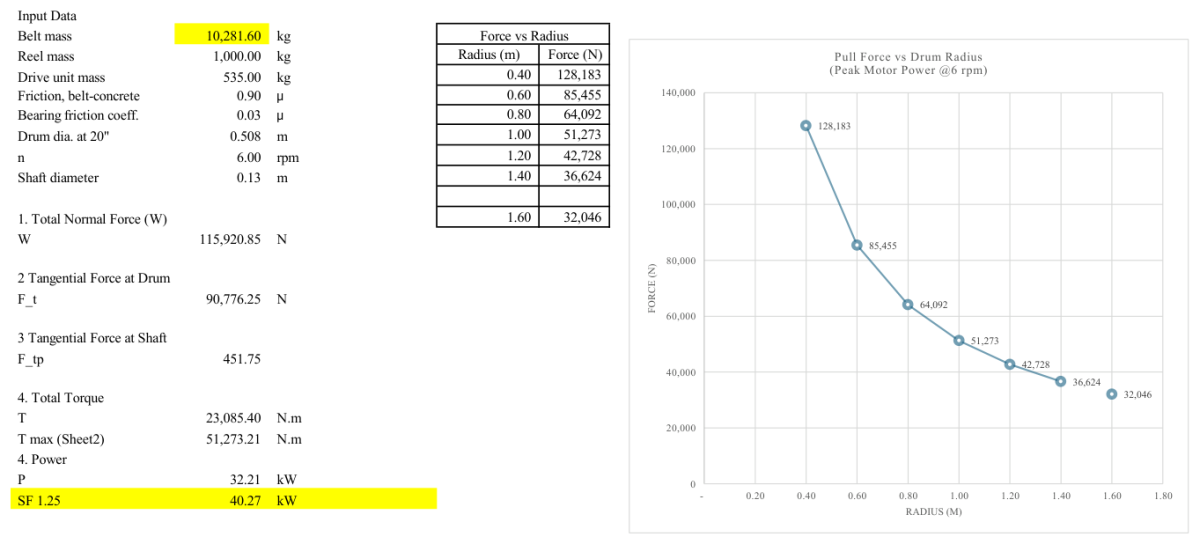
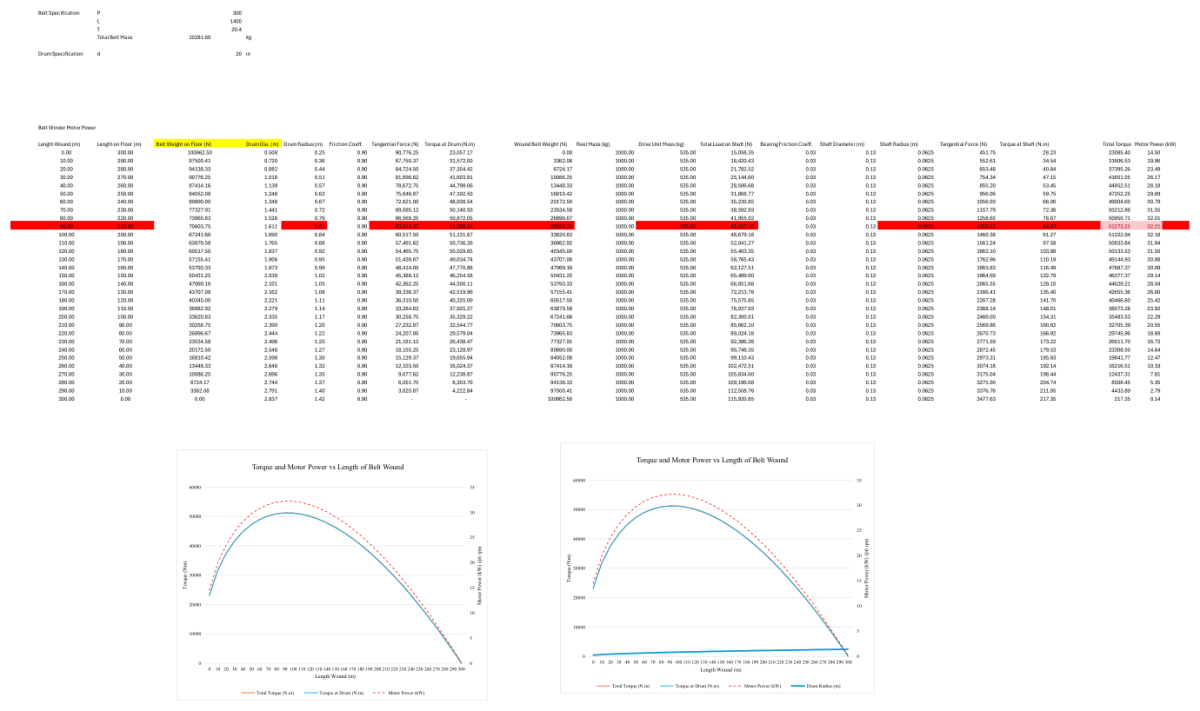
Sizes the drive motor of a belt winder that pulls a used conveyor belt off a concrete floor and winds it onto a drum. Sheet1 works through the forces and torque at the bare drum step by step. Sheet2 tabulates the winding every 10 m: the length still on the floor, the friction drag, the growing roll diameter (from the wound belt area), the drum torque, the bearing-friction torque on the shaft and the motor power, with charts of torque and power against the length wound. The motor power on Sheet1 is taken from the peak torque in that table. The sheet was translated into English by ExcelCalcs in version 1.2 (17 November 2026).
Inputs
- Belt length, width, thickness and total mass (kg)
- Belt-to-concrete friction coefficient (0.9 in the example)
- Reel and drive unit masses (kg) and bearing friction coefficient
- Drum diameter (in), shaft diameter (m) and drum speed (rpm)
Outputs
- Drag force and torque at the bare drum
- Roll diameter, drum torque, bearing torque and total torque at every 10 m wound
- Peak total torque during winding and the motor power from it, P = T·n/9550, with a 1.25 service factor
- Pull force available against drum radius at the peak power
The example winds a 300 m, 1,400 mm wide, 20.4 mm thick belt of 10,282 kg onto a 20 in drum at 6 rpm. Torque peaks at 51,273 N·m after about 90 m has been wound, giving 32.2 kW, or 40.3 kW with the 1.25 factor. SI units.
Checked and corrected
Every result was recomputed independently. ExcelCalcs made four corrections to the uploaded file (17 November 2026, version 1.1):
- The motor power is now sized from the peak torque. Sheet1 used the torque at the bare drum (23,085 N·m), but the drag times the growing roll radius peaks part-way through winding. A new cell gives the peak total torque from the Sheet2 table and the power uses it: 14.50 kW becomes 32.21 kW, and 18.13 kW becomes 40.27 kW with the 1.25 factor.
- The bearing friction load is now kept in newtons. The wound belt weight (already in N) was added to the reel and drive masses in kg and the sum multiplied by 9.81 again. At full roll the bearing torque is now 217 N·m, not 1,883 N·m; the peak total torque falls from 51,778 to 51,273 N·m and moves from 100 m to 90 m wound.
- Typed values linked to the inputs: the reel mass (1,000 kg) in every Sheet2 row and the 6 rpm in every power formula now come from the input cells on Sheet1.
- Labels: the force–radius chart title no longer says “37 kW Motor” (no cell gave 37 kW), and the red highlight on the peak row of Sheet2 now marks the 90 m row.
Please note
- The whole belt still on the floor is assumed to slide with a friction coefficient of 0.9; acceleration, belt bending and drive efficiency are not included. Allow for them when choosing the motor.
- The picture on Sheet1 (torque rising from about 29,000 to 33,000 N·m) does not match the sheet's own figures, and its labels remain in Indonesian; use the live charts on Sheet2.
- The drum diameter is entered twice (Sheet1 B7 in metres, Sheet2 D7 in inches); keep them in step.
Calculation Preview
 (0/0)
Full download access to any calculation is available to users with a paid or awarded subscription (XLC Pro).
Subscriptions are free to contributors to the site, alternatively they can be purchased.
Click here for information on subscriptions.

**What we corrected**
- Sheet1 now sizes the motor from the peak torque during winding. A new cell B22 takes the maximum total torque from your Sheet2 table, and the power in B24 uses it: 32.21 kW (it was 14.50 kW from the bare drum), or 40.27 kW with the 1.25 factor (it was 18.13 kW).
- The bearing friction on Sheet2 now keeps the load in newtons: column N adds the wound belt weight (already in N) to the reel and drive masses times 9.81, and column R no longer multiplies by 9.81 again. At full roll the bearing torque is 217 N·m (it was 1,883 N·m).
- The reel mass in L20:L49 and the 6 rpm in the power column V now come from the input cells on Sheet1.
- The force–radius chart title no longer says "37 kW Motor", and the red highlight on Sheet2 now marks the new peak row.
An independent check agreed with your bare-drum torque of 23,085 N·m and with the roll diameter of 2.038 m after 150 m; with the bearing term corrected the total torque peaks at 51,273 N·m after 90 m wound, which is 32.2 kW at 6 rpm. Points left for a future version: the picture on Sheet1 does not match the sheet's figures and is best replaced by the live charts; state the assumptions (whole remaining belt sliding at μ = 0.9, no acceleration, bending or drive efficiency); and add a purpose line and a sketch of the winder.
Thank you for a clear calculation; tabulating the whole winding was the right approach and made the peak easy to find. I have awarded you a 3-month XLC Pro subscription by way of thanks. Our guidance for authors is in The Good Calculation Guide: [https://www.excelcalcs.com/calcs/good-calc-guide](https://www.excelcalcs.com/calcs/good-calc-guide).
An independent check agreed with your bare-drum torque of 23,085 N·m and power of 14.5 kW on Sheet1. But as the roll grows the drag torque rises before it falls: your Sheet2 table peaks at 51,778 N·m, which is 32.5 kW at 6 rpm, at about 100 m wound. A motor chosen from Sheet1 (18.1 kW with the 1.25 factor) would be too small.
**What needs to change**
- Size the motor from the peak torque during winding, not the bare-drum value.
- Correct the bearing friction column: the wound belt weight is already in newtons but is added to the reel and drive masses in kg and multiplied by 9.81 again (at full roll this gives 1,883 N·m instead of 217 N·m).
- Replace typed values (reel mass 1,000 kg, 6 rpm) in the formulas with references to the input cells.
- Remove the picture on Sheet1, whose figures do not match the sheet, and correct the "37 kW Motor" chart title.
- Add a line stating the purpose and assumptions, units for the belt dimensions, and a sketch of the winder.
If you upload a corrected version we'll be glad to review it again: a corrected calculation earns a 3-month XLC Pro subscription, and one that follows the guide in full earns 12 months.
We offer guidance for authors on The Good Calculation Guide: [https://www.excelcalcs.com/calcs/good-calc-guide](https://www.excelcalcs.com/calcs/good-calc-guide). We hope that this does not discourage you from trying again and thanks for your interest in the site.