
Spring Calculator
 (0/0)
Description
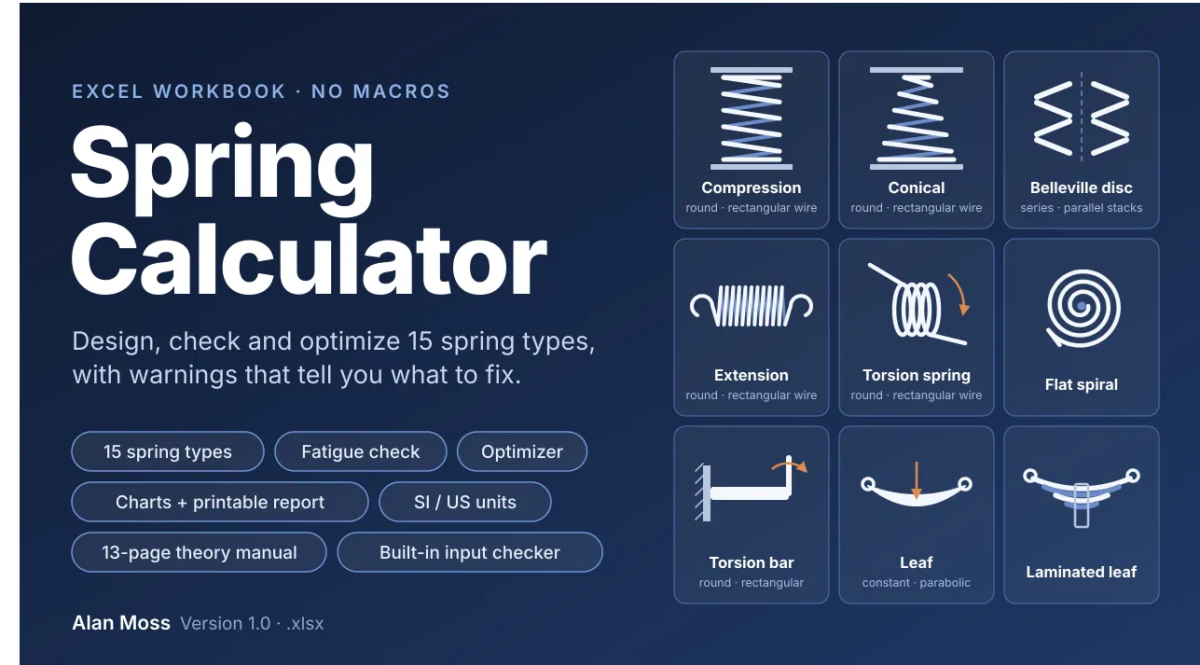
Spring Calculator is an Excel workbook that designs and checks fifteen types of spring with ordinary worksheet formulas and no macros. It covers helical compression springs in round and rectangular wire, conical springs in both wire forms, Belleville disc stacks, extension springs in round and rectangular wire, flat spiral springs, torsion springs in round and rectangular wire, round and rectangular torsion bars, and constant-thickness, parabolic and laminated leaf springs. Every section takes loads, geometry and a material and returns rate, lengths, stresses, safety factors, permissible load, buckling, surge frequency, mass and stored energy, in SI or US units, with the moduli corrected for working temperature.
What sets it apart is the Check column. Inputs that make no physical sense are caught before any result is shown, and every warning says what to change, with a number: the free length that clears coil bind, the wire size that reduces stress, the largest arbor that will not bind. Round-wire coil springs use the curvature-corrected Bergsträsser factor, permissible loads take the lowest governing limit (stress, coil bind or hooks), and a fatigue section checks any spring against a required life and safety factor.
An Optimizer sheet searches the standard wire sizes for the lightest compression, extension or torsion spring that meets the loads, diameter and length limits and, if you wish, the fatigue requirement, and returns a complete set of values to copy back. A Charts sheet draws load, stress and fatigue diagrams for the chosen spring, plus reference curves for stress factors, wire strength and buckling. A Report sheet gathers the inputs, results, checks and charts into a printable design report.
A thirteen-page theory manual is built into the workbook, with every equation and every variable defined and the textbook sources cited, and each parameter has a plain-language hover note. Formulas are locked against accidental edits; the password is given on the About sheet. The results are calculated when the file is opened, so click Enable Editing if Excel opens it in Protected View. Results are screening estimates and should be confirmed for critical applications.
Calculation Preview
(0/0)
Full download access to any calculation is available to users with a paid or awarded subscription (XLC Pro).
Subscriptions are free to contributors to the site, alternatively they can be purchased.
Click here for information on subscriptions.
I also reviewed the calculation against our Good Calculation Guide: https://www.excelcalcs.com/calcs/good-calc-guide
**What works well**
- Fifteen spring types and a fatigue check in one workbook, each section headed, numbered and running down a single column.
- The Check column, which says what to change and by how much, and the Optimizer that searches standard wire sizes.
- The built-in theory manual, with every equation, its source and a table of independent checks.
- A true SI/US switch: re-entering the same spring in lbf and inches gave identical results.
**Suggestions that would make it even better**
- Save the workbook after Excel has calculated it. At present the results are not stored in the file, so a downloaded copy shows blanks until Enable Editing is clicked.
- The About sheet (B20) still says coil stress uses Ks = 1 + 0.5/C; the sheet and manual use the Bergsträsser factor for as-wound springs.
- The bending endurance fractions on the Materials sheet (0.50 and 0.53) are Shigley's 10^6-cycle values, but section 17 uses them at 10^7 cycles. Please also give the source for the 0.8 Sut reference in the fatigue line (Shigley uses 0.67 Sut in torsion).
- A small sketch of each spring with its dimensions marked, and the XLC add-in to show the equations in standard notation.