
Residual Unbalance Force on a Rotating Shaft from ISO 1940 Balance Grade
 (0/0)
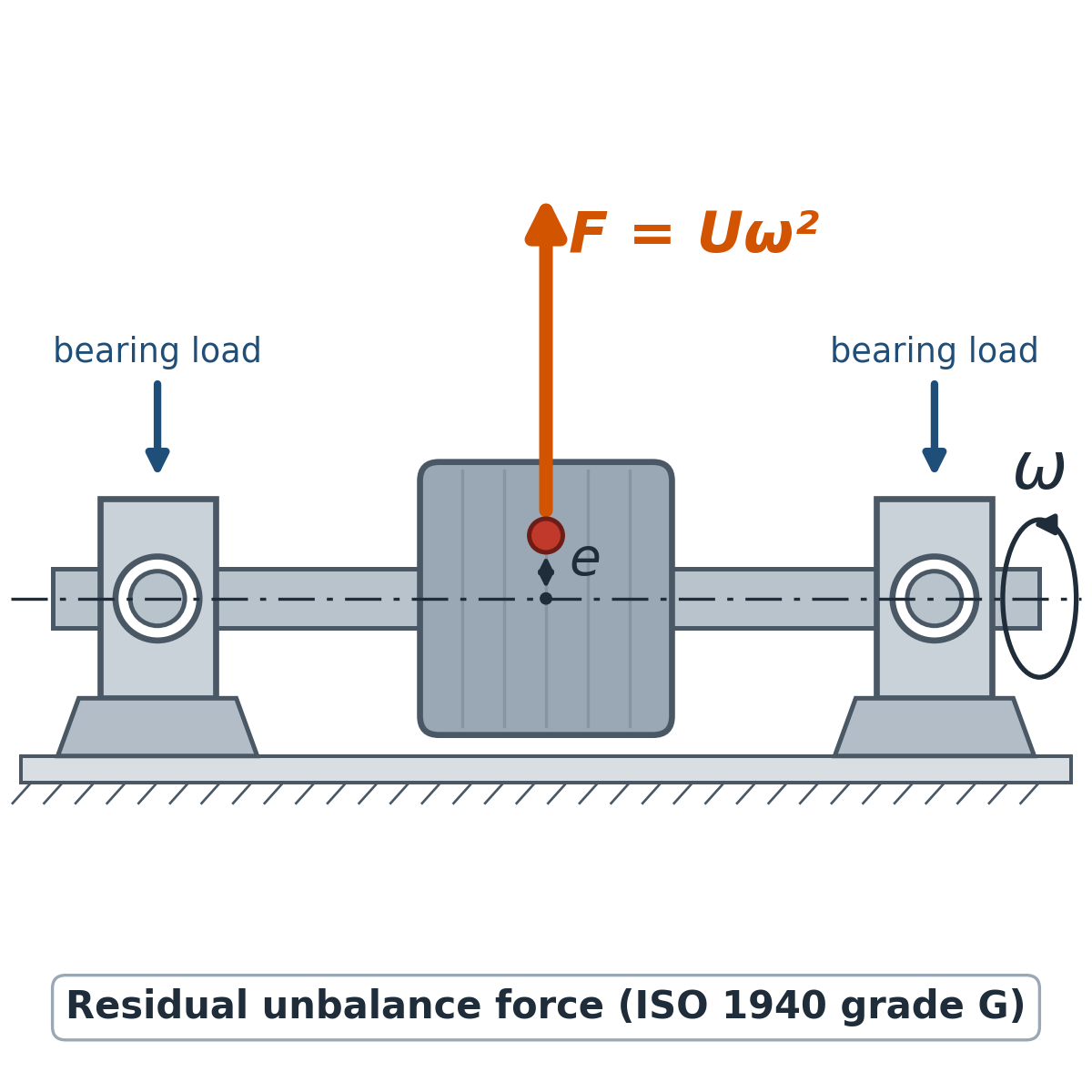
Description
Residual Unbalance Force on a Rotating Shaft from the ISO 1940 Balance Grade
This workbook works out the rotating force produced by the permissible residual unbalance of a rigid rotor balanced to an ISO 1940-1 quality grade. That force acts on the bearings in addition to the rotor's weight, so it is a useful allowance when sizing bearings and supports.
Method
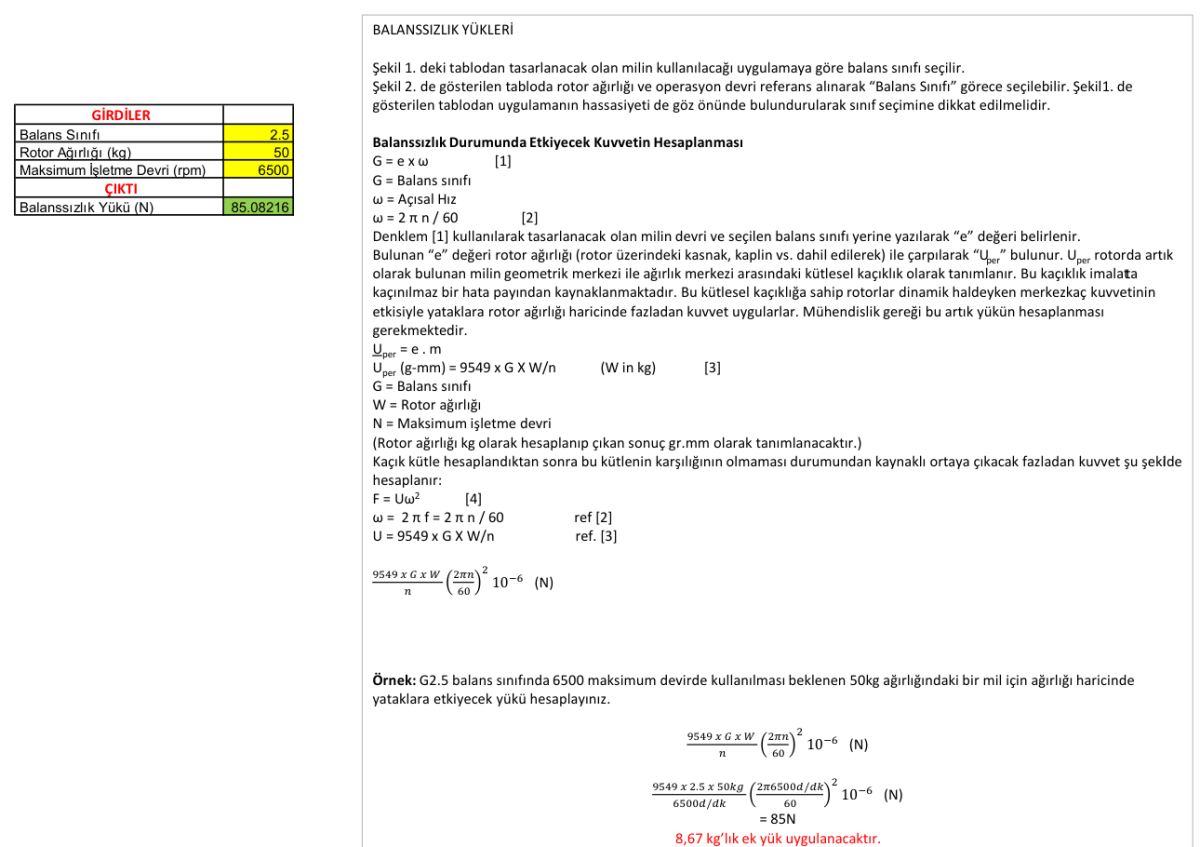
ISO 1940-1 defines the balance quality grade G as the product e·ω (mm/s), where e is the permissible offset of the rotor's centre of mass from its axis. From G, the rotor mass m and the maximum service speed n:
- ω = 2πn / 60
- Uper = 9549 · G · m / n (g·mm), the permissible residual unbalance
- F = Uper · ω², the centrifugal force in newtons
Inputs
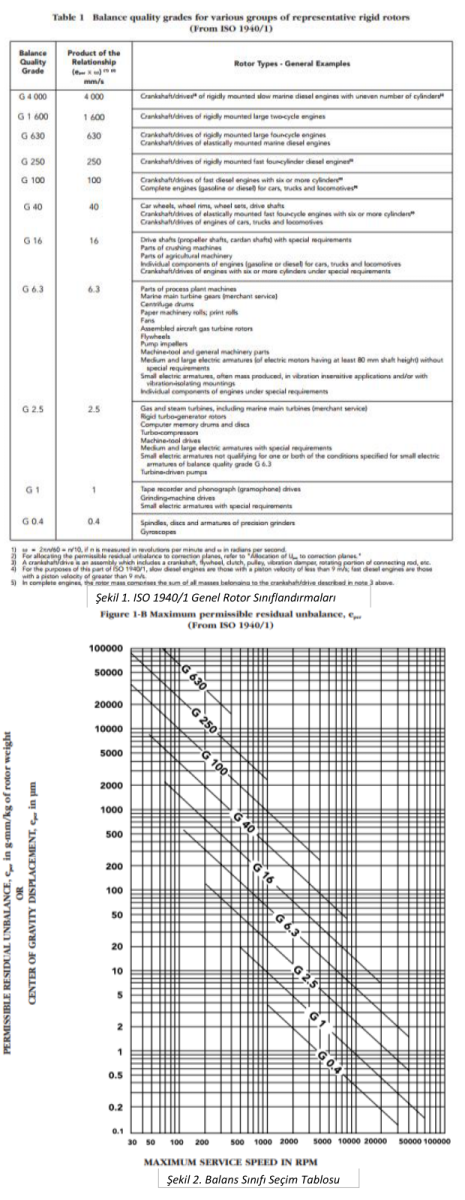
- Balance quality grade G (mm/s), for example G 2.5 for turbines and machine-tool drives
- Rotor mass (kg), including pulleys, couplings and anything else fitted to it
- Maximum service speed (rpm)
Outputs
- The residual unbalance force on the rotor (N)
Checked
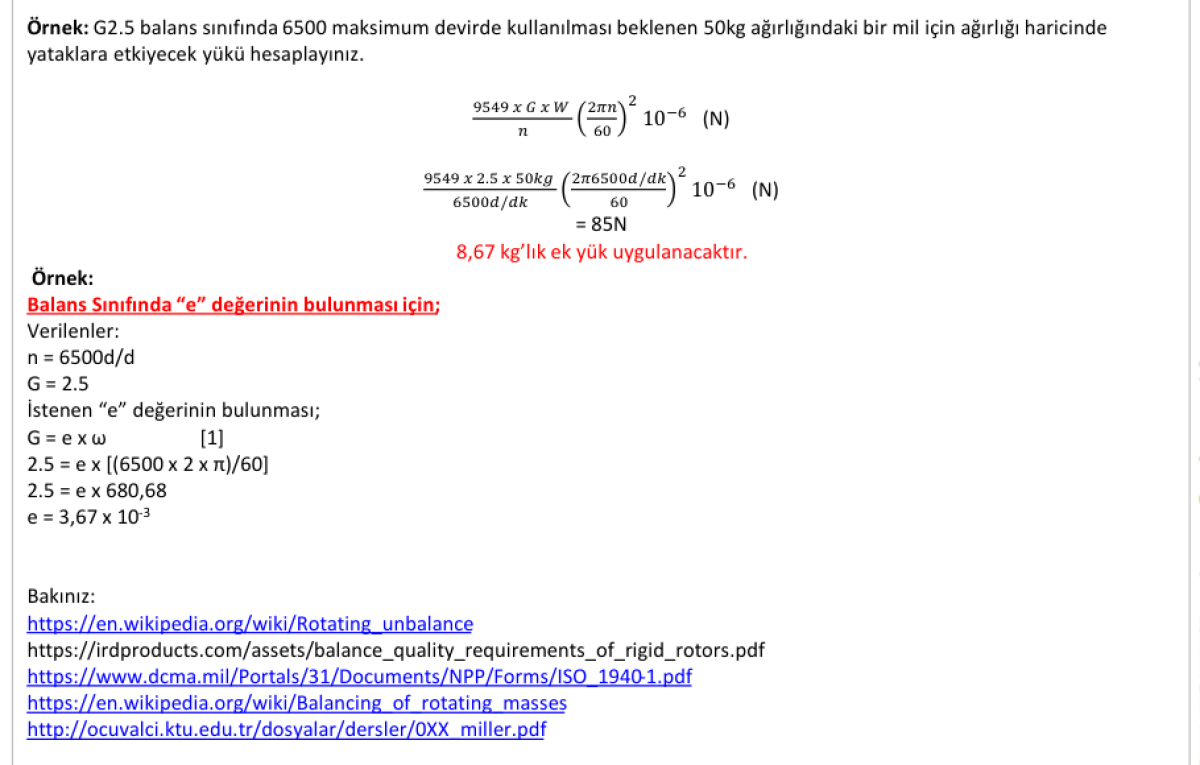
The worked example (grade G 2.5, a 50 kg rotor at 6,500 rpm) was recomputed independently: ω = 680.68 rad/s, e = 3.67 µm, Uper = 183.6 g·mm and F = 85.1 N, the same as the sheet (about 8.7 kgf).
Please note
- The force is the total for the rotor; each bearing carries a share that depends on where the unbalance lies relative to the bearings.
- It assumes the rotor is exactly at its permissible residual unbalance; unbalance in service can be greater.
- ISO 1940-1 has been replaced by ISO 21940-11; the grades and the relationship are unchanged.
- The worksheet is in Turkish. The balance grade table and chart from ISO 1940 are included for reference.
Calculation Preview
 (0/0)
Full download access to any calculation is available to users with a paid or awarded subscription (XLC Pro).
Subscriptions are free to contributors to the site, alternatively they can be purchased.
Click here for information on subscriptions.
Comments: 1
×
I also reviewed the calculation against our Good Calculation Guide: [https://www.excelcalcs.com/calcs/good-calc-guide](https://www.excelcalcs.com/calcs/good-calc-guide)
**What works well**
- A compact calculation with the method, the equations and a worked example set out properly.
- Only three inputs, so it is quick to use.
- The sources are listed on the sheet.
**Suggestions that would make it even better**
- Say that the result is the total rotating force, and show how it is shared between the two bearings.
- Show e (µm) and Uper (g·mm) as intermediate results.
- Offer the balance grade as a drop-down list of the standard grades.
- Refer to ISO 21940-11, which replaced ISO 1940-1.
- Add a simple sketch of the rotor and its bearings.
If you send in an updated version that covers these points, it would qualify for our 12-month XLC Pro award.