
Column Buckling Calculator
 (0/0)
Description
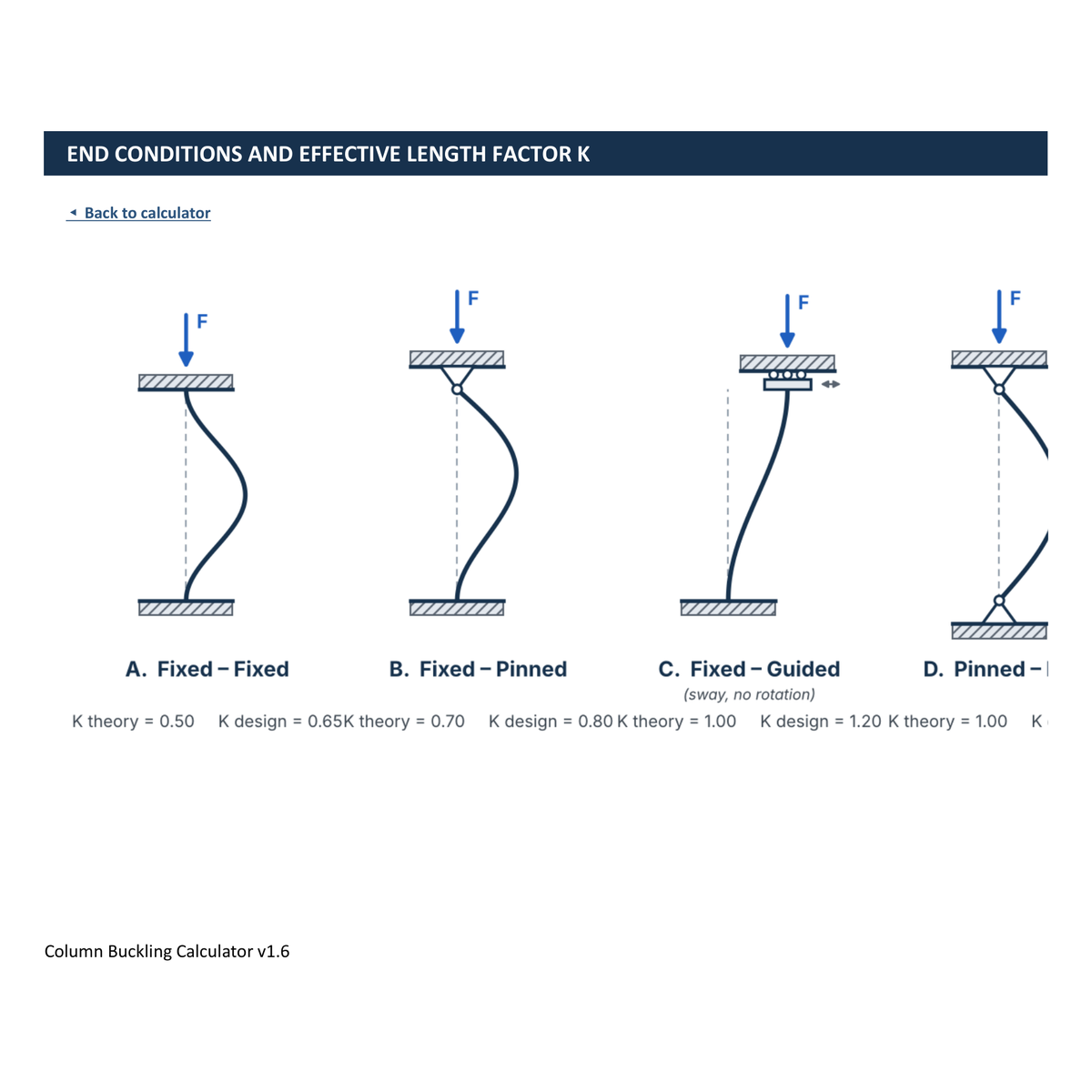
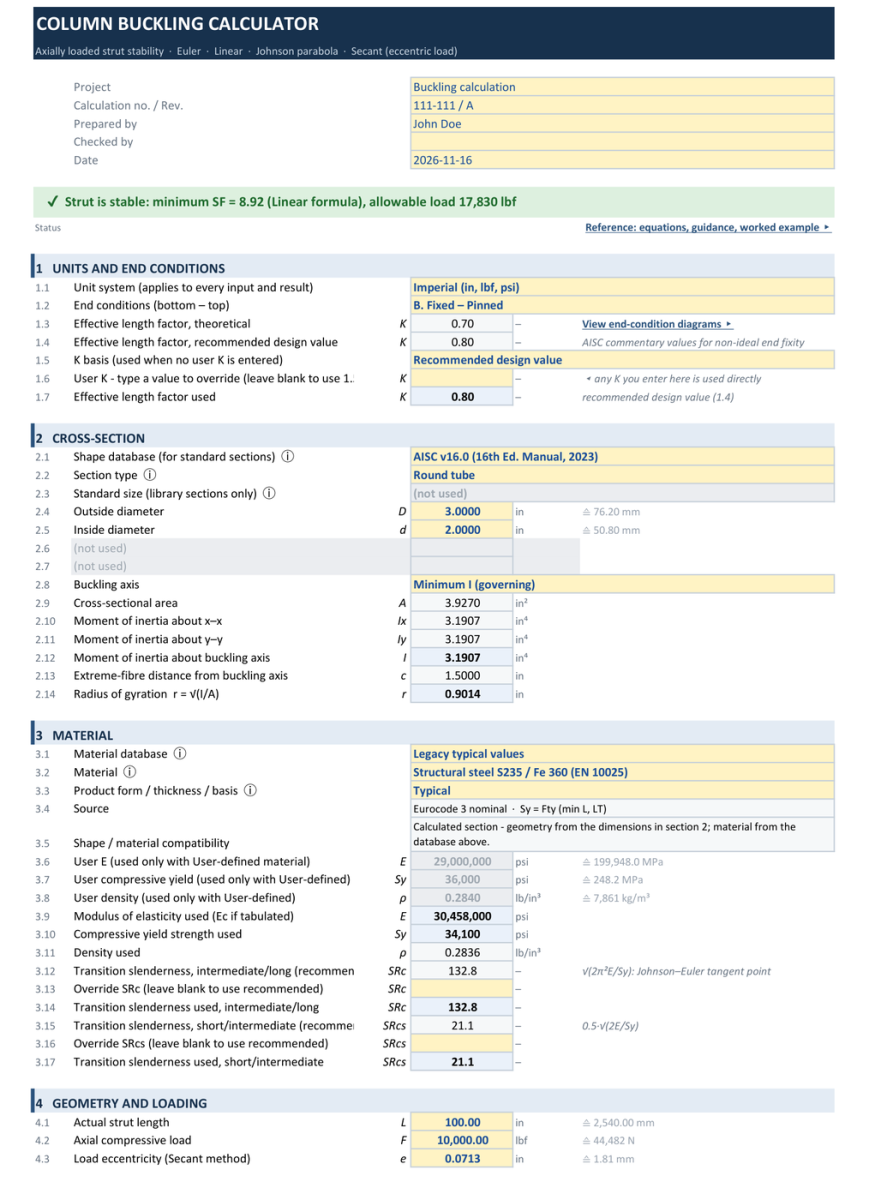
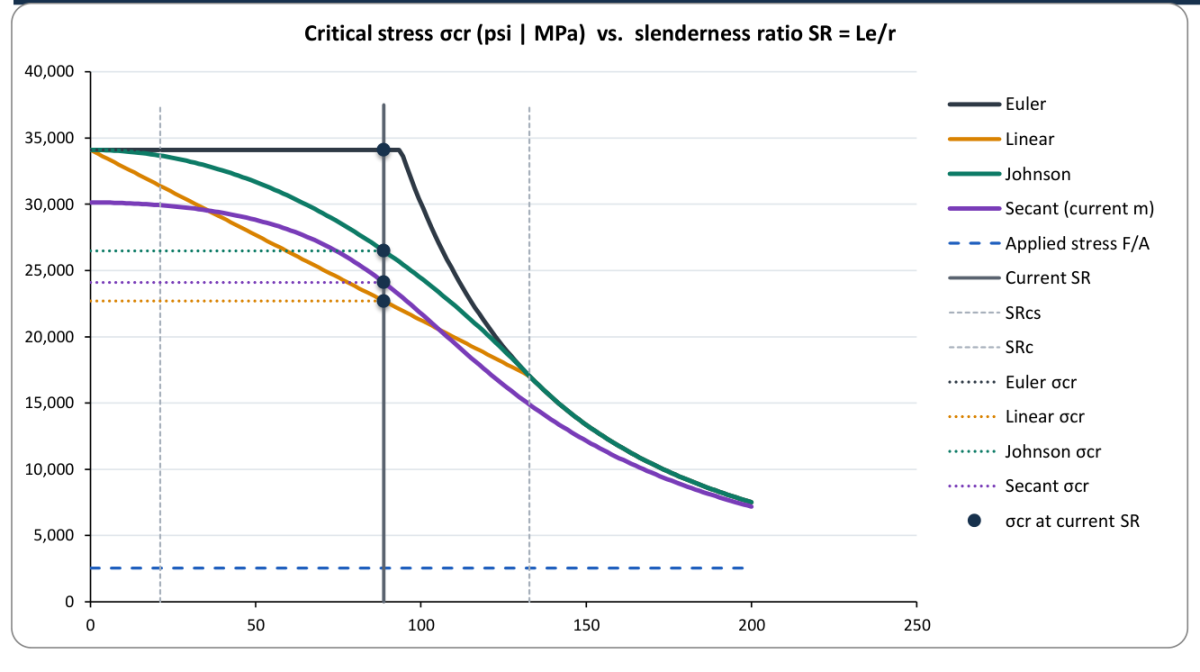
The Column Buckling Calculator checks an axially loaded strut for flexural buckling by four classical methods side by side: Euler elastic buckling, the Johnson parabola, the linear (Tetmajer-type) formula and the secant formula for eccentric loading. It also checks the pure-compression squash load. It reports the critical stress, critical load and safety factor for each method, flags any method below your acceptance limits, and identifies the governing case and allowable load in a single status line. Six end conditions are built in with theoretical and recommended K factors, or you can type your own K. The secant critical stress is solved directly in worksheet formulas, so the workbook is entirely macro-free, works in Imperial or SI units, and carries a live chart of critical stress against slenderness ratio with the short, intermediate and long-column zones marked.
Sections can come from 14 parametric shapes, the full AISC Shapes Database v16.0 (W, M, S, HP, C, MC, WT, MT, ST, single and double angles, HSS and pipe), legacy AISC and DIN/EN tables, user-entered properties from CAD, or any irregular outline. For an irregular part, type the vertices on the Custom Section sheet and the workbook computes the area, centroid, principal moments and extreme-fibre distance, then draws the part to scale. Materials come from 1,323 MMPDS-01 design allowables (A-, B- and S-basis, with compression yield and compression modulus used where tabulated), a set of typical engineering materials, or your own values. The shape and material tables are open for editing, so you can add sizes and alloys.
Beyond the check itself, a secant-method sizing routine proposes the dimensions or the standard size that meets a target safety factor. A Reference sheet sets out every equation with its variables defined, guidance on K, safety factors, eccentricity ratio and allowable basis, and a live worked example that shows the arithmetic for the case currently entered. The workbook prints as a ready-made report: calculation pages, a chart page and the reference section. Formulas are protected against accidental change while inputs stay open. The workbook is by Alan Moss.
Calculation Preview
 (0/0)
Full download access to any calculation is available to users with a paid or awarded subscription (XLC Pro).
Subscriptions are free to contributors to the site, alternatively they can be purchased.
Click here for information on subscriptions.
Your lifetime XLC Pro subscription, awarded for all eight of your calculations, is well deserved.
I also reviewed the calculation against our Good Calculation Guide: https://www.excelcalcs.com/calcs/good-calc-guide
**What works well**
- Four methods and the squash load side by side, with the governing case and allowable load in one status line.
- The critical stress v. slenderness chart with zones marked, the section drawn to scale and the mode shape.
- The range of sections and materials: AISC v16.0, DIN/EN, MMPDS-01 and digitised custom outlines.
- A live worked example on the Reference sheet that shows the arithmetic for the case entered.
**Suggestions that would make it even better**
- Remove the sheet protection, or at least state the password; our guide asks for unprotected sheets.
- Add a validation line comparing a result with a published example, for instance from Shigley or Timoshenko and Gere.
- Mark the Euler result "not applicable" below the transition slenderness, and describe the straight line as a generic line rather than Tetmajer's.
- Clear the "Prepared by: John Doe" placeholder, and try the XLC add-in to show the equations in standard notation.