
POLEFDN.xls
 (4/39)

Description
Pole Foundation Embedment Depth by Five Methods
Finds the embedment depth needed for a free-headed, rigid round pier (pole foundation) carrying horizontal and vertical loads and an applied moment. Because no single method is universally accepted, the workbook offers five on separate sheets so the results can be compared.
Sheets and methods
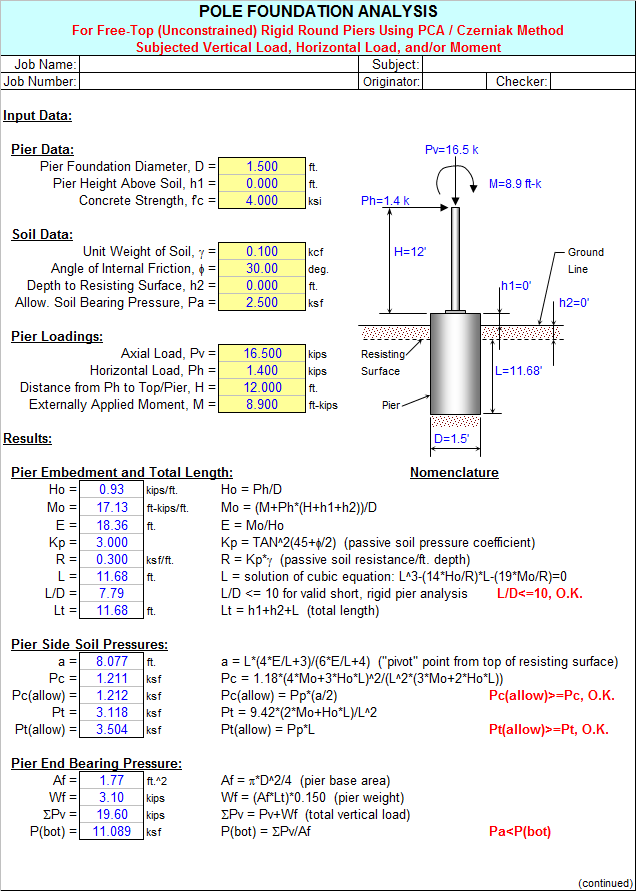
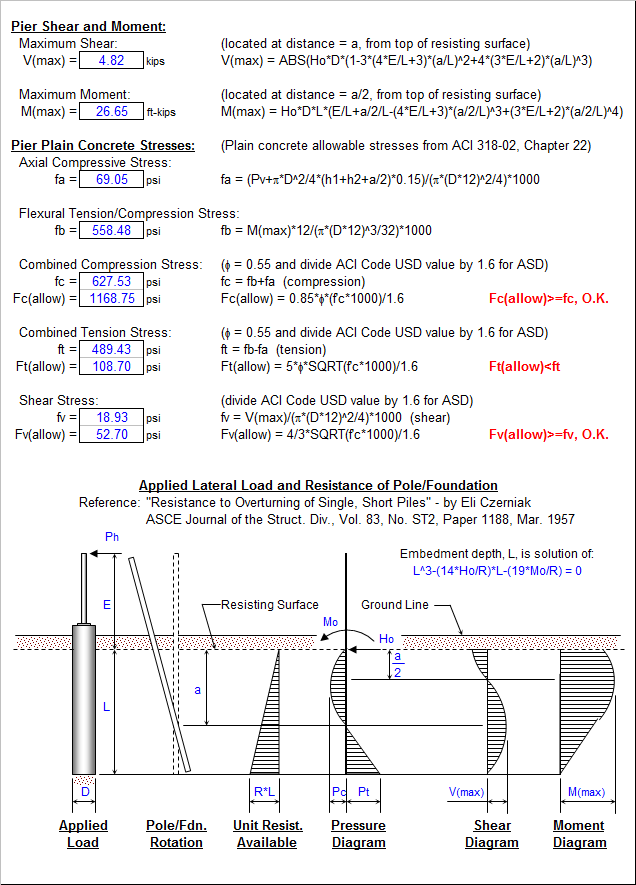
- Pole Fdn (Czerniak) – Czerniak/PCA method: L from the cubic L³ − 14.14HoL/R − 18.85Mo/R = 0, with R = Kpγ. Also gives side soil pressures, end bearing, the maximum shear and moment in the pier, and plain concrete stresses to ACI 318-11 Chapter 22. Valid for L/D ≤ 10.
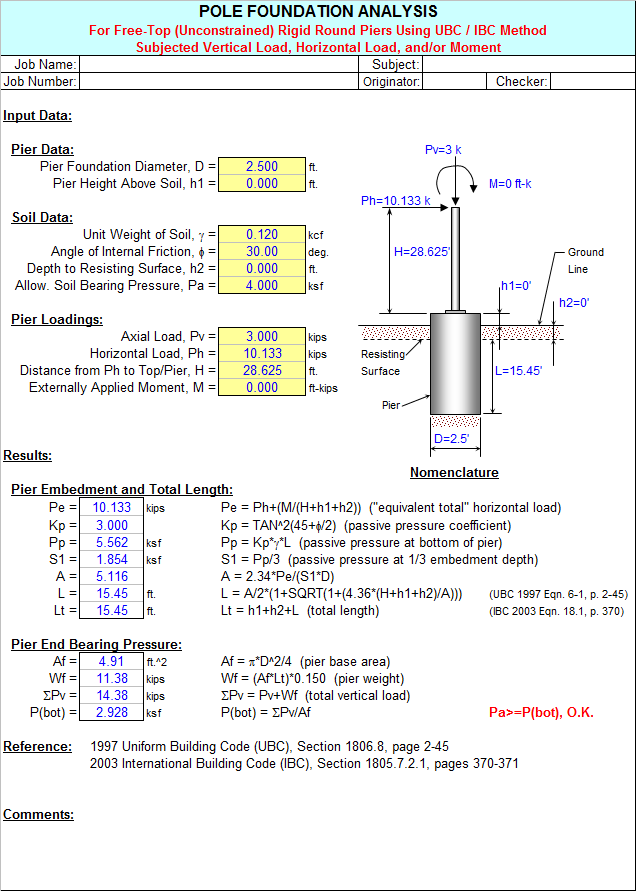
- Pole Fdn (IBC) – IBC 2012 Section 1807.3.2.1, L = 0.5A[1 + √(1 + 4.36h/A)]
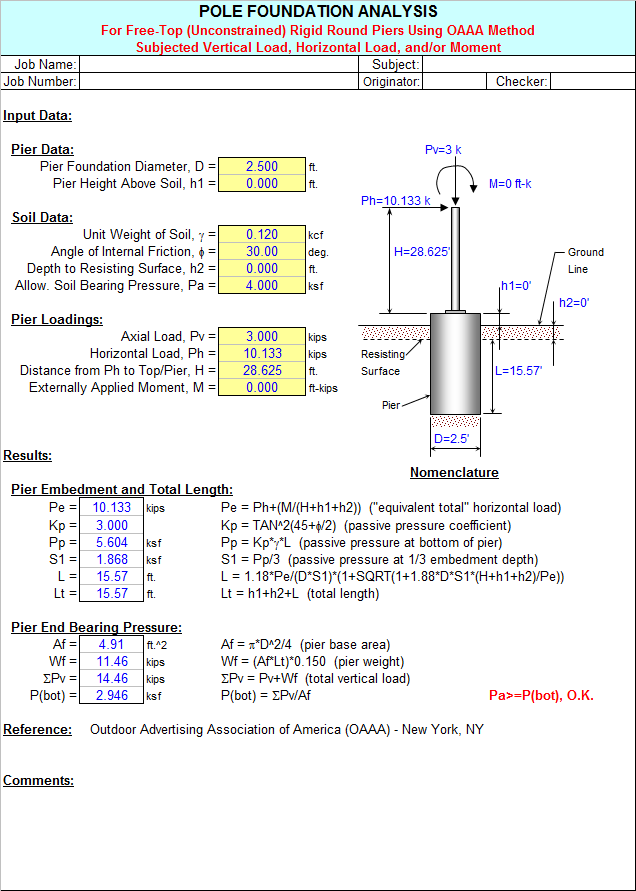
- Pole Fdn (OAAA) – Outdoor Advertising Association of America method
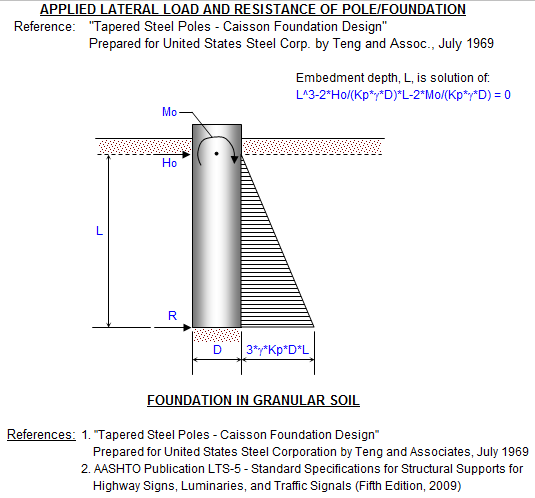
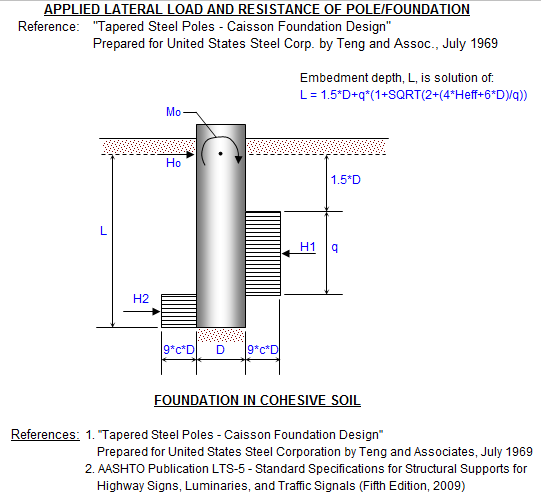
- Granular Soil (Teng) and Cohesive Soil (Teng) – USS/Teng method with AASHTO LTS-5, soil strength from the SPT blow count N
Inputs
- Pier diameter and height above ground, concrete strength
- Soil unit weight and friction angle (or N), depth to the resisting surface, allowable bearing pressure
- Axial load, horizontal load and its height, applied moment
Outputs
Required embedment and total pier length, pier weight and bearing pressure, with pass/fail checks and a pressure, shear and moment sketch on the Czerniak sheet.
In the stored Czerniak example (1.5 ft pier, 1.4 kips at 12 ft plus 8.9 ft-kips, φ = 30°) the embedment is 11.67 ft, and two checks fail: end bearing of 11.1 ksf against 2.5 ksf and plain concrete tension of 489 psi against 119 psi. For a 2.5 ft pier with 10.1 kips at 28.6 ft, the IBC sheet gives 14.9 ft and the OAAA sheet 15.6 ft.
Please note
- Results differ between methods; the Czerniak method is the most conservative. Short rigid piers only.
- US customary units. Sheets protected without a password, formulas hidden but printed as text. No macros.
- Written by Alex Tomanovich, P.E. References: E. Czerniak, ASCE J. Struct. Div. ST2 (1957); F. Randall, PCA (1968); IBC 2012; OAAA; Teng and Associates for US Steel (1969); AASHTO LTS-5 (2009).
Calculation Preview
 (4/39)
Full download access to any calculation is available to users with a paid or awarded subscription (XLC Pro).
Subscriptions are free to contributors to the site, alternatively they can be purchased.
Click here for information on subscriptions.

I have downloaded your POLEFDN. It is excellent program. I have a scenario, for the following conditions;
1. Can these design for Monoblock foundations, where
a. Foundation is 2mx2m (square).
b. Foundation is fully embedded, except for top 300mm which is above ground level.
c. Can units be changes to SI system.
This has been corrected.
You are absolutely right. I was using the "average" shear stress on a circular section (fv = V/A), when I should have been using the maximum value of the shear, fv = 4*V/(3*A), as you pointed out.
Per ACI, the allowable shear stress is Fv = 2*(phi)*f'c^(1/2), where phi is 0.75 for shear. Thus, again as you pointed out, that works out to be Fv = 2*0.75*f'c^(1/2) = 1.5*f'c^(1/2).
Thank you for bringing that to my attention. I will make the corrections and get the update reposted.
Alex
In the process, I also discovered that I had some inconsistency in the variable labeling that was used for the passive resistance parameter. I showed both "R" and "Pp" in different places, so I changed each occurrence of the variable to "R", as was used in the Czerniak reference.
The current version of this workbook is now version 2.3.

Actually, in substance the IBC has not changed for embedded pole-type foundations since the 2006 version of the Code. Only the table and section designations have changed.
The version of this workbook is now 2.2.
This added information was obtained via another reference that I recently came across, AASTO Publication LTS-5 - "Standard Specifications for Structural Supports for Highway Signs, Luminaries, and Traffic Signals (Fifth Edition, 2009). The material in this reference was essentially the same as the original Teng & Associates reference, but included the additional equations for maximum moment and location.
I was using a simple iterative approach to solve the polynomial equation for the theoretical embedment depth, "L". In Column V of the worksheet, I have what I term index numbers for each iterative evaluation of the expression to help isolate where the solution converges to zero. Problem was, I had an inadvertent small gap of numbers in the index numbers, and thus they were not completely sequential. One "lucky" gentleman had a design situation where his solution fell at that exact point where the gap in the index numbers occurred, and the solution crashed. Lucky for me he stumbled upon the problem.
This has now been corrected and this workbook is now version 2.0.
Alex