
Post-Tensioning Tendon Friction Loss (EN 1992-1-1)
 (0/0)
(0/0)

Description
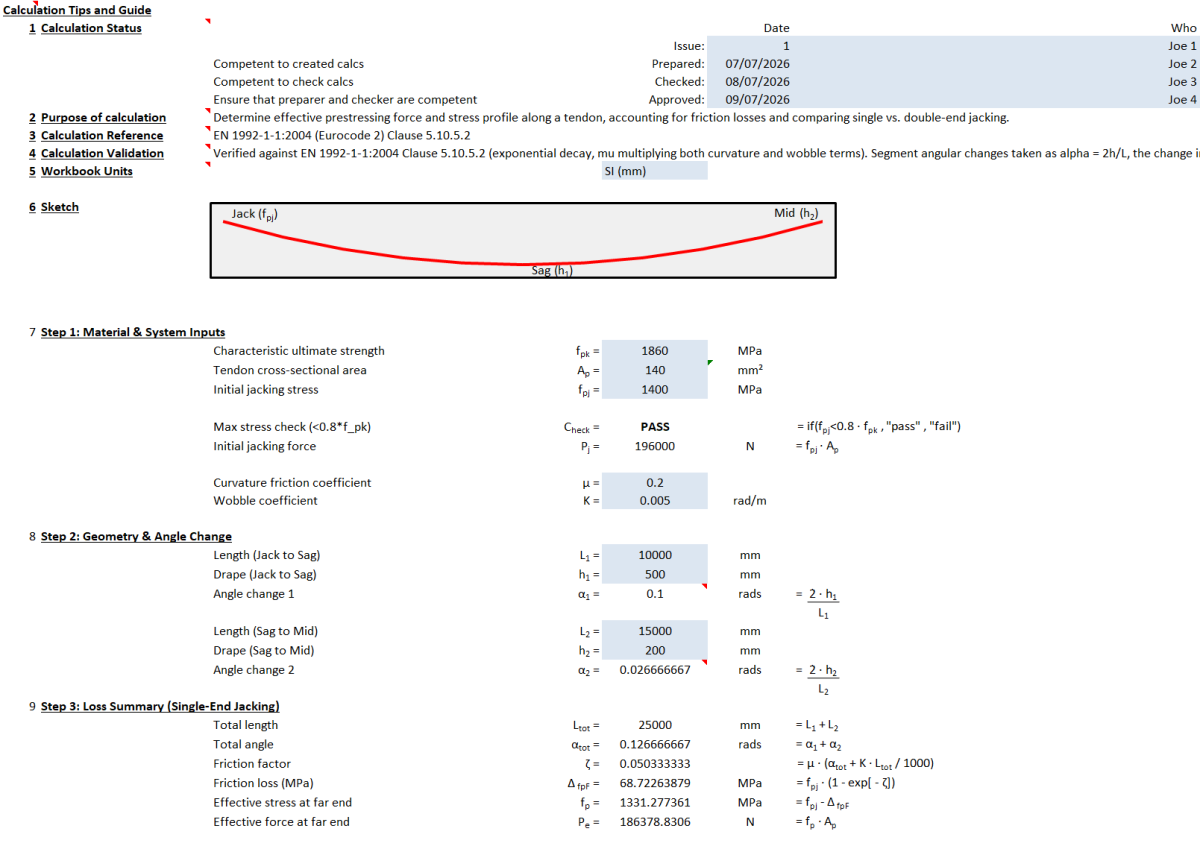
This calculation determines the effective prestress force and stress profile along a draped post-tensioned tendon, accounting for friction losses between the tendon and its duct. It implements the friction model of EN 1992-1-1:2004 (Eurocode 2), Clause 5.10.5.2:
σ(x) = σpmax · e−μ(θ + kx)
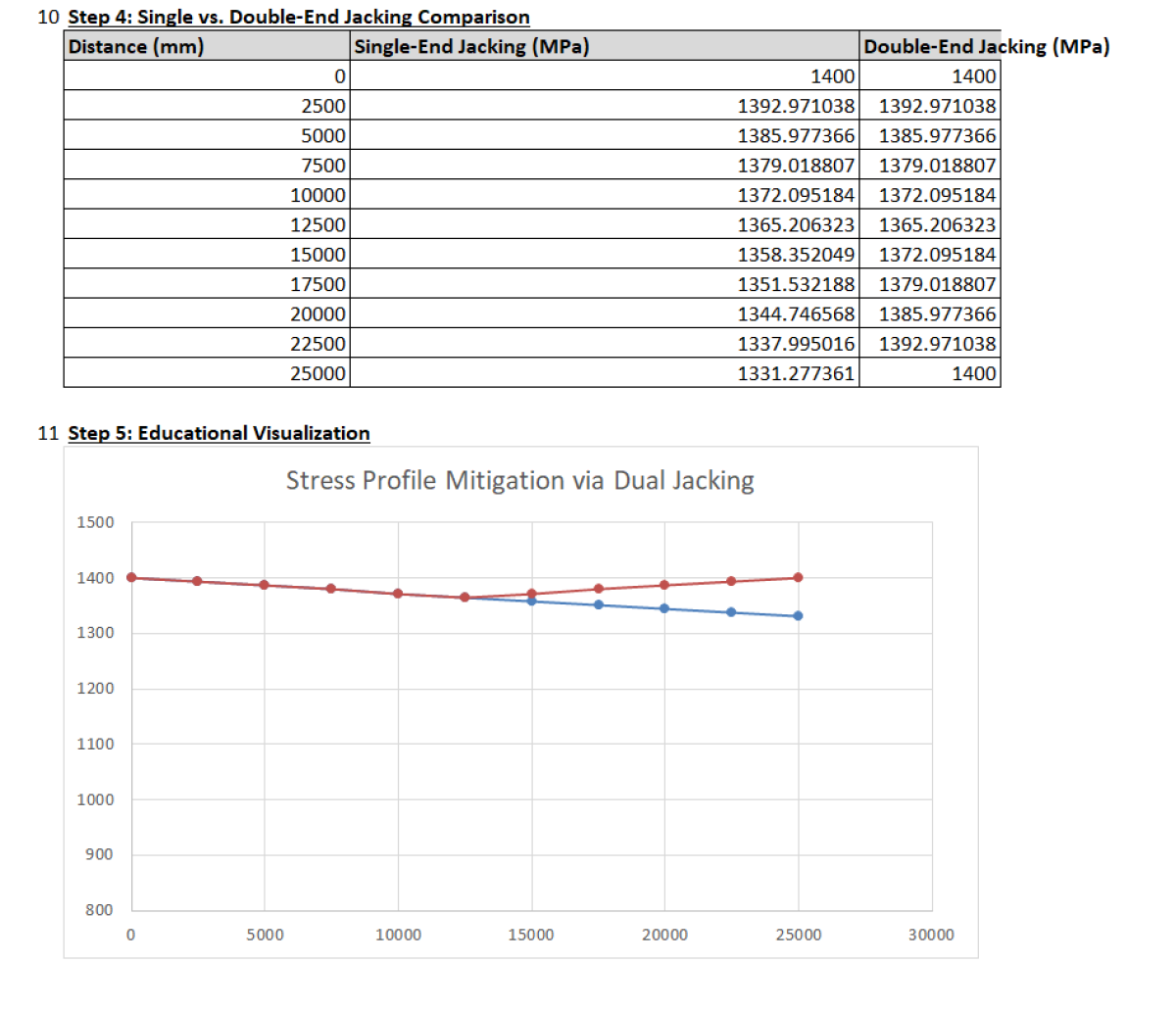
where μ is the curvature friction coefficient, θ the cumulative angular deviation of the tendon, k the wobble (unintentional angle) coefficient and x the distance from the jack. The sheet computes the jacking-stress limit check, the total angular change from the tendon geometry, the friction loss and the effective stress/force at the far end, and it plots the stress profile for single-end vs. double-end jacking so the benefit of stressing from both ends can be seen at a glance.
Tendon segment angles are derived parametrically from the drape and length of each parabolic segment using α = 2h/L (the change in tangent slope of a parabolic segment from its horizontal-tangent vertex to the far end).
How to use it
- Set the workbook unit system from the dropdown (this calc is set up in SI, mm).
- Enter the material and system inputs (blue cells) in Step 1: characteristic strength fpk, tendon area Ap, jacking stress fpj, and the friction coefficients μ and k. The sheet checks fpj against the 0.8·fpk stressing limit (PASS/FAIL).
- Enter the tendon geometry in Step 2 — for each parabolic segment, its length L and drape h. Segment angles α, total length and total angle are calculated automatically.
- Read the results in Step 3: friction factor, friction loss (MPa), and the effective stress and force at the far end.
- Review Step 4 for the single- vs. double-end jacking stress profile along the tendon.
All grey/white cells are locked formulas; only the light-blue cells are meant to be edited. Change any input and the whole calculation, including the profile table, updates.
How it was validated
- Independent recomputation — every formula was reproduced by an alternate calculation and agrees (e.g. ζ = μ(θ + kL) = 0.0503, friction loss = fpj(1 − e−ζ) = 68.7 MPa, effective stress = 1331 MPa for the sample inputs).
- Code compliance — the exponential decay form and the placement of μ multiplying both the curvature term θ and the wobble term kx follow EN 1992-1-1:2004 Cl. 5.10.5.2 exactly.
- Geometry check — the double-end profile is symmetric about mid-span and equals the single-end profile at the jack, as expected physically.
- Assumption noted — segment angles use α = 2h/L for a parabolic tendon with horizontal tangents at the sag and mid-span. Users whose tendon profile differs (inclined anchorage tangent, reverse curvature, multiple drapes per span) should compute θ from the change in tangent slope instead.
Please note that the XLC Addin is used to render equations and must be installed to pevent #NAME! errors
Calculation Preview
 (0/0)
(0/0)
Full download access to any calculation is available to users with a paid or awarded subscription (XLC Pro).
Subscriptions are free to contributors to the site, alternatively they can be purchased.
Click here for information on subscriptions.