
CALCULATION OF PLANE TRUSSES.zip
 (4/9)
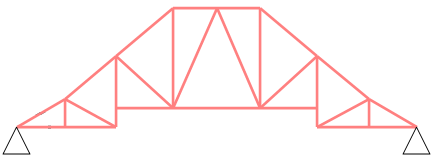
Description
Plane Truss Analysis and Member Sizing (Stiffness Method, Spanish)
A macro-driven workbook that analyses pin-jointed plane trusses by the direct stiffness method and then sizes the members from tables of steel sections. The zip holds an empty template and twelve examples, including textbook trusses, a transmission tower and a simplified bridge. Labels are in Spanish.
Method
The global stiffness matrix is assembled from the bar properties and solved for the joint displacements, and the bar forces and support reactions follow. The workbook says whether the structure is statically determinate, indeterminate or a mechanism. A sizing macro then picks a section for each bar from tables of equal angles, round, square and rectangular hollow sections, channels, built-up channels and U sections, using tabulated ω (omega) buckling coefficients for compression bars, and lists the bar weights.
Inputs
- Number of joints and bars
- Joint coordinates, support restraints (x, y) and applied joint loads
- Bar connectivity, elastic modulus E and area A
- Choice of section family for sizing
Outputs
- Bar lengths, axial forces and tension/compression type; joint displacements; support reactions
- The stiffness matrix, on its own sheet for printing
- The section chosen for each bar with its area, weight, radius of gyration and buckling check
- A drawing of the truss, and optional export to a DXF file for CAD
In example “CE 301 - ex 1”, an eight-joint, thirteen-bar truss spanning 80 with loads of 10, 12 and 16 at the bottom chord gives reactions of 17.5 and 20.5. The end diagonal carries 29.17 in compression, which matches a hand calculation.
Please note
- Macros must be enabled; all the analysis is done by unprotected VBA macros run from buttons. According to the author’s notes, the DXF export writes its file to the root of drive C.
- Pin-jointed plane trusses with joint loads only. Use consistent units: the examples use E = A = 1 for the analysis, so their displacements are not physical.
- The section tables can be edited to match the sections available locally.
- Reference: matrix analysis of structures.
Calculation Preview
(4/9)
Full download access to any calculation is available to users with a paid or awarded subscription (XLC Pro).
Subscriptions are free to contributors to the site, alternatively they can be purchased.
Click here for information on subscriptions.

Your spreadsheet looks very good by the way.
I send a small correction that I made to the book excel
In the graphics routine it made the error of confusing a fixed support with one motive unless had non null forces in the sense x as y. Changing the variable to evaluate solved the problem.
I WOULD LIKE THAT SOMEBODY CONTRIBUTES SOME IDEAS TO HELP IMPROVE THESE CODES.

I HAVE BEEN WORKING IN IT AND ALSO IN THE INTRODUCTION OF DATA OF KNOTS AND BARS BY MEANS OF USERFORMS AND IN IMPROVING THE ONE CENTERED OF THE DRAWINGS IN THE FILES DXF
I ADD SEVERAL CASES THAT HAS NOT BEEN POSSIBLE TO SOLVE WITH THE LEAF OF I CALCULATE PREVIOUS AND SOME NEW EXAMPLES, AMONG WHICH THERE IS A CURIOUS CASE: THE BRIDGE HELL DE PENNSYLVANIA
NOBODY SEEKS TO CALCULATE A STRUCTURE OF THIS SPAN WITH SO MUCH SIMPLIFICATION, IT IS ALONE AN ACADEMIC EXAMPLE THAT SHOWS THE EASY THING THAT IT IS THE USE OF THIS TOOL: THEN OF INTRODUCING THE ALONE DATA WE HAVE TO PRESS SOME BELLBOYS AND TO WAIT SOME SECONDS
I SUPPOSE THAT HE/SHE WILL HAVE TO REPLACE THEM IN THEIR IT PAGINATES. I APOLOGIZE HIM A THOUSAND FOR THE NUISANCES, ALTHOUGH I BELIEVE THAT IT HAD ALREADY CLARIFIED HIM THAT IT SENT THE CODES MACRO DESPROTEGIDOS BECAUSE THEY WERE SUBJECT TO MODIFICATIONS
I WOULD LIKE THAT SOMEBODY CONTRIBUTION SOME IDEAS TO IMPROVE THESE CODES