
ASCE702S.xls
 (5/7)
Description
Flat Roof Snow Load and Snow Drift to ASCE 7-02
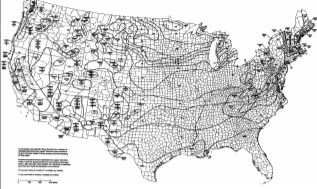
Calculates the design snow load on a flat or low-slope roof (up to 5°) to Section 7 of ASCE 7-02, including drift on a lower roof beside a higher roof or wall, and rain-on-snow surcharge where it applies. A dimensioned sketch of the drift updates with the results, and the ground snow load map (Figure 7-1) is included.
Method
- γ = 0.13pg + 14 ≤ 30 pcf; pf = 0.7CeCtIpg, not less than the code minimum
- hb = pf/γ, hc = ho − hb; drifts apply when hc/hb ≥ 0.2
- Leeward drift 0.43∛lu∜(pg + 10) − 1.5 (upper roof length) and windward drift at 0.75 of that (lower roof length); the larger governs, limited to hc, with width 4hd or 4hd²/hc ≤ 8hc
- Rain-on-snow to Section 7.10 (pg ≤ 20 psf, slope under ½ in./ft)
Inputs
- Building category, ground snow load pg, exposure and thermal factors
- High and low roof lengths, height difference and roof slope
Outputs
- Importance factor, snow density, flat roof and minimum loads
- Balanced and clear heights, leeward and windward drift heights, design drift height and width
- Peak drift surcharge, rain-on-snow surcharge and total load at the drift peak; drift load at any chosen distance
The stored example (category II, pg = 50 psf, roofs 170 ft and 100 ft long, step 2.1 ft) gives pf = 35 psf and a drift limited by the 0.39 ft clear height to 8.05 psf over 3.14 ft, for a total of 43.05 psf.
Please note
- Balanced loads, lower-roof drifts and rain-on-snow only (rain-on-snow is conservatively added to the drift); unbalanced, sliding and sloped-roof loads are not covered. ASCE 7-02 has since been superseded.
- US customary units. No macros. Sheets protected without a password; tables and equations are in cell comments.
- Written by Alex Tomanovich, P.E. Reference: ASCE 7-02, Minimum Design Loads for Buildings and Other Structures.
Calculation Preview
(5/7)
Full download access to any calculation is available to users with a paid or awarded subscription (XLC Pro).
Subscriptions are free to contributors to the site, alternatively they can be purchased.
Click here for information on subscriptions.
Comments: 1
×
At some point I will just drop the ASCE798.xls workbook, since most folks are probably using either the ASCE 7-05 or ASCE 7-02 Codes in their work.
For now I have made the corrections to the sketches in all three workbooks, and they are all now version 1.3