
Pile Axial Bearing Capacity to TCVN 10304:2014
 (0/0)
(0/0)

Description
Pile Axial Bearing Capacity to TCVN 10304:2014 (Ø350×350 Jacked Pile)
Overview
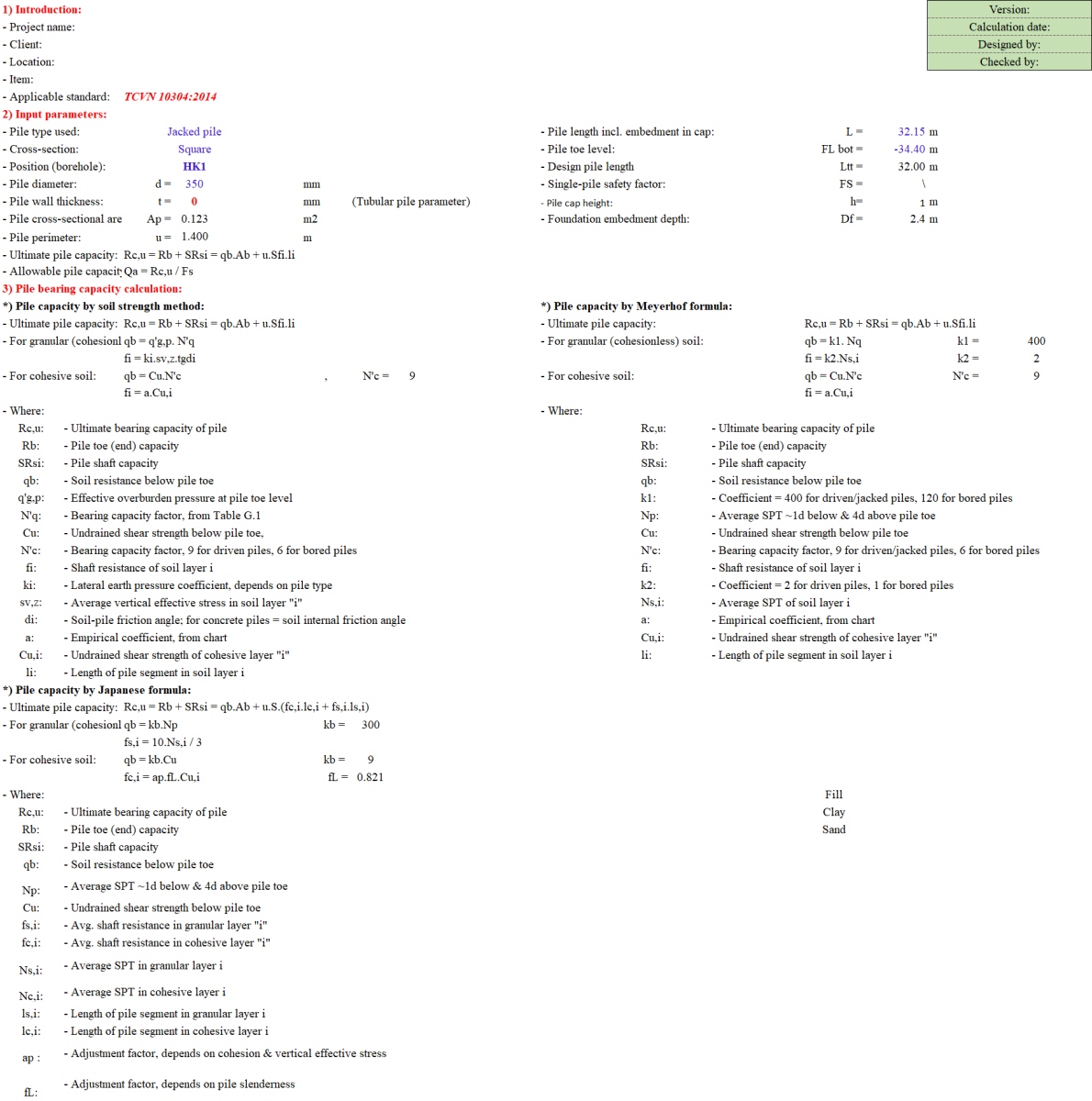
This workbook calculates the axial compressive bearing capacity of a single driven/jacked square pile (350 × 350 mm) and the allowable design load for pile groups, in accordance with TCVN 10304:2014 ("Pile foundations – Design standard"). Soil data is taken from a borehole log (SPT, undrained shear strength, unit weight, friction angle) over 14 layers down to the pile toe at ≈ 34.4 m.
The capacity is estimated by four independent methods and cross-compared:
| Method | Basis | Ultimate capacity Rc,u |
|---|---|---|
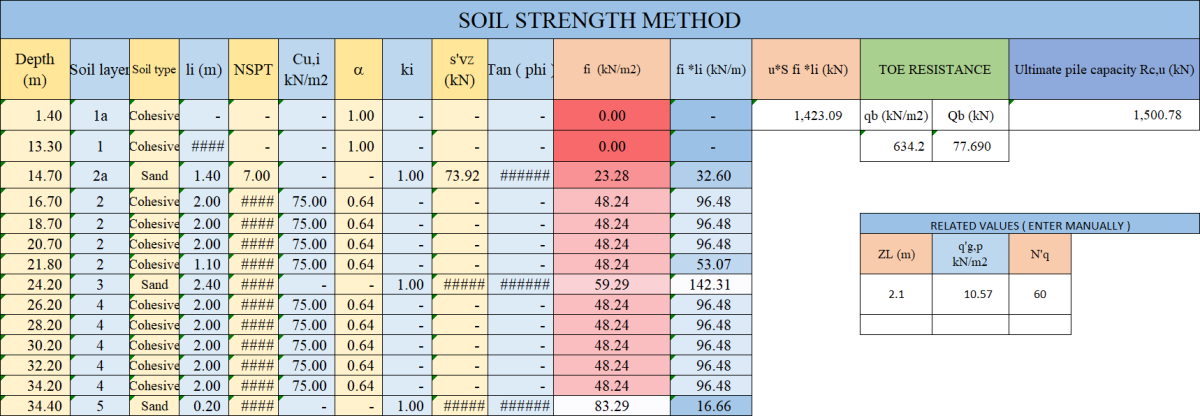
| Soil strength (cohesion/friction) | α·Cu for clay, kᵢ·σ'v·tanδ for sand | ≈ 1,501 kN |
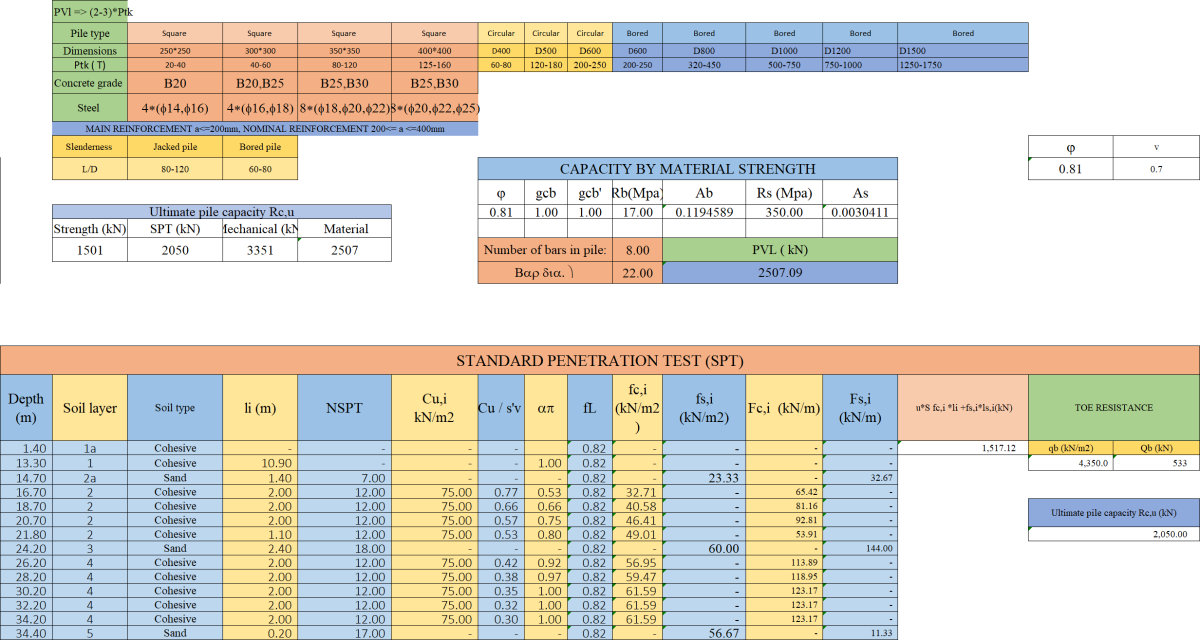
| SPT / Japanese formula | Meyerhof-type toe + SPT shaft | ≈ 2,050 kN |
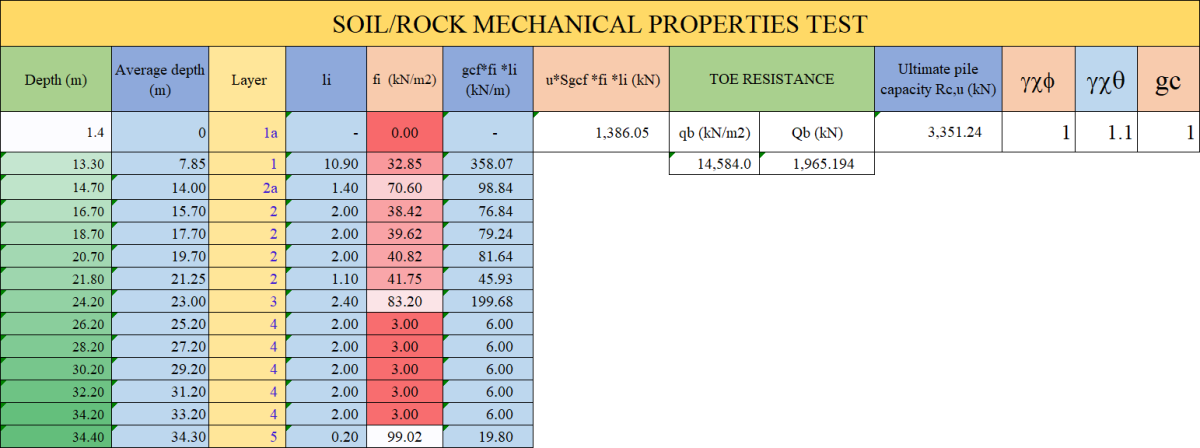
| Soil mechanical (lab) | qb + Σ γcf·fᵢ·lᵢ | ≈ 3,351 kN |
| Pile material strength (PVL) | Concrete + reinforcement | ≈ 2,507 kN |
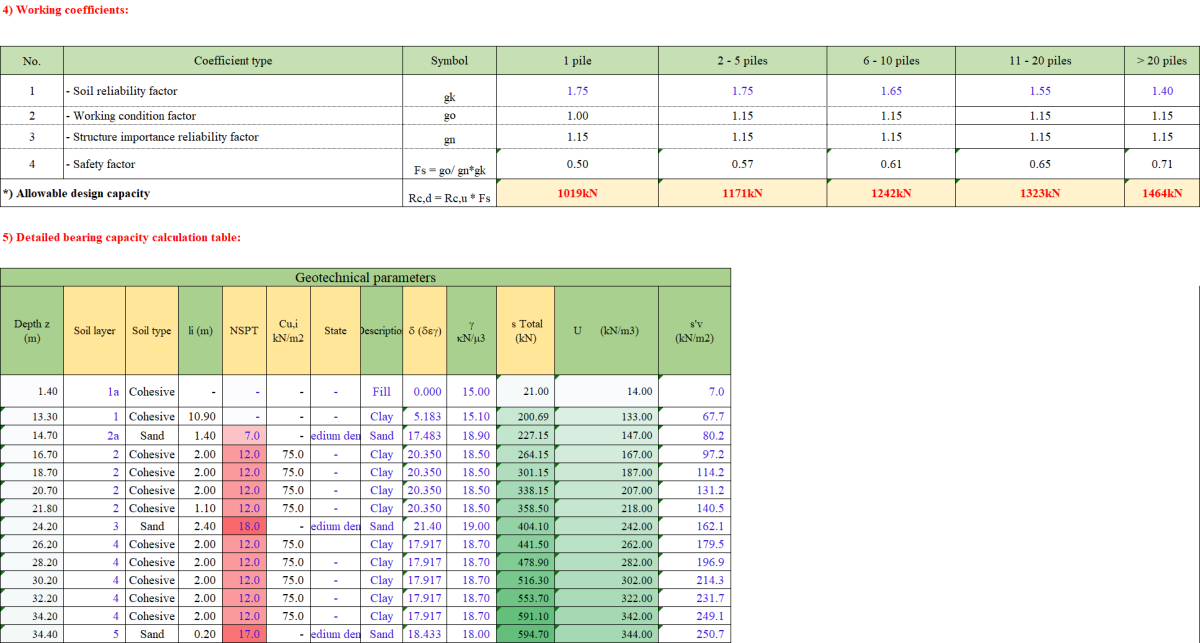
The allowable design capacity Rc,d = Rc,u × Fs is then tabulated for group sizes of 1 / 2–5 / 6–10 / 11–20 / >20 piles, where Fs = γo /(γn·γk) follows the reliability factors in the standard.
Validation
The workbook has been audited cell-by-cell. There are no formula errors (#REF!, #VALUE!, #DIV/0!), the effective-stress build-up and the clay/sand friction branching are correct, and the three shaft-friction summations correctly span all soil layers. A dedicated "Validation Checks" tab documents every check with a severity rating and suggested action. The main points a reviewer should note:
- The design allowable currently draws on the SPT/Japanese capacity; consider taking the minimum of the geotechnical methods for a conservative design.
- A few pile-toe resistance inputs are entered by hand (marked on the sheet) and should be confirmed against the soil report and TCVN Table G.1.
- Full details, including minor items, are in the Validation Checks tab.
English version
The original sheet is in Vietnamese. An English translation has been added as a separate tab, "Trang_tính1 (English)", so international users can follow the method. All labels, headers, units and dropdown lists are translated, and the internal formula logic (soil-type, pile-type and section-shape tests) was translated too, so the English sheet computes identical results to the original.
Guide to the English sheet
The calculation reads top-to-bottom in numbered sections:
- Introduction – project, client, location, applicable standard.
- Input parameters – the blue-highlighted, editable inputs: pile type (dropdown), length, cross-section shape (dropdown), diameter, toe level, and the derived cross-sectional area (Ap) and perimeter (u).
- Pile bearing capacity calculation – the governing equations for each method with a full symbol legend (Rb toe, ΣRsi shaft, qb, Cu, N'q, etc.).
- Working coefficients – reliability/condition factors (γk, γcb, γn), the overall safety factor Fs, and the material-strength capacity block (concrete Rb, steel Rs, bar count).
The detailed calculation tables (Section 5) are where the numbers are built:
- Geotechnical parameters – per layer: depth z, layer no., soil type (auto-classified cohesive/sand), thickness lᵢ, NSPT, undrained strength Cu, state, description, friction angle φ, unit weight γ, and the running total stress, pore pressure and vertical effective stress σ'v.
- Standard Penetration Test (SPT) – the Japanese-formula table: adhesion factor aᲠ, slenderness factor fL, unit shaft resistances fc,i (clay) and fs,i (sand), the per-metre shaft forces, and the toe resistance → ultimate capacity.
- Soil/rock mechanical properties test – the lab-based (cơ lý) table using unit shaft friction fᵢ and toe bearing qb.
- Soil strength method – the effective-stress table: σ'vz at mid-layer, tanφ, unit friction fᵢ·lᵢ, summed shaft plus toe.
- Reference tables (right side) – pile size vs. typical allowable load Ptk, concrete grade, and reinforcement options used by the dropdowns.
To reuse it: change only the blue input cells and the borehole layer data; every capacity, coefficient and design load recalculates automatically. Cells marked "enter manually" (the pile-toe resistance values) should be set from the site's soil report.
Calculation Preview
 (0/0)
(0/0)
Full download access to any calculation is available to users with a paid or awarded subscription (XLC Pro).
Subscriptions are free to contributors to the site, alternatively they can be purchased.
Click here for information on subscriptions.