
STEEL_CONNECTIONS.xlsx
 (4/38)
Description
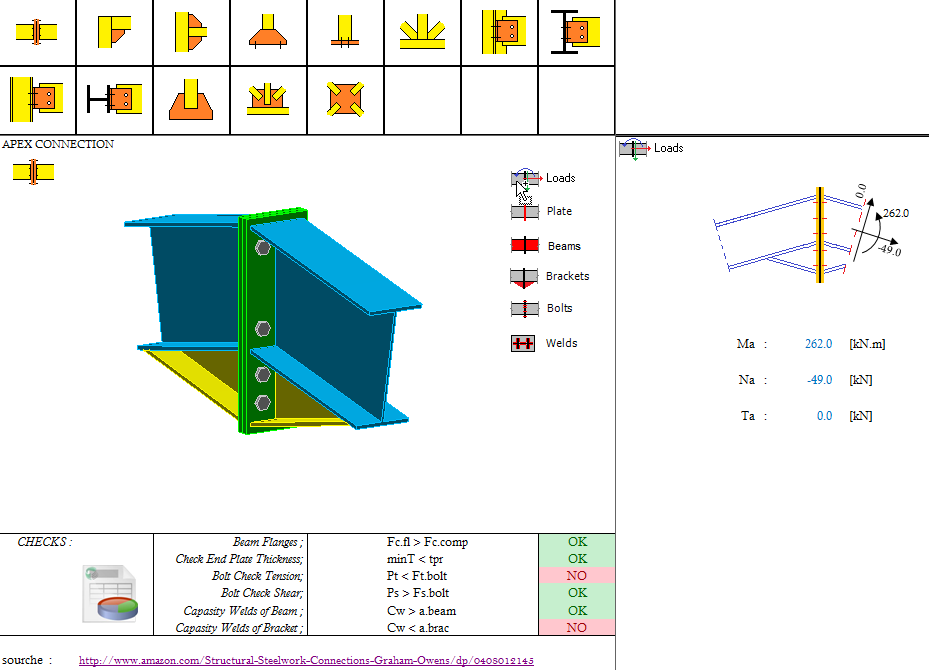
Steel Portal Frame Apex Connection (Bolted End Plate with Haunch)
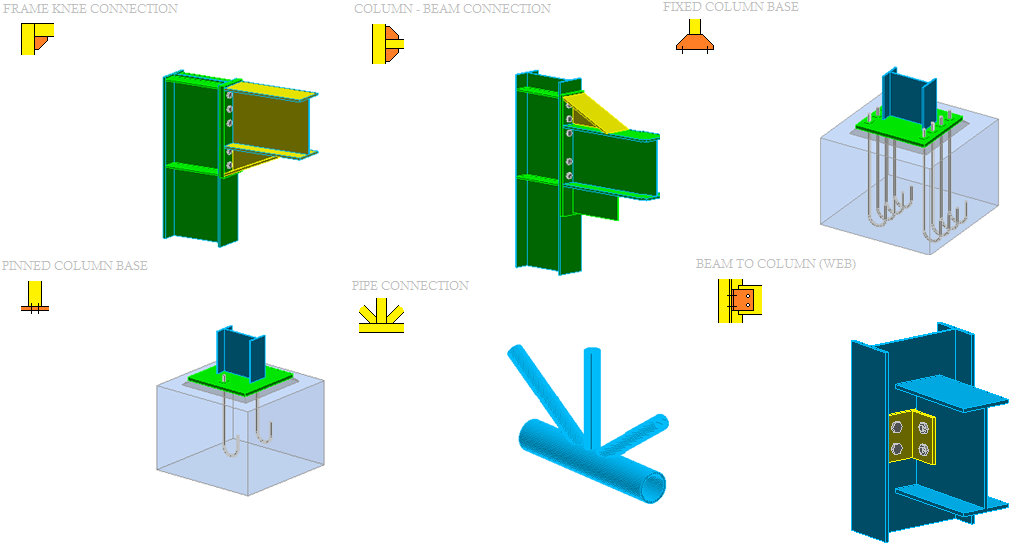
Checks a bolted end-plate apex connection of a steel portal frame rafter, with a haunch below the rafter, for a given moment, axial force and shear, reporting OK/NO for each component. The workbook is planned as a suite of connection types, but only the apex connection is implemented; the other headings on the menu sheet (knee, column bases, beam-to-column, gusset plates and so on) are placeholders.
Method
- Rafter forces resolved at the inclination angle into connection moment, axial force and shear
- Bolt-row forces in proportion to distance from the compression flange, Fi = 0.5Myi/Σy²; compression flange capacity
- Bolt forces shared between flange and web by effective lengths (plastic and elastic); end-plate thickness from plate bending
- Prying, bolt tension and shear capacity of HSFG bolts; fillet weld forces around the rafter and haunch
Inputs
- Rafter moment, axial force and shear
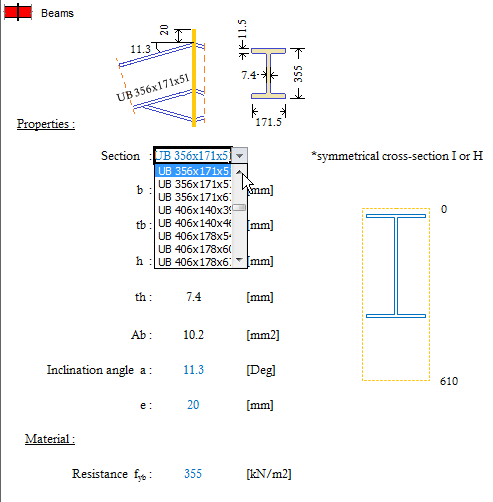
- Rafter section from built-in tables (IPE, HE, UB, UC, W and other series), inclination and grade
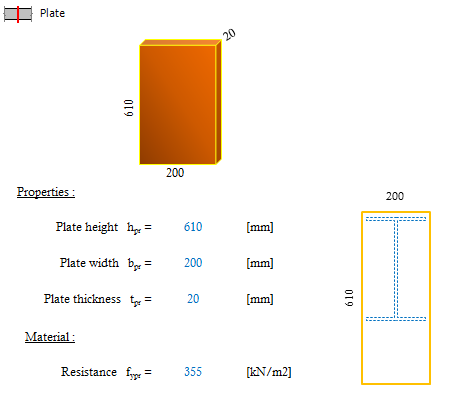
- End plate and haunch dimensions and grades; bolt grade (BS 4395 8.8 or 10), size, gauge and up to 10 row positions; weld sizes and strength
Outputs
- Bolt-row forces, required end-plate thickness, prying forces, bolt tension and shear, weld forces, each with OK/NO
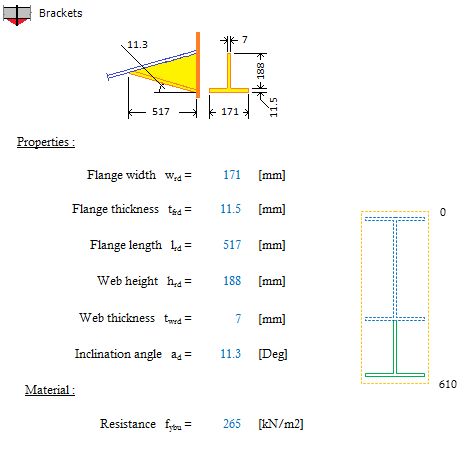
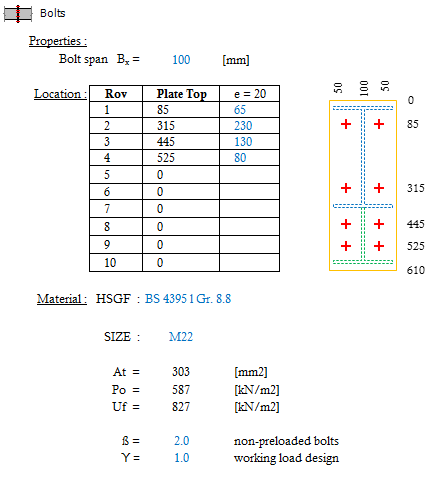
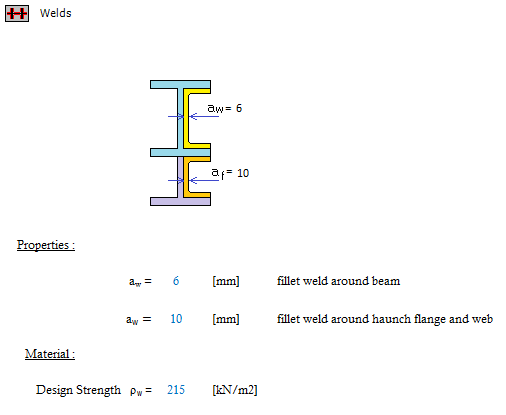
The stored example, a UB 356×171×51 rafter at 11.3° with M = 262 kNm, a 20 mm end plate and eight M22 grade 8.8 bolts, needs an 18.3 mm plate (OK) and has 689 kN flange compression against 700 kN (OK). The bolt tension check fails (161.1 against 159.5 kN), as does the haunch weld (1.516 against 1.505 kN/mm).
Please note
- The end-plate thickness and prying checks use the haunch steel strength (265 N/mm² in the example) rather than the end-plate strength (355 N/mm²), which is conservative.
- Bolt shear capacity is taken as AtPo (178 kN for M22), higher than a BS 5950 bolt shear capacity; check bolt shear separately where it matters.
- No macros. Sheets protected. References: G. W. Owens, Structural Steelwork Connections; Steel Designers’ Manual.
Calculation Preview
 (4/38)
Full download access to any calculation is available to users with a paid or awarded subscription (XLC Pro).
Subscriptions are free to contributors to the site, alternatively they can be purchased.
Click here for information on subscriptions.
Comments: 10
×

1 year ago
only apex connection working

5 years ago
only the apex connection has the full inputs. is there a version of this spreadsheet that has all the connections working?

11 years ago
Please refer to [FAQs ](/support/faqs/trouble-with-units/)it might be useful.

12 years ago
Does this includes all the connection that TEKLA software models
and BCSA
and BCSA

13 years ago
Excellent work!

14 years ago
can I expect "Future Developments" in the near future?....It's a request.

14 years ago
version 1.2
-Some bugs fixed angle. (important)
- Cross-sectional selection easier.
information about the version.
- Version A.B
A = added a new connection.
B = connection developed.
example: Adding knee frame connection
will be Version 2.B.
-follow.
-Some bugs fixed angle. (important)
- Cross-sectional selection easier.
information about the version.
- Version A.B
A = added a new connection.
B = connection developed.
example: Adding knee frame connection
will be Version 2.B.
-follow.
14 years ago
beam-beam was added to the graphics module.
14 years ago
Looks like another essential excel design guide from the inimitable Turan Babacan. I'm looking forward to see how this latest development evolves.
Thank you for your steel apex connection calculation. We worked through the bolt forces in your example independently and got the same results, including the top bolt tension of 161.1 kN against a capacity of 159.5 kN.
While rewriting the description we found two points on the APEXRPR sheet:
- D249, D257 and D267 use D73, the haunch strength (265 N/mm² in the example), for the end-plate bending and prying checks instead of D59, the end-plate strength (355 N/mm²). This errs on the safe side.
- D292 takes the bolt shear capacity as At·Po, the proof load (177.9 kN for M22). The BS 5950-1 shear capacity of a grade 8.8 M22 bolt is ps·At, about 375 × 303 = 114 kN. This is unconservative, although the shear in the example is small (1.2 kN per bolt).
A small label slip: C134 reads "Vy = Ta. sin a", but the formula uses the cosine.
We have mentioned the first two points in the file's description so users are aware. If you upload a corrected version, we will review it and publish it as the next version.
ExcelCalcs Review Team