
PILEGRP.xls
 (4/19)
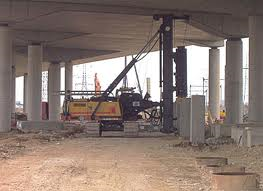
Description
Pile Group Reactions under a Rigid Cap (Elastic Method)
Distributes the loads from one or more piers or columns on a rigid pile cap to the piles below, giving the vertical and horizontal reaction in every pile. Sheets are provided for up to 25, 75, 300 and 400 piles, each in US and metric versions, plus a sheet that checks beam and punching shear around a single corner pile to help size the cap thickness.
Method
- Elastic method: the cap is rigid and all piles are vertical, identical and at the same level. Pier loads are summed at the centroid of the group, with horizontal loads times the height to the pile tops adding to the moments.
- Vertical reaction Rz = P/n plus the moment terms, using Ix, Iy and Ixy of the pile group (unsymmetrical layouts allowed)
- Horizontal reaction Rh from the horizontal loads shared equally plus the torsion Mz about the centroid
- Corner pile: one-way and two-way shear in the cap to ACI 318 (edition selectable, 318-99 to 318-11)
Inputs
- Number of piles and their X, Y coordinates (first quadrant)
- For each pier: X, Y position, height to the pile tops, Pz, Hx, Hy, Mx, My, Mz
- Corner pile: reaction, pile size, edge distance, spacing, cap thickness, f′c
Outputs
Group properties, loads at the centroid, a table and plan plot of pile reactions, and the corner pile shear checks.
The stored example, six piles on a 6 ft × 8 ft grid carrying 600 kips with horizontal loads and moments, gives pile reactions from 79.2 to 120.8 kips and 6.01 kips horizontal per pile. The corner pile example (120 kips, 36 in cap) passes beam shear at 192 kips against 211 kips.
Please note
- The cap and pier self-weight are not included. Pile reactions are not checked against capacities, and cap flexure is not designed.
- Battered piles are not covered. Sheets protected without a password. No macros.
- Written by Alex Tomanovich, P.E.
Calculation Preview

 (4/19)
Full download access to any calculation is available to users with a paid or awarded subscription (XLC Pro).
Subscriptions are free to contributors to the site, alternatively they can be purchased.
Click here for information on subscriptions.
Comments: 4
×

12 years ago
Great work- Thanks.

13 years ago
In the "Corner Pile Shear" worksheet of the "PILEGRP.xls" spreadsheet workbook, the user had been limited to selecting either the ACI 318-99, 318-02, or 318-05 Code versions. I added the ability to select either the ACI 318-08 or 318-11 Code versions as well. Actually, for this particular worksheet this change is somewhat of a formality, as the "phi" factor for shear changed from the ACI 318-99 Code value of 0.85 to a value of 0.75 starting with ACI 318-02 Code, and has remained constant through ACI 318-11 Code.
This workbook is now version 3.6.
This workbook is now version 3.6.
18 years ago
This workbook has some concrete design in them, based on the ACI 318-99 Code in their original form. To reflect the use of the ACI 318-05, I decided to give the user the option of selecting what ACI Code is desired to be used, 318-99, 318-02, or 318-05, in those specific worksheets. Once the user selects the desired ACI Code, the appropriate "phi" factors are displayed and used. One word of caution, be careful not to mix & match "phi" factors and load factors from the various concrete codes. It's obviously up to the user to be consistent. For the purpose of just what specific concrete analysis and design is done in this workbook, the selection of either ACI 318-02 or 318-05 gives the same results.
The Horizontal Pile Reaction, 'Rh', at each pile is calculated as follows: Rh = (((Sum Hx)/Np + (Sum Mz)*Yp/J)^2 + ((Sum Hy)/Np + (Sum Mz)*Xp/J)^2)^(1/2)
where: Xp = x-distance of pile from centroidal Y-axis Yp = y-distance of pile from centroidal X-axis
There seems to be a units error here.
(Sum Hx)/Np would be force/(number of piles) = force assuming units of kips and inches would result in kips as the unit which is correct.
but
Sum Mz)*Yp/J would result in in-k * in / in^4, which results in kips/in^2 or ksi
Am I missing something here? Kips and kips/in^2 are inconsistent.
Thanks
CLM