
DECKSLAB.xls
 (4/42)
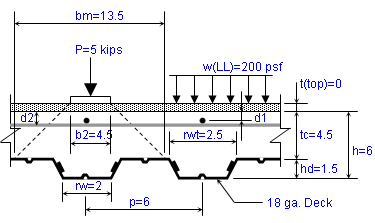
Description
DECKSLAB – Slab on Metal Deck Analysis and Design
Analyses and designs concrete slabs on steel deck, either as composite deck slabs (without studs) or as slabs cast on form deck, for one, two or three equal spans under a uniform live load or a concentrated load. A documentation sheet describes the assumptions.
Method
- Composite Deck – the deck acts as the positive moment reinforcement. The deck is first checked as a form for construction loads (bending, shear, shear–moment interaction, web crippling and deflection); the composite slab is then checked for positive moment (cracked section), negative moment over supports, beam shear (deck plus concrete, with a lightweight factor), shear–moment interaction and live load deflection
- Form Deck (1-layer Reinf.) and Form Deck (2-layers Reinf.) – the deck is ignored for bending, and the slab is designed as a reinforced concrete section with one layer or with separate top and bottom layers; the deck shear capacity can be included or not
- For concentrated loads, effective strip widths for moment and shear, and punching shear
- Built-in SDI deck property tables (five profiles, 16–22 gauge) and bar and mesh tables
Inputs
Deck profile, gauge and yield strength; slab thickness and topping; concrete unit weight and f′c; clear span and number of spans; reinforcement areas and depths; uniform live load or concentrated load and its footprint.
Outputs
Factored moments and shears against design strengths, interaction ratios and deflections, with O.K. flags.
The stored example, a 6 in lightweight (115 pcf) slab on 18 gauge 1.5×6 composite deck spanning 2 × 6 ft with 200 psf live load or a 5 kip load, gives φMn+ = 6.39 ft-kips/ft against 3.33 ft-kips/ft for the concentrated load, and φVnt = 6.72 kips against 1.43 kips. US customary units.
Please note
- Composite deck without shear studs only; continuous spans use fixed moment coefficients for equal spans.
- Sheets are protected (no password) with formulas hidden. No macros.
Author: Alex Tomanovich. References: SDI Composite Deck Design Handbook (1997); SDI Designing with Steel Form Deck (2003); Vulcraft Steel Deck and Floor Deck catalogue (2008); ACI 318-14.
Calculation Preview
(4/42)
Full download access to any calculation is available to users with a paid or awarded subscription (XLC Pro).
Subscriptions are free to contributors to the site, alternatively they can be purchased.
Click here for information on subscriptions.


You're absolutely right! I found the typo error right away in cell O51, and it was as you said, that I had 12,000 in the live load portion of the 2-span formula instead of 1,000, converting lbs./ft. to k/ft. Shoot, I only missed it bay a factor of 12!!!!!
Seriously, dang it, I try my hardness to be error free and strive for perfection, but that quest, as you know, can just about drive one crazy. Thanks for bringing the typo error to my attention. I suppose any astute, experienced engineer, like yourself, would/should have caught that extreme inconsistency between the calculated values for a 2-span and 3-span condition. Just goes to show you that there is no substitute for taking a minute to review the results of any software that you use to see it the results make sense.
I've corrected the typo error and updated the workbook version to v1.3. I'll try to figure out how to upload spreadsheets to this website, as John Doyle has been kind enough to spoil me by doing it for me in the past. In the event that I'm unsuccessful tonight, I'll ask John to do it for me tomorrow.
Thanks,
Alex
That should fix it!
For a two span condition, the negative moment (Cell B79) that it calculates is incorrect. The equation written directly beside the cell is correct as shown, but it's like you have the wrong amplification factor in the actual calculation cell B79.
It is significantly lower than what it should be. If you compare a two span case to a 3 span, the two span should be much higher, but it is significantly lower.
Can you investigate this for me and possibly revise and repost the spreadsheet for downloading?
Thanks!
Great spreadsheet by the way!
Andy Heigley, PE
worksheet in input cell C20, there was an incorrect cell reference in the input data validation. The spreadsheet was referencing what was an empty cell, B29, where it should have been referencing cell B30, for the deck rib height.
I have made the correction and reissued the calculation.
Alex Tomanovich, P.E.