
Appendix D - Anchor Bolt Anchorage ACI 318
 (5/26)
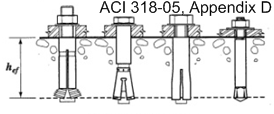
Description
Anchor Bolt Design to ACI 318-05 Appendix D
Checks the strength of a cast-in or post-installed anchor, or a group of anchors, in concrete under factored tension and shear to ACI 318-05 Appendix D. Each failure mode is set out on one sheet with the relevant code tables and figures beside the input cells, and a documentation sheet explains the assumptions.
Method
- Strength reduction factors φ chosen from the steel ductility, the presence of supplementary reinforcement (Condition A or B), the anchor type and, for post-installed anchors, the installation category; a further 0.75 factor in regions of moderate or high seismic risk
- Tension: steel strength (D.5.1), concrete breakout of a single anchor or group (D.5.2, including the 16√f′c hef5/3 form for 11 in ≤ hef ≤ 25 in), pullout (D.5.3) and side-face blowout of headed anchors (D.5.4)
- Shear: steel strength (D.6.1), concrete breakout (D.6.2) and pryout (D.6.3)
- Tension–shear interaction (D.7), using the 1.2 trilinear limit
- Factors for eccentricity, edge distance, cracking and lightweight concrete
Inputs
- Factored tension Nu and shear Vu (kips)
- Anchor type, number of anchors, effective area, futa, fy and bearing area
- Embedment depth, edge distances, spacing, eccentricities, member thickness and f′c
- Cracked or uncracked concrete, concrete type and seismic condition
Outputs
- Design strength for each failure mode compared with the factored load, and the interaction check
The stored example, four headed studs (Ase = 1.23 in², futa = 105 ksi) embedded 21 in in uncracked 4,350 psi concrete with Nu = 107 kips and Vu = 56 kips, is governed by concrete breakout: φNcbg = 158.3 kips and φVcbg = 199.7 kips, giving an interaction ratio of 0.96 ≤ 1.2 (OK). US customary units.
Please note
- The pullout strength is calculated for one anchor and compared with the total group load (conservative), but it is left out of the interaction check.
- The sheet is protected without a password. No macros. Later editions of ACI 318 changed parts of Appendix D (now Chapter 17).
Calculation reference: ACI 318-05.
Calculation Preview
(5/26)
Full download access to any calculation is available to users with a paid or awarded subscription (XLC Pro).
Subscriptions are free to contributors to the site, alternatively they can be purchased.
Click here for information on subscriptions.
Comments: 7
×

7 years ago
Thank you for sharing the spreadsheet. It makes going through Appendix D a lot more bearable.
13 years ago
Nice job!

14 years ago
Please download the [ChangeUnits add-in](/404/) it makes conversion from US to metric units very straight forward.

16 years ago
Could you please be more specific? What cell could you use as an example of the 1.45 factor?
All output capacities may be multiplied by 0.75 if Anchors are located in a structure assigned to SDC C, D, E, or F. (Section D3.3)
All output capacities may be multiplied by 0.75 if Anchors are located in a structure assigned to SDC C, D, E, or F. (Section D3.3)
16 years ago
What is the purpose of dividing all results by 1.45? Can't seem to find that in ACI-318
Are you converting to ASD?
Are you converting to ASD?
18 years ago
To comment on Mark Yerges remarks: It is true that spreadsheet does not yet account for eccentricity for bolt steel strength, but this spreadsheet is more for design of anchor bolt embedment capacity. Eccentricity & spacing is accounted only for concrete embedment strength. Unfortunately, this spreadsheet does require the user calc Avc & Anc (which accounts for edge distance) but this is elementary structural engineering.
Thank you for your ACI 318 Appendix D anchorage calculation. An independent check of your example agreed on every mode we tried, including concrete breakout (158.3 kips), shear breakout (199.7 kips) and the interaction ratio of 0.956.
While rewriting the description we found one gap. The interaction check in AI207/AI208 takes the governing tension strength as the minimum of steel, breakout and side-face blowout (E47, E88, E117/E125), but leaves out the pullout strength in E104. Where pullout governs, for example a single anchor with a small head, the interaction ratio will be unconservative. Including E104 in the minimum would fix this.
You may also want to consider E104 itself, which compares the pullout strength of one anchor with the total group load. That is conservative for a group, but comparing like with like would be clearer.
We have mentioned this in the file's description so users are aware. If you upload a corrected version, we will review it and publish it as the next version.
ExcelCalcs Review Team