
RECTBEAM.xls
 (5/21)
Description
Rectangular Reinforced Concrete Beam and Column Sections to ACI 318-99
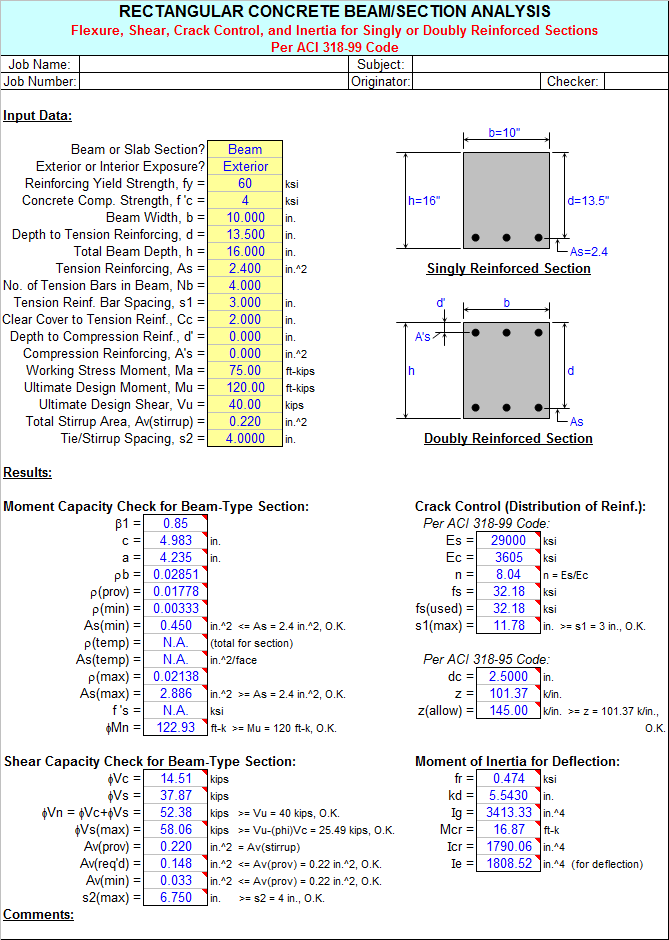
A workbook for checking rectangular reinforced concrete beams, slabs and short columns to ACI 318-99. A “Complete Analysis” sheet checks flexure, shear, crack control and cracked inertia together; separate sheets cover each check, torsion, and axial load with uniaxial or biaxial bending.
Method
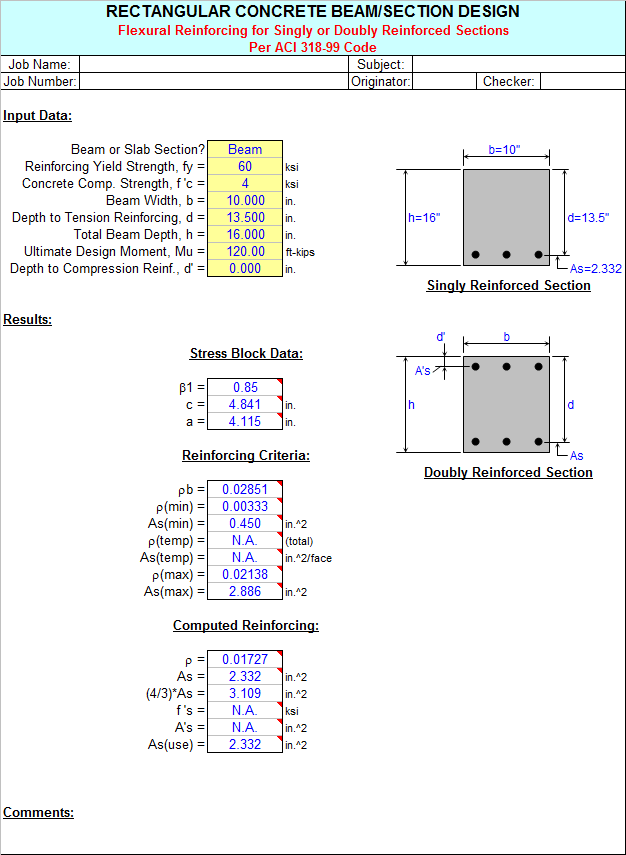
- Flexure: rectangular stress block for singly or doubly reinforced sections (φ = 0.9), with ρmin, ρmax = 0.75ρb and slab temperature steel. One sheet finds the steel needed for a given Mu; another finds φMn for given steel.
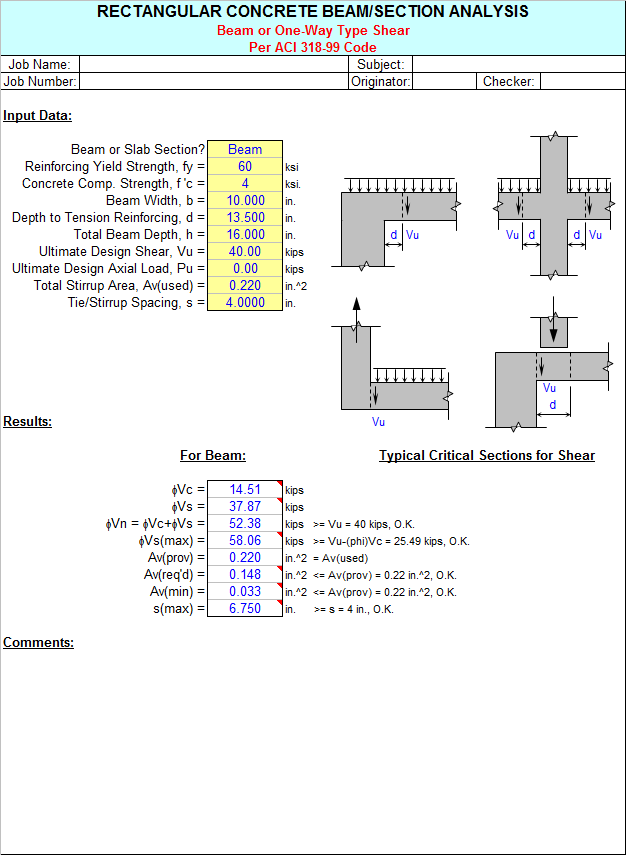
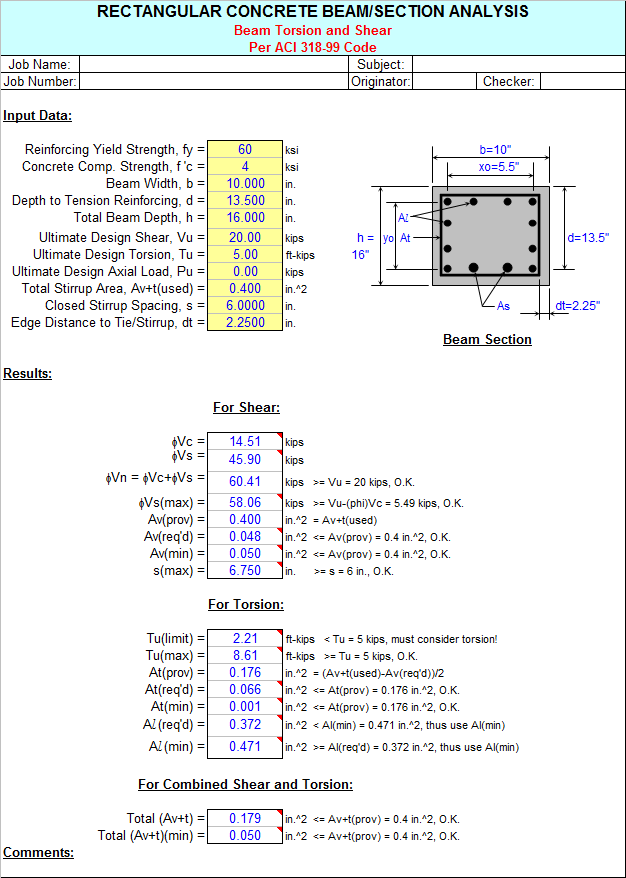
- Shear: φVc = 0.85 × 2√f′cbd with stirrup strength, minimum area and maximum spacing; a torsion sheet checks combined torsion and shear
- Crack control: maximum bar spacing to ACI 318-99 from the service steel stress
- Deflection inertia: Ig, Mcr, Icr and Branson’s effective Ie
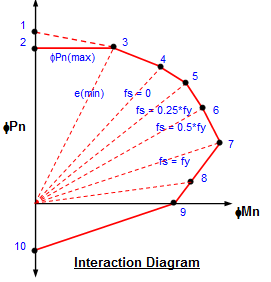
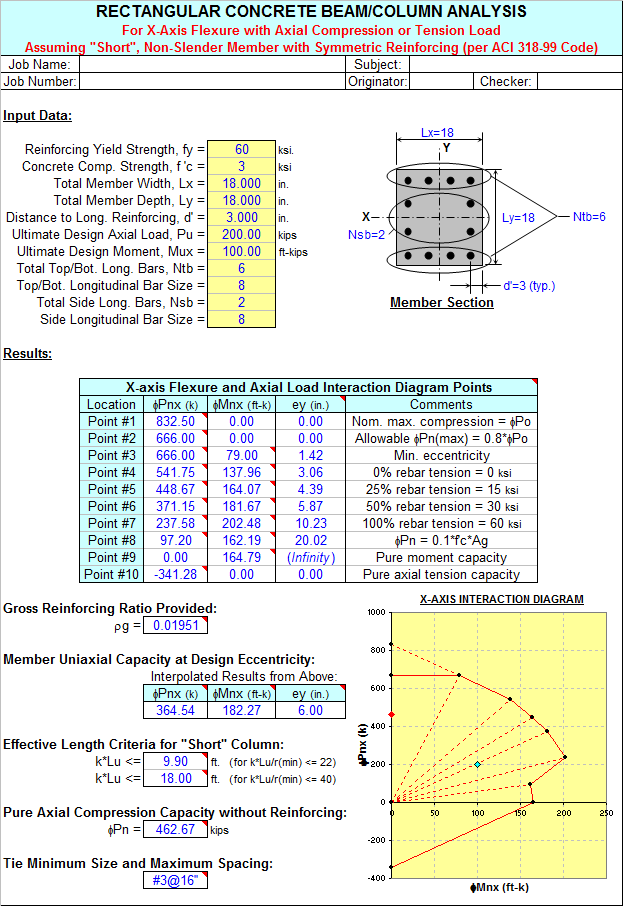
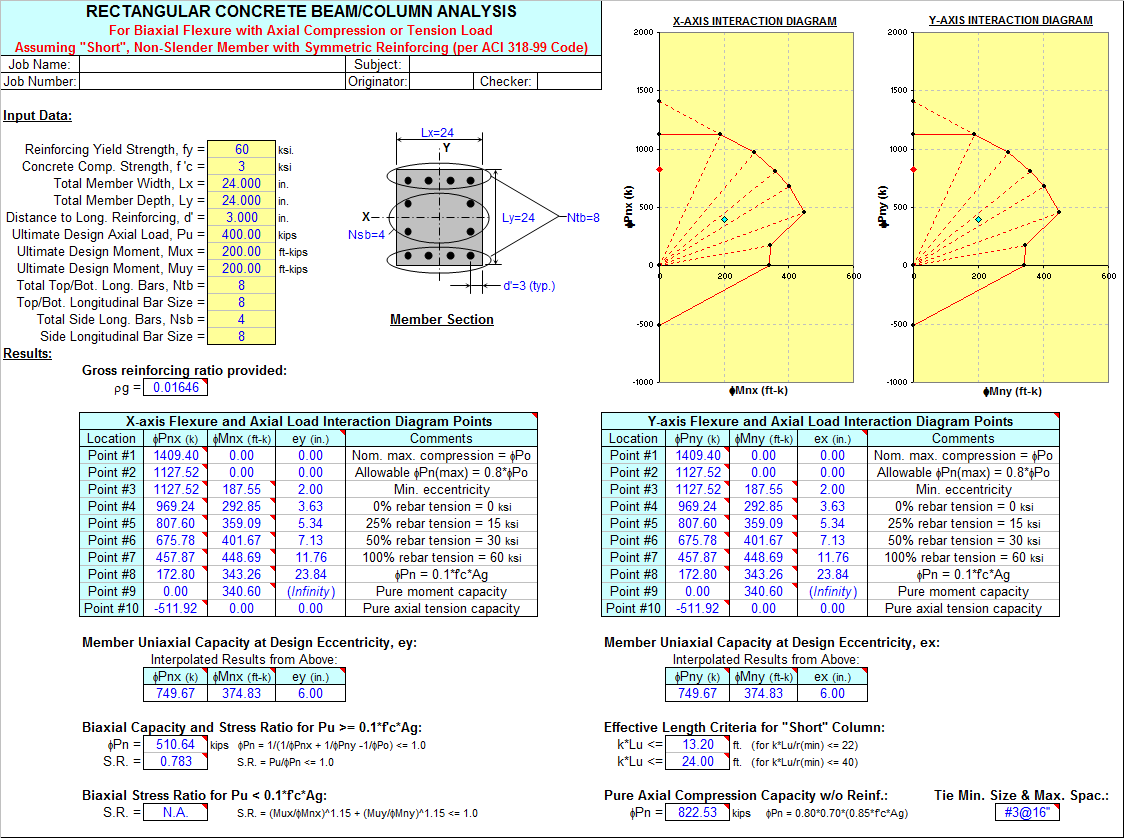
- Columns: a 10-point interaction curve from the CRSI Universal Column Formulas; biaxial bending by the Bresler reciprocal load or load contour method
Inputs
Section size and depths, bars, cover, fy, f′c, exposure, service and factored loads, and stirrups.
Outputs
φMn, required As, steel ratio limits, shear and torsion capacities with stirrup checks, allowable bar spacing, Icr and Ie, interaction curves and stress ratios. Each check is marked O.K. or N.G.
The stored beam example (10 in. × 16 in., d = 13.5 in., As = 2.4 in², f′c = 4 ksi, fy = 60 ksi) gives φMn = 122.9 ft-kips against Mu = 120 ft-kips, φVc = 14.5 kips and φVn = 65.0 kips with #3 stirrups at 3 in., and Ie = 1,809 in4.
Please note
- The column sheets assume fy = 60 ksi, symmetrical bars and a short (non-slender) column. The CRSI formulas are approximate.
- The crack control check takes the smaller of the calculated service stress and 0.6fy, which may understate fs when the calculated stress is higher.
- ACI 318-99 has been superseded; an ACI 318-05 version of this workbook is also in the repository.
- US customary units. No macros. Sheets protected without a password.
- Written by Alex Tomanovich, P.E.
Calculation Preview
 (5/21)
Full download access to any calculation is available to users with a paid or awarded subscription (XLC Pro).
Subscriptions are free to contributors to the site, alternatively they can be purchased.
Click here for information on subscriptions.

ganti
**ATomanovich wrote:**
I've had a few other folks with the same reuest for metric versions. I personally have never worked on an all-metric required project in my 36 of practice, however that's not to say that it won't still come. However, since I do these spreadsheets on my own time and distribute them freely, I'm obviously inclined to do what facilitates my own work and the work of the people that surround me.
Since I'm still a practicing engineer, finding the time to do all that I have on my wish list is a very difficult task at best. Also, not being experienced with metric units, I'm not even sure what the commonly used set of units would be for replacing feet, inches, kips, ft-kips, ksf, ksi, and psi.
As you know, all my spreadsheets are protected, but not with a password. Thus, I encourage you or others to have a go at it. You could reach me by email via my forum contact information if you wanted me to review what you have done. That's the best answer that I can give you for the moment.
Alex
No, the CRSI "Universal Column Formulas"are from the CRSI Design Handbook, 8th Edition, 1996, pages 3-225 to 3-230.
I was incorrect in my statement that the ACI 318-02 and ACI 318-05 Codes state that you may still use ACI 318-99. That is not exactly true. What I actually meant was that Appendix C in ACI 318-05 gives you the load factors and "phi" factors that can be used as an alternative. The "phi" factor for tied compression members is shown 0.70, same as in ACI 318-99, and the ultimate load factors are for the most part the same as in ACI 318-99. The main difference is that you cannot take a 0.75 reduction times the D+L+W load combination, as was allowed in ACI 318-99. As long as you use the correct load factors and load combinations from ACI 318-05 Appendix C, you can use the column worksheets from the RECTBEAM.xls workbook, because you are prompted for the ultimate factored loads, and the "phi" factor used is 0.70.
That's my take on it anyway.
Alex
I am assuming you are referring to the Maunual of Standard Practice. Is that correct? I have a copy of the Design Handbook from 1993 and 2002 and couldn't find any reference to these equations.
I did note that ACI 318-05 permits the use of the CRSI Handbook (2002) or the ACI design handbook (1997, which uses 318-95). Where does it make reference to ACI 318-99? Feels like I've been chasing my tail to make sure I stay consistent throughout the entire process.
The CRSI “Universal Column Formulas” are from editions of the CRSI Manual from the mid to late 1990’s. As far as I know CRSI has not republished these formulas, reflecting the change in the “phi” factor from 0.70 to 0.65. I wish that they would, because I plan to create an updated version on the RECTBEAM.xls workbook. For now, in the 2 colum worksheets my best bet is to ratio down the original “Universal Column Formulas” formulas by a factor of 0.65/0.70. Problem is, the way those equations are expressed and simplified down, it does not make it readily apparent where to make those adjustments. I will get it figured out…..hopefully.
Remember that both the ACI 318-02 and ACI 318-05 Codes still permit the use of the ACI 318-99 Code, as long as the applicable “phi” factors and ultimate load factors for that prior code are still used as a matter of consistency.
Alex
Thank you so much for sharing your wisdom and knowledge!
Michael Jones