
ASCE705W Wind Loading
 (4/30)
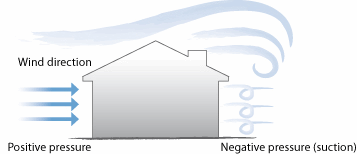
Description
Wind Loads to ASCE 7-05 for Buildings, Stacks and Open Structures
A multi-sheet workbook for wind loading to ASCE 7-05. Each sheet selects or calculates the pressure coefficients and code parameters for one type of structure and tabulates the net design wind pressures, in US customary units.
Sheets
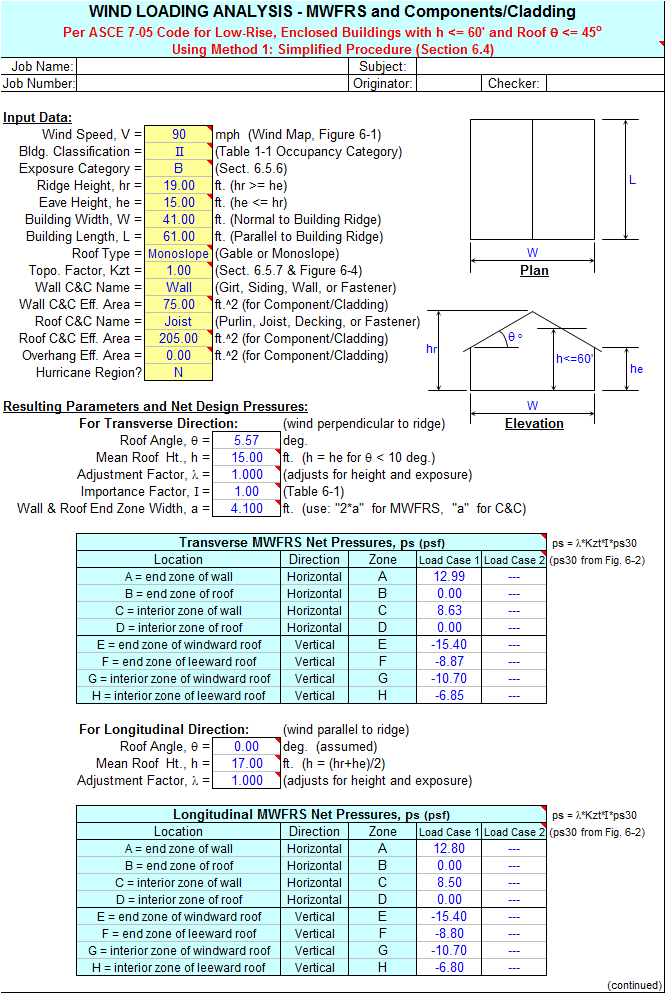
- Simplified – Method 1 for low-rise buildings (Section 6.4.1)
- MWFRS (Low-Rise) and MWFRS (Any Ht.), with Figure 6-9 load cases 2 and 4 on separate sheets
- Wall C&C and Roof C&C – flat, gable (≤ 45°) and monoslope (≤ 3°) roofs
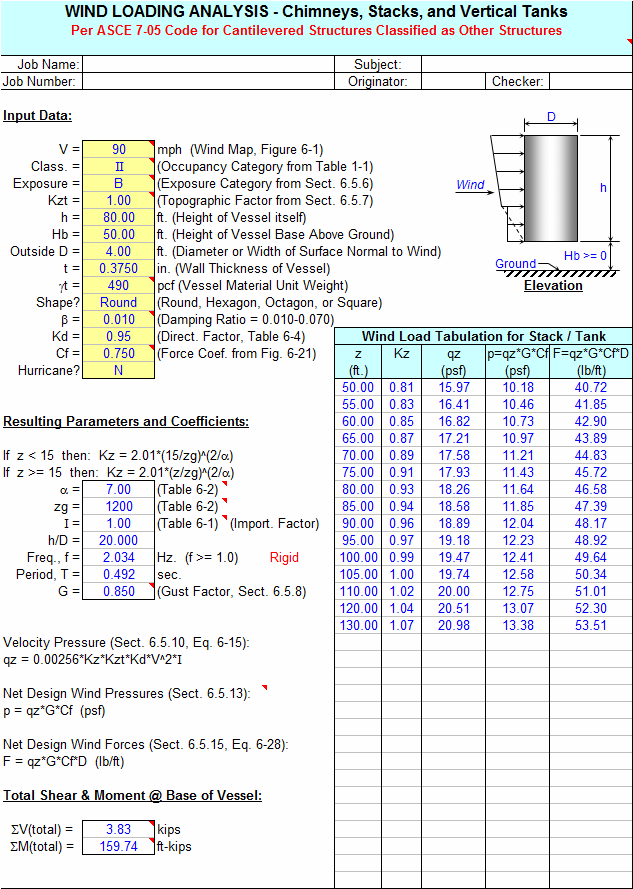
- Stacks & Tanks (up to 600 ft) and Open Structures (no roof), such as pipe racks
- Wind Map – Figure 6-1
Method
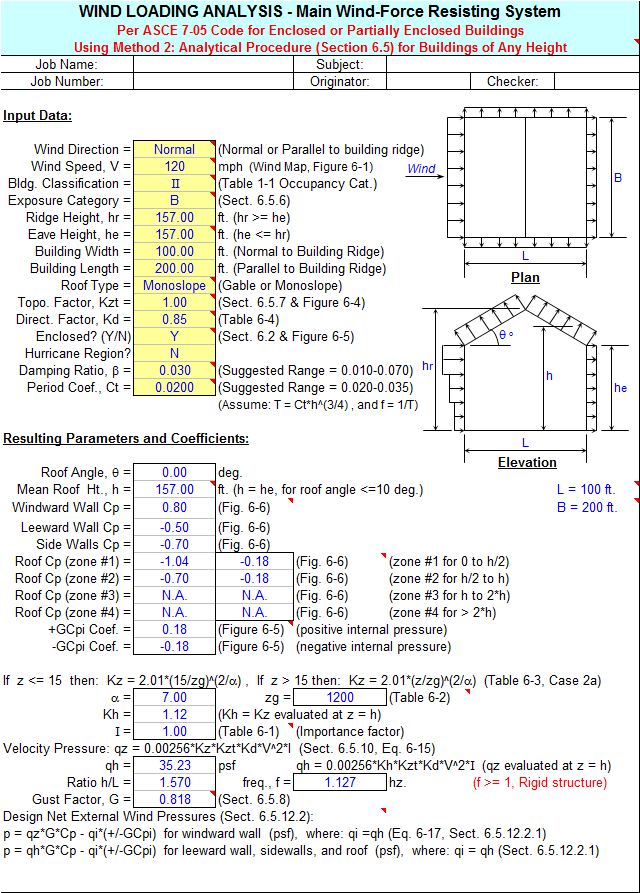
qz = 0.00256KzKztKdV²I with Kz from Table 6-3, and p = qGCp − qi(±GCpi). G is the smaller of 0.85 and the Section 6.5.8.1 value for rigid structures, or Gf to Section 6.5.8.2 for flexible ones, with T = Cth0.75. Cladding GCp values use the equations in Mehta and Coulbourne’s guide.
Inputs and outputs
Inputs include wind speed, occupancy category, exposure, building dimensions, roof type, Kzt, Kd, enclosure, damping and period coefficient. Outputs are the coefficients, qh, G and tables of pressure against height for each surface, with zone sketches.
The stored any-height example (V = 120 mph, exposure B, 157 ft high, 100 ft × 200 ft) gives qh = 35.2 psf and G = 0.818, with windward wall pressure at roof height of 16.7/29.4 psf and leeward wall pressure of −20.8/−8.1 psf (with +GCpi/−GCpi).
Please note
- ASCE 7-05 has been superseded; check which edition your project requires.
- Sheets are protected without a password and formulas are hidden; explanations are in cell comments. No macros.
- Written by Alex Tomanovich, P.E. References: ASCE 7-05; K.C. Mehta and W.L. Coulbourne, Guide to the Use of the Wind Load Provisions of ASCE 7-05.
Calculation Preview
 (4/30)
Full download access to any calculation is available to users with a paid or awarded subscription (XLC Pro).
Subscriptions are free to contributors to the site, alternatively they can be purchased.
Click here for information on subscriptions.

Just kidding, great workbook, much used.


That formula is f = 0.56/h^2*SQRT(E*I/m). The inverse of the frequency value is then taken to arrive at the period, "T". Also of note, this same formula is used in the Fluor Structural Guideline 000.215.1215, "Wind Load Calculation".
In the past, I had been using the rather simplistic and approximate formula from ASCE 7-05 of T = Ct*h^(3/4) for the period. The main issue with having used this formula is that there is no accounting for varying the diameter (width) of a vessel in determining the period.
Also, I have corrected some minor "typo" errors in a few of the worksheets
This workbook is now version 1.4.

I was given a couple of websites which you might find convenient for determining the basic wind speed and ground snow load
for any location in the continental United States per the ASCE/SEI 7-05 Code, so I thought I'd pass them along.
The website links are as follows:
http://www.windspeedbyzip.com/
http://www.groundsnowbyzip.com/
You must register to make use of either website, but you only have to register at one, not both of the websites.
Once you register at one of them, you will automatically have access to information from the other one.
The two websites allow you to input either the street/city/state address or just the zip code.
The resulting location latitude and longitude are given. Regular (street), satellite, and hybrid maps are available as well.


Since I'm still a practicing structural engineer, I tend to write spreadsheets on topics based on my experience to be used as tools to facilitate my own work.
Do you have any or plan to create any spreadsheets for wood design?
Thanks .. love all your work
Thanks for the kind words. I've fallen WAY behind as far as the various code changes are concerned. Since I still work, I create these spreadsheet workbooks predominantly in my spare time, which there never seems to be enough of. Retirement for me is hopefully within the next year, and thus with much more free time on my hands, I plan to stay active with the workbooks and make the attempt to stay more current with the codes.
As far as the ASCE 7-10 wind workbook is concerned, David Taylor (a contributor on this website) has taken my ASCE 7-05 workbook and basically updated it to ASCE 7-10. You might want to check that out.
Alex